Long before any store, the first peoples of this land fed themselves from it for thousands of years. This chapter is a debt to that knowledge: the wild foods, the water from a tree, the bark that keeps you alive until you find more. It is not one people's way but many, for North America held hundreds of distinct nations, each with its own plants and seasons. Learn it with respect, and learn it with care: out here a wrong plant is not a mistake, it is a funeral. Never eat anything you cannot name with total certainty.
Old Ways · FieldThree Sisters & Corn
The Three Sisters & Parched Corn
The garden and the grain that fed a continent, and the ash trick that made it whole food.
DifficultyBeginner
TimeSeason + prep
CostLow
SkillsBasic
Why it is worth it
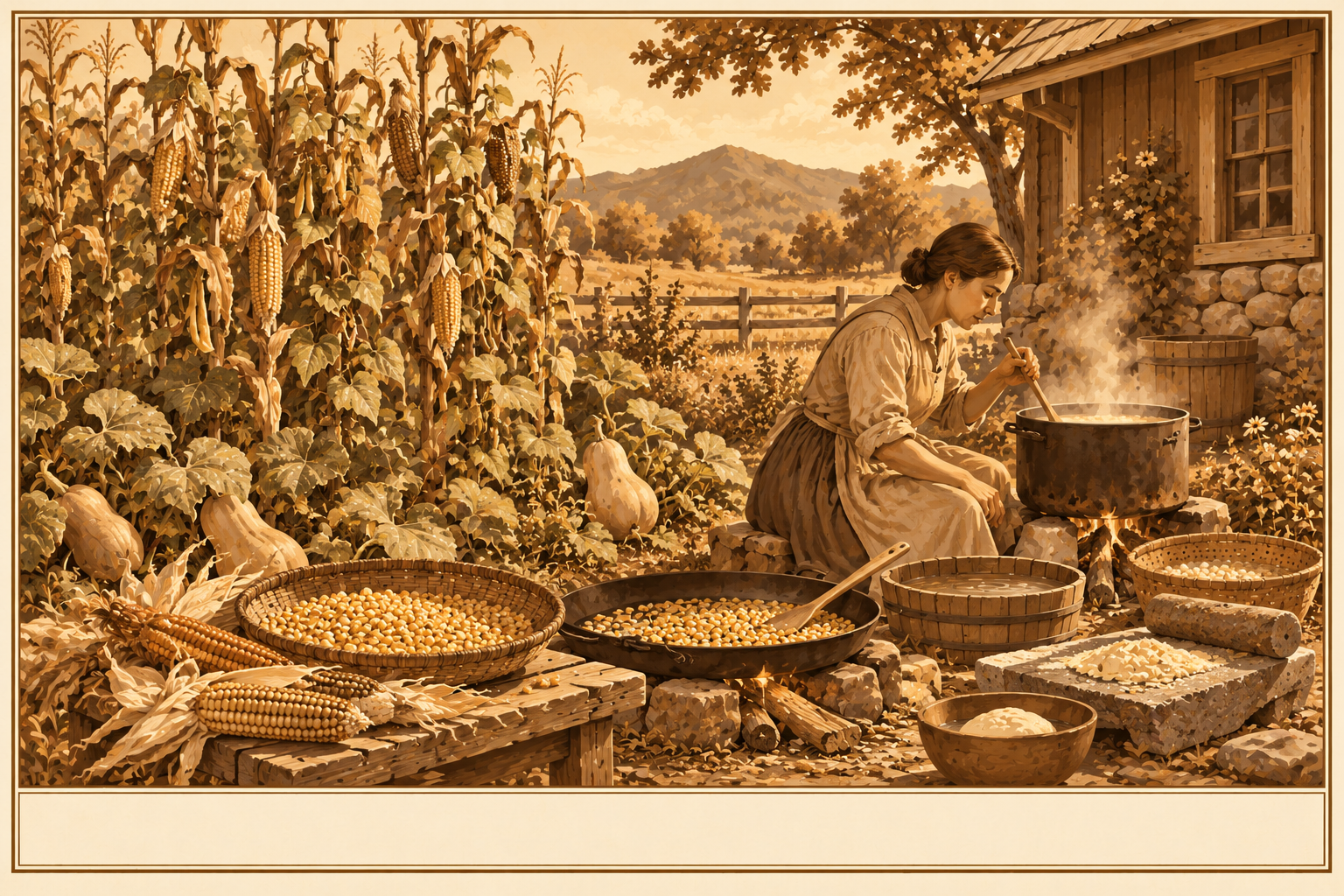
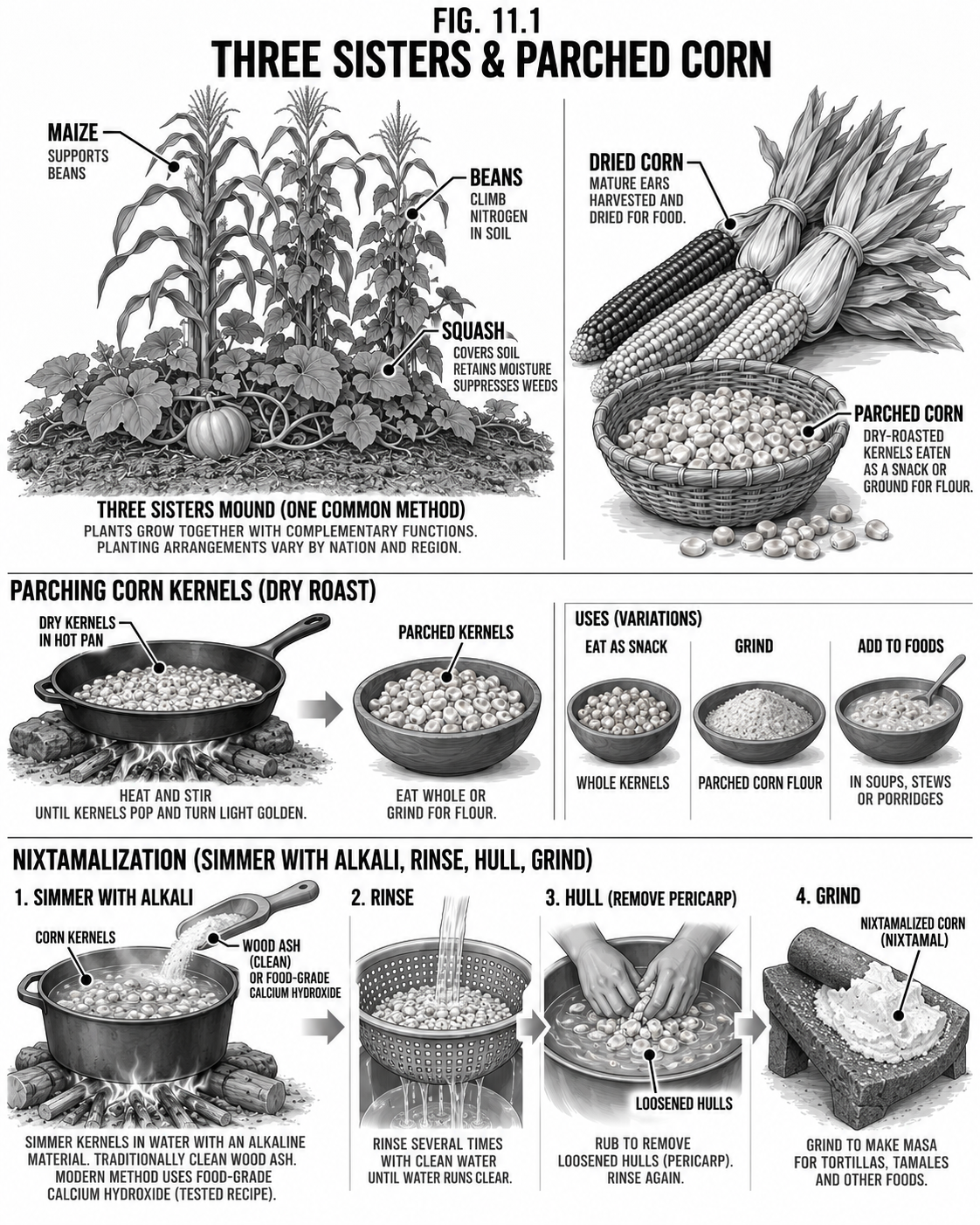
Corn, beans, and squash grown together (the Three Sisters, see Food) was the heart of Eastern and Southwestern farming: corn for the beans to climb, beans to feed the soil, squash to shade it. Dried, the three keep all winter and together make a near-complete diet.
Parched corn & the ash trick
Parched corn: dry-roast dried kernels in a hot pan until they puff and brown; they keep for months and travel as trail food, eaten dry or boiled soft.
Nixtamalization (the ash trick): simmer dried corn in water with hardwood ashes (lye) or lime, then rinse and rub off the hulls. This is not just for taste: it unlocks the niacin in corn, and peoples who ate corn this way never got the deadly deficiency (pellagra) that struck those who skipped it.
Grind the treated corn (hominy) wet for masa or dry for meal.
Tips & variations Wood-ash lye is strong: rinse the corn well until the water runs clear before eating.
Old Ways · NutsAcorns & Wild Nuts
Acorns & Wild Nuts
The forest's grain crop, free for the gathering, once you leach the bitter out.
DifficultyBeginner
TimeDays (leaching)
CostFree
SkillsProcessing
Why it is worth it
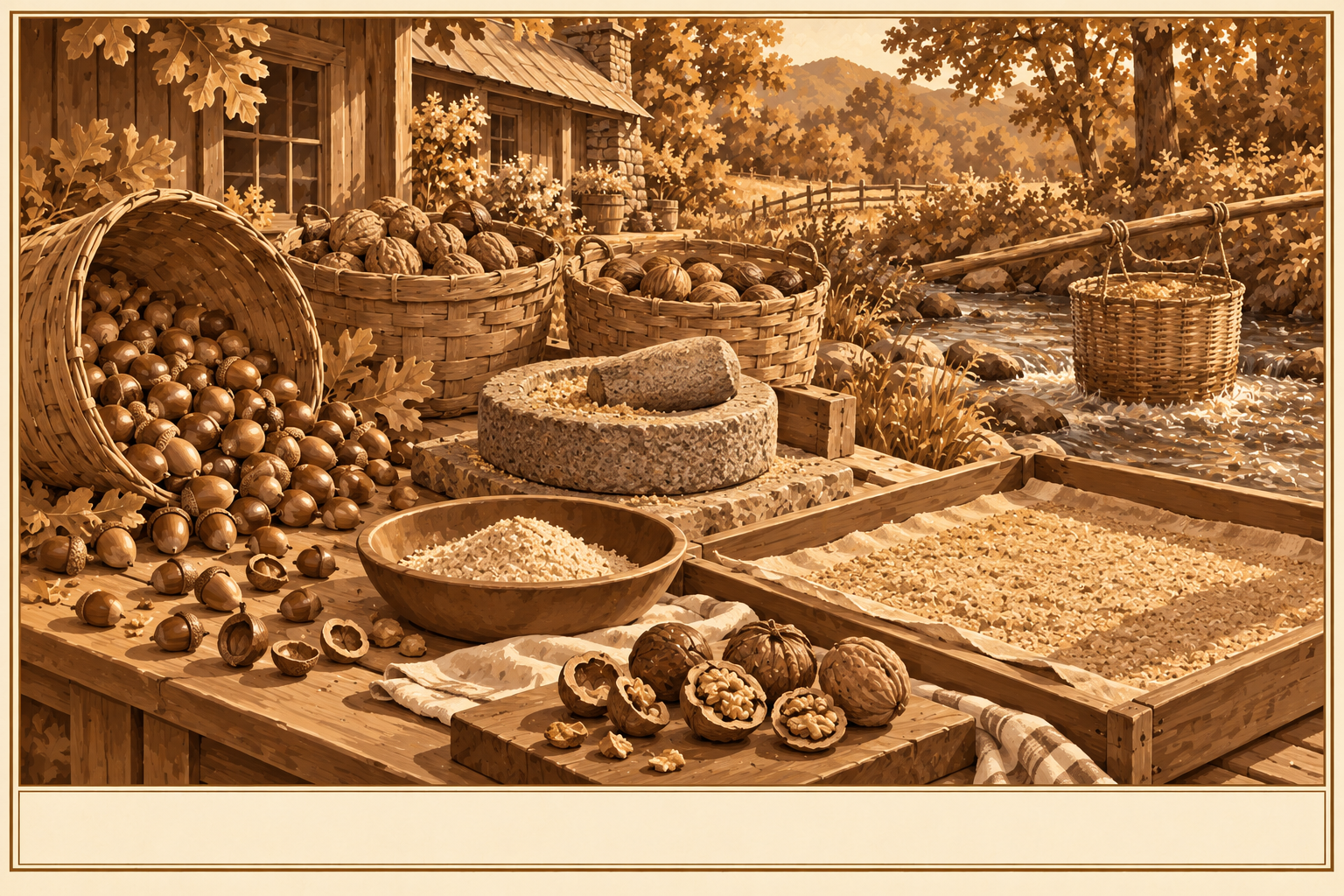
Acorns were a staple across much of the land: a fat- and carbohydrate-rich nut that drops by the bushel. Raw they are too bitter and astringent to eat (the tannins), but leached they become a sweet, nutritious flour. Hickory, walnut, butternut, hazelnut, and pine nuts add rich oils.
Step by step (acorns)
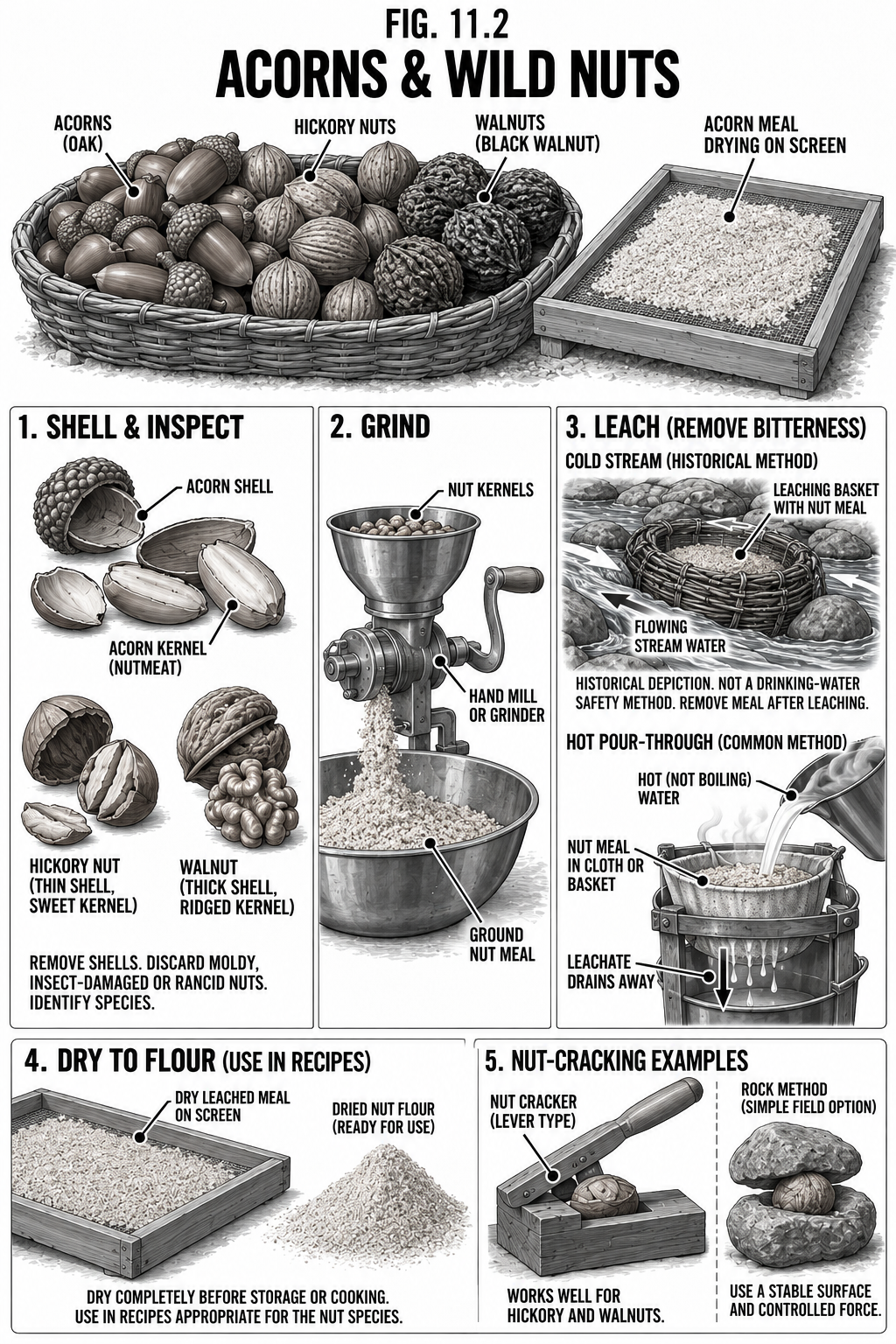
Gather sound acorns, shell them, and discard any wormy or moldy ones.
Grind the meats coarse.
Leach out the tannins: either tie the meal in cloth in running water for days (cold leach), or pour boiling water through it, changing the water again and again, until it is no longer bitter.
Dry the leached meal and use it as flour, or boil it into a mush.
Safety Taste-test for bitterness, not for identification: leach until the meal tastes bland, never while it still bites. Crack a few nuts to check for insect damage before you process a batch.
Old Ways · WetlandCattail & the Marsh
Cattail & the Marsh Pantry
One plant gives you a vegetable, a flour, and a fire-starter all year round.
DifficultyBeginner
TimeSeasonal
CostFree
SkillsForaging
Why it is worth it
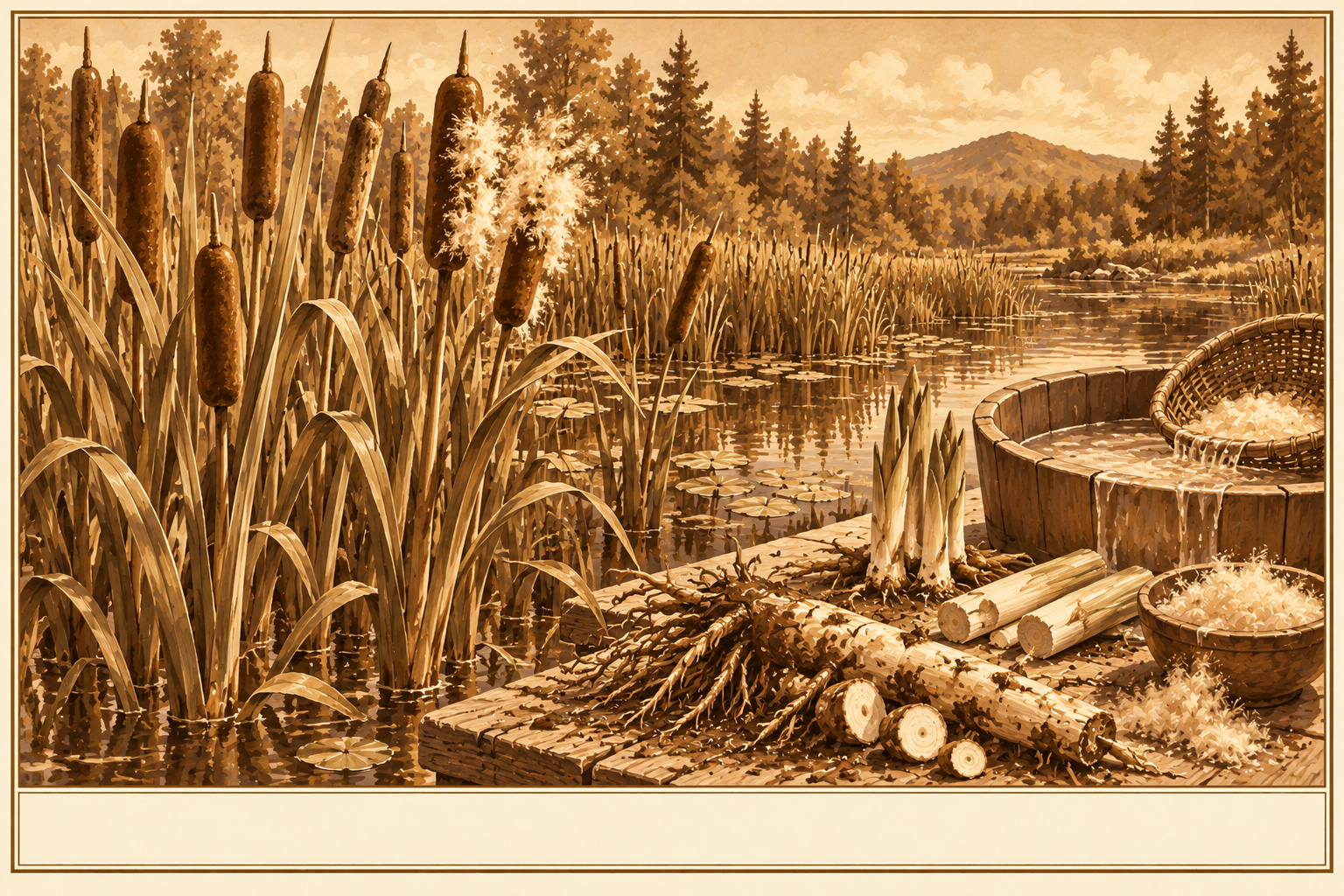
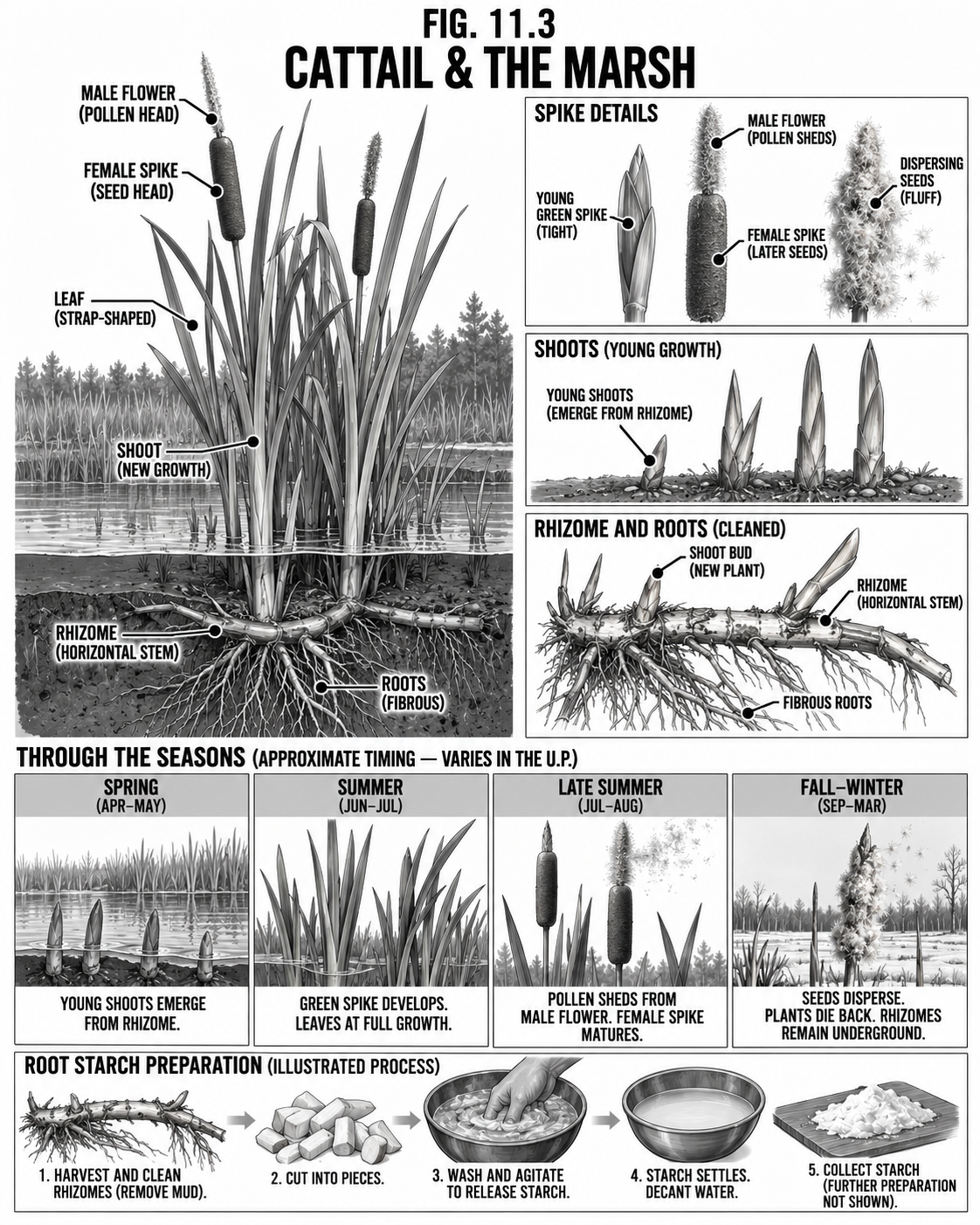
Cattail is the marsh supermarket. In spring the young shoots ("Cossack asparagus") eat like a vegetable; early summer the green flower spikes boil like corn on the cob; the yellow pollen is a protein-rich flour; and all year the starchy roots can be pounded in water to settle out a white flour. Wild rice, arrowhead tubers, and groundnut share the same wetlands.
Step by step
Spring: peel young shoots to the tender white core and eat raw or boiled.
Early summer: boil the green flower spikes and eat like corn; shake the later yellow pollen into a bag for flour.
Fall and winter: dig roots, crush them in water, let the starch settle, pour off the water, and dry the flour.
Safety Young cattail can be confused with the deadly iris and other toxic marsh plants before the heads form: only harvest where you have seen the brown seed-heads growing. And never eat anything from fouled or polluted water, which the roots concentrate.
Old Ways · TreesInner Bark
Inner Bark: Eating the Cambium
The thin living film under the bark that can carry you to the next meal.
DifficultyBeginner
TimeAn hour
CostFree
SkillsForaging
Why it is worth it
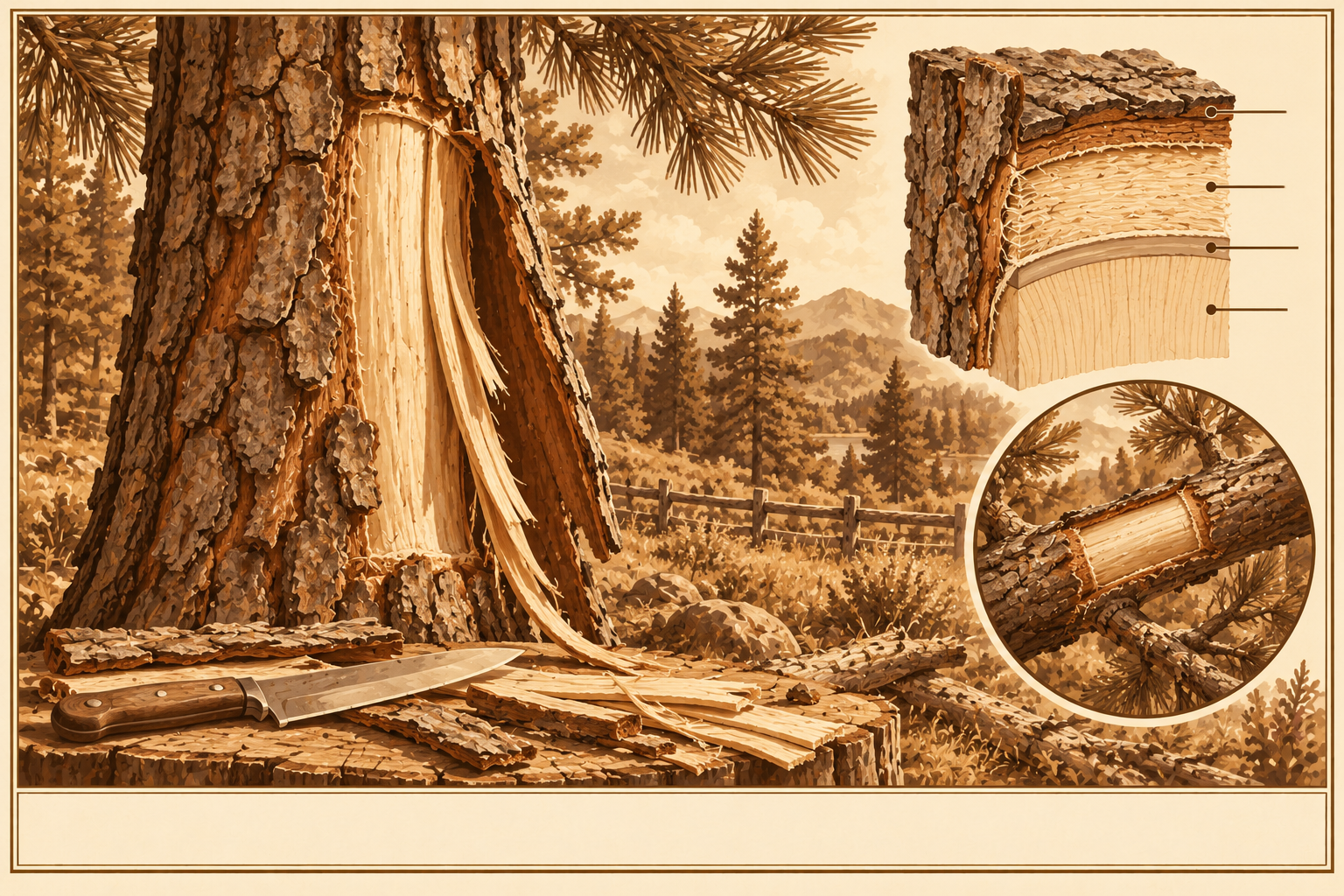
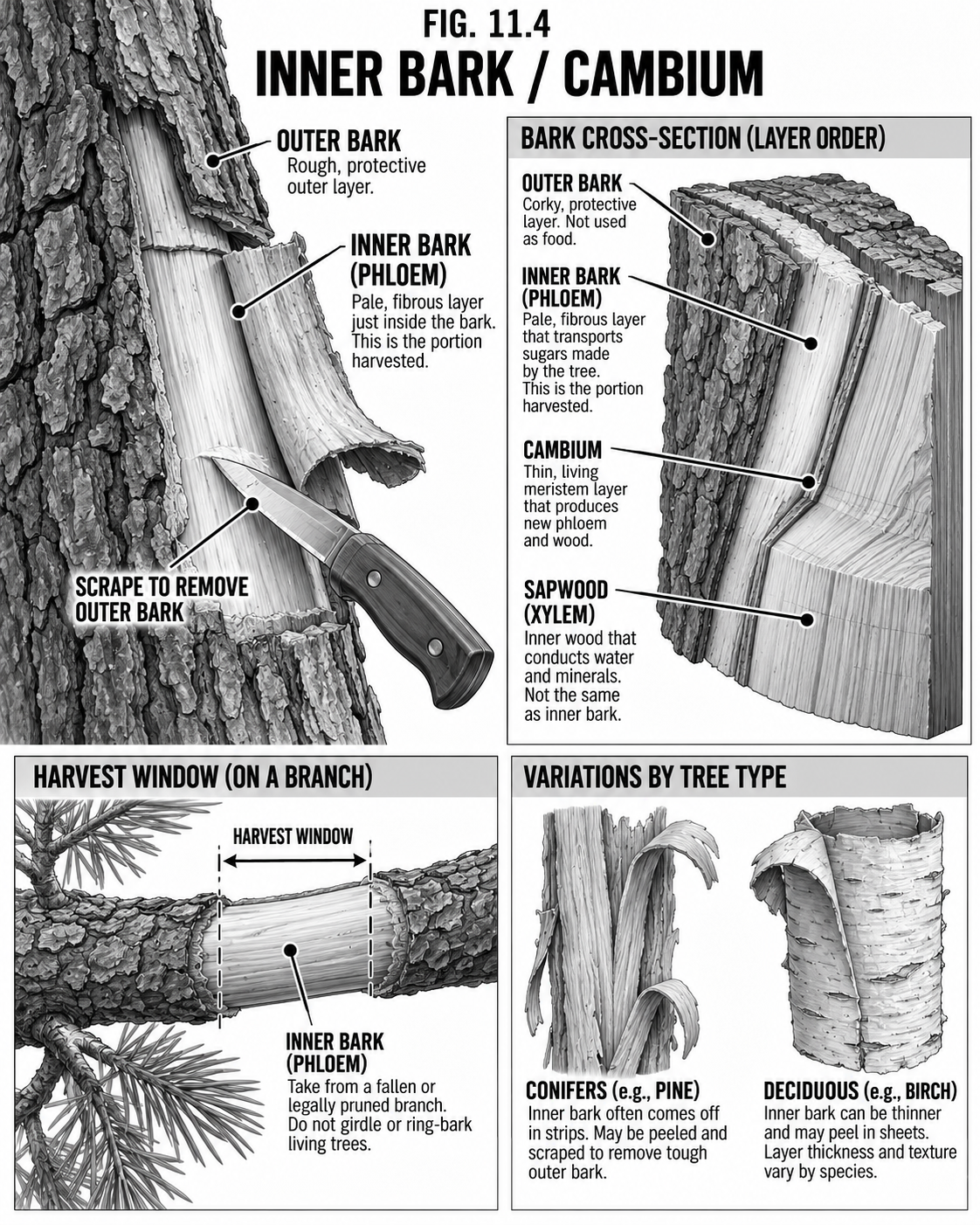
Just under the rough outer bark of many trees is a thin, pale, moist layer (the inner bark and cambium) that is food. Pine, spruce, birch, poplar, aspen, cottonwood, willow, and slippery elm all carry it. Northern peoples ate it in the hungry weeks of early spring: it is carbohydrate and fiber that will keep you going when nothing else is up yet. The Adirondacks are even named for a word said to mean bark-eaters.
Step by step
In spring, when the sap is up, cut a window through the outer bark of a branch or a tree you can spare.
Peel it back and scrape off the soft, pale inner layer.
Eat it raw in a pinch, or dry it and grind it to a flour, or cut it in strips and boil it like noodles.
Safety Only the INNER bark is food; the outer bark is not. Stripping a ring all the way around a trunk (girdling) kills the tree, so take from branches or from a tree you are felling anyway. This is a survival and early-spring food, not an everyday one. Avoid cherry and other bark that carries cyanide compounds unless you know it.
Old Ways · WaterSap & Needle Tea
Birch & Maple Sap, Pine-Needle Tea
Tap a tree for clean drinking water, and brew the needles against scurvy.
DifficultyBeginner
TimeSpring
CostFree
SkillsForaging
Water from a tree
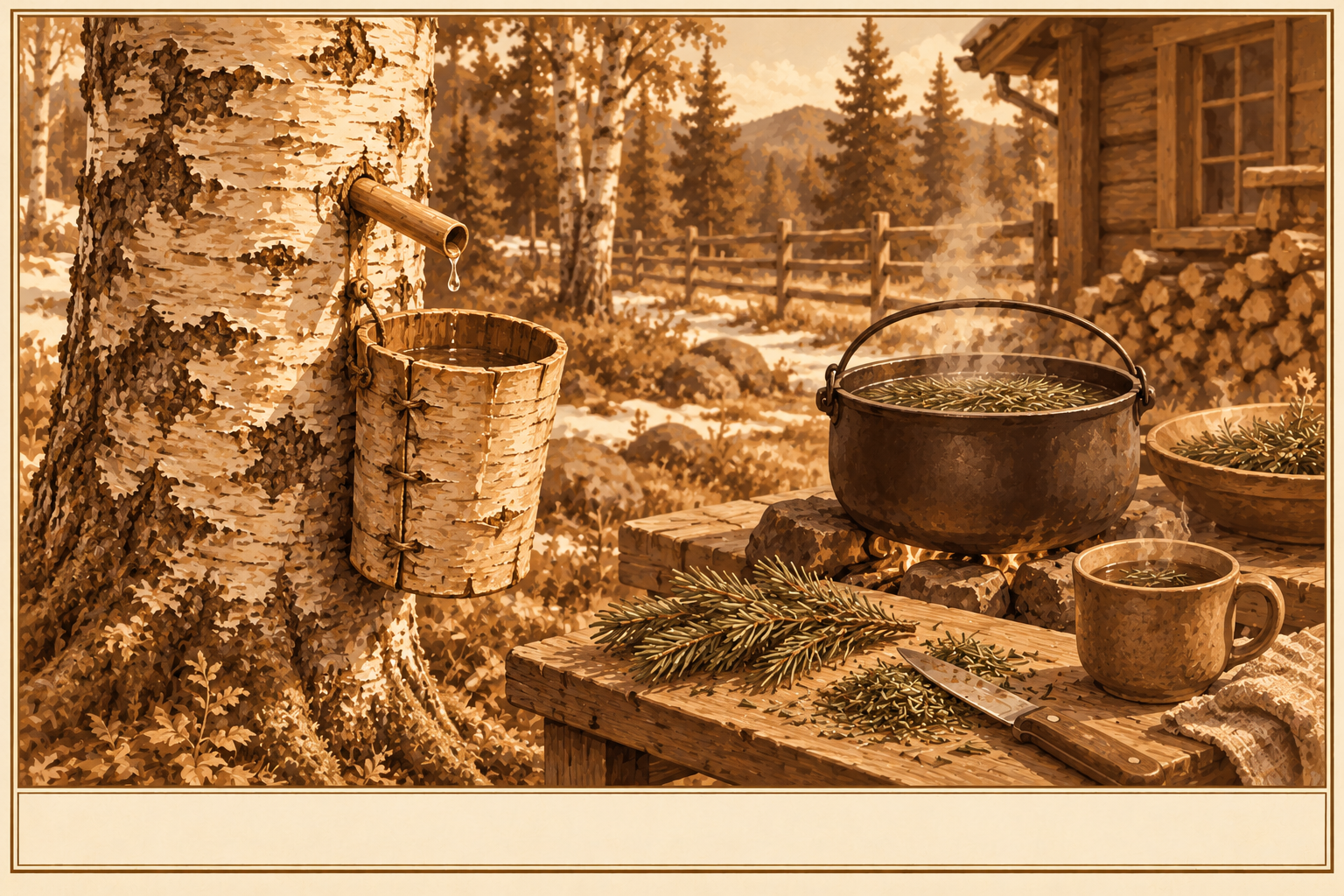
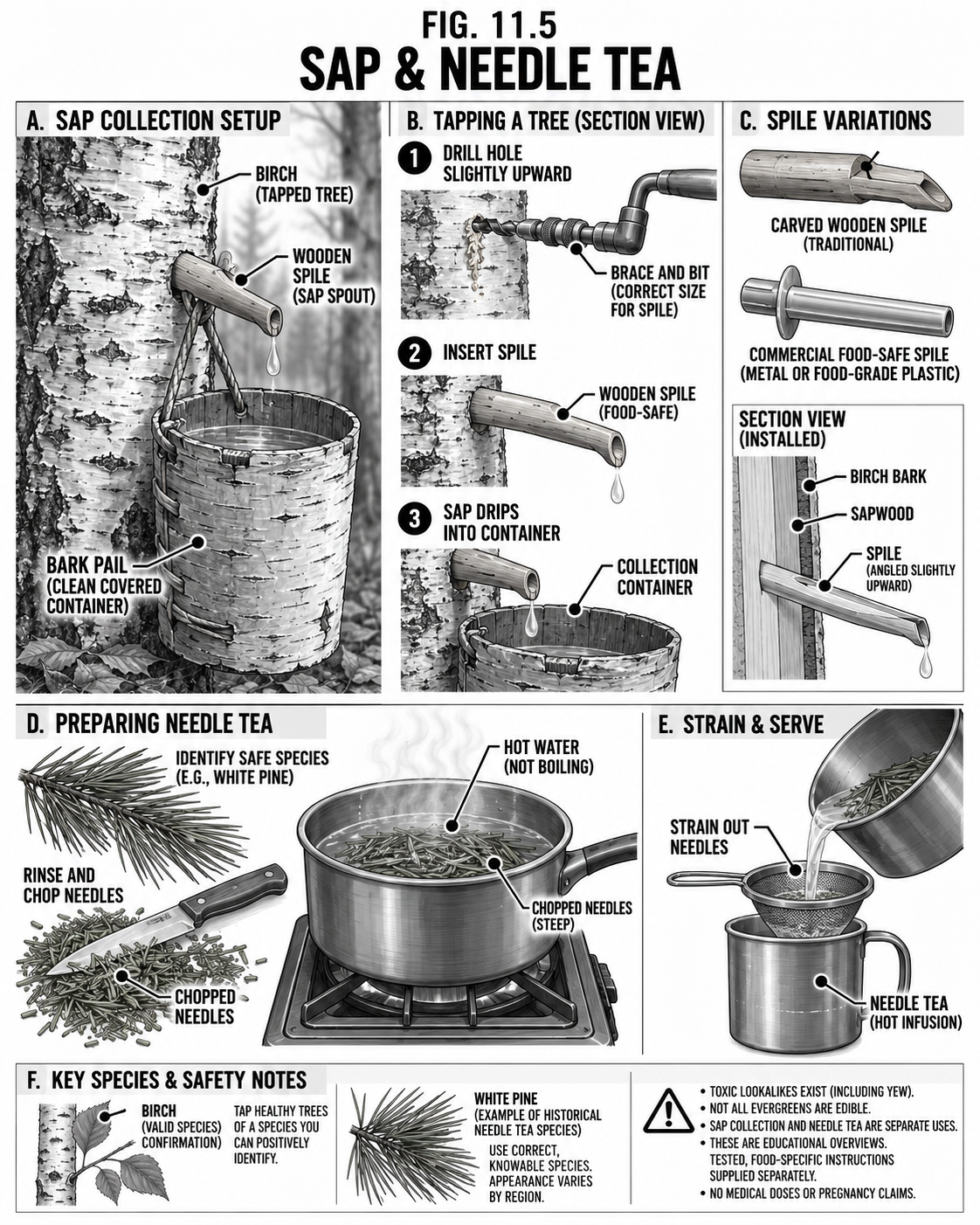
In early spring the sap rises, and birch and maple run almost-clear, lightly sweet water you can drink straight from the tree. Bore a shallow hole, set a carved spigot (a hollowed twig of sumac or elder works), and hang a pail. Birch especially gives a thin drinkable sap; boil maple down for sugar (see below). It is some of the cleanest water in the woods.
Pine-needle tea
A tea of green pine, spruce, or fir needles is loaded with vitamin C. In the winter of 1535 the Iroquoian people at Stadacona taught Jacques Cartier's scurvy-dying crew to brew a conifer tea, and it saved them. Steep a handful of chopped green needles in hot (not boiling) water.
Safety Know your evergreen: yew is deadly poison and not a pine, and some (like Ponderosa and a few junipers) should be avoided for tea, especially in pregnancy. Brew only from trees you can positively identify as true pine, spruce, or fir.
Old Ways · HarvestBerries & Juniper
Berries, Rose Hips, Sumac & Juniper
The wild sugars, the vitamin C, and the seasonings, with the ones that bite back.
DifficultyBeginner
TimeSeasonal
CostFree
SkillsForaging
Why it is worth it
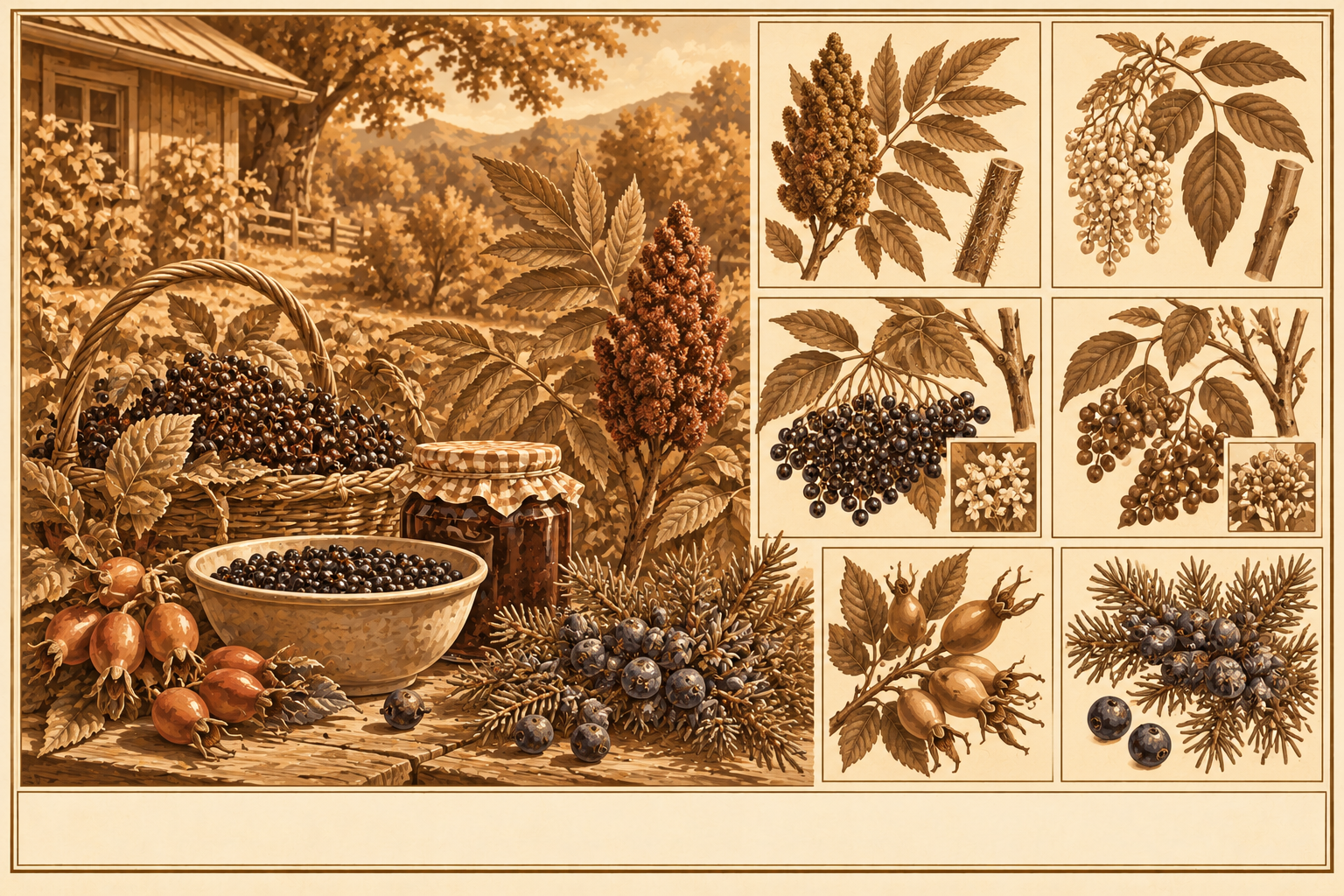
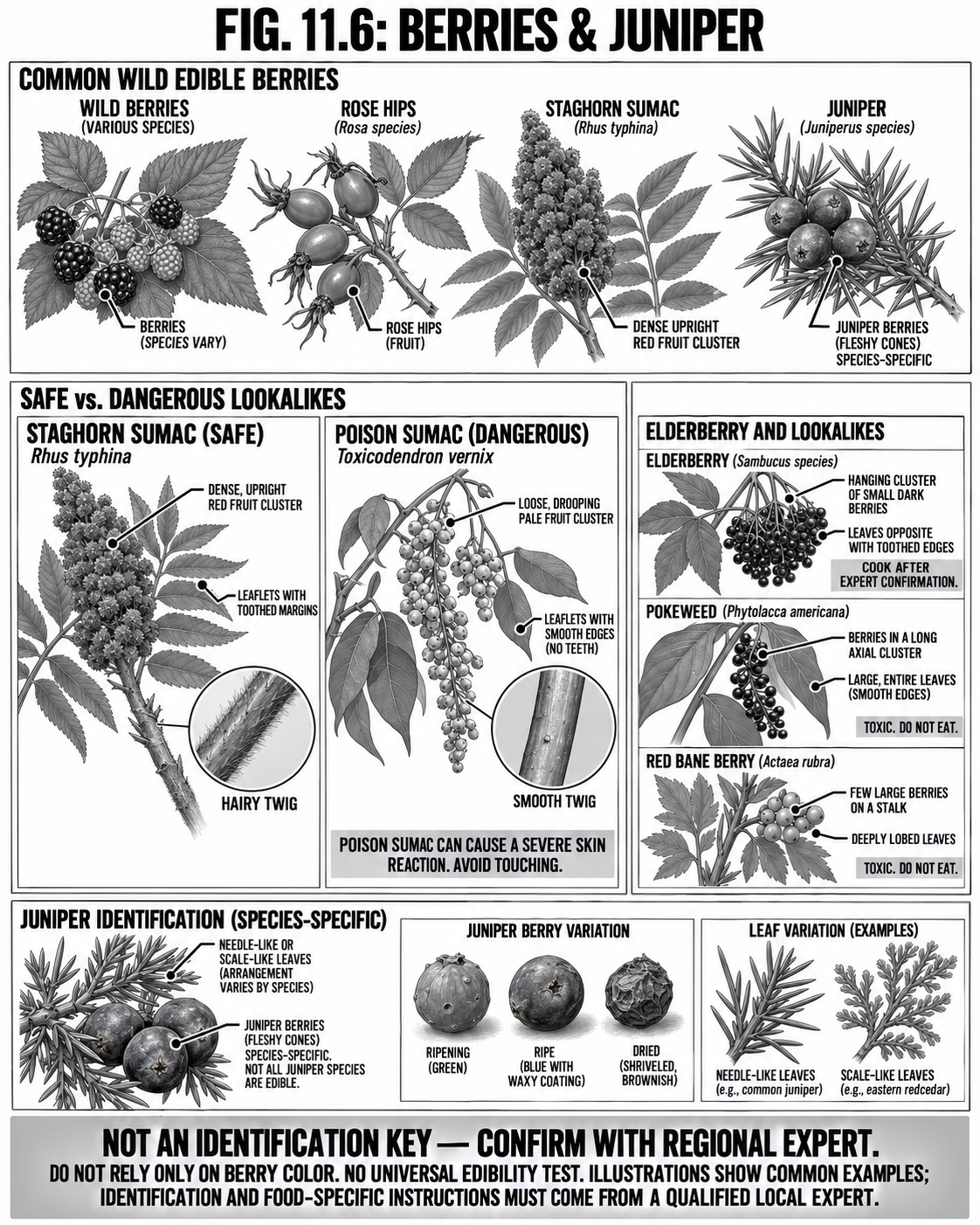
Wild fruit carried the sweetness and the vitamins. Blueberries, chokecherries, serviceberries (Saskatoon), elderberries, and more were eaten fresh and dried into cakes or into pemmican (Chapter 10). Rose hips are packed with vitamin C. Staghorn sumac's red berry clusters, steeped in cool water, make a tart pink "lemonade." Juniper berries season meat and brew a tea.
Step by step
Dry surplus berries in the sun or by the fire into cakes for winter, or pound them into pemmican.
Rose hips: split, remove the irritating inner seeds and hairs, and dry for tea or syrup.
Sumac: soak the red berry clusters in cool water, strain through cloth, and sweeten.
Juniper: use a few dried berries as a seasoning or a light tea, not a meal.
Safety This is the deadly-mistake group, so read it twice. SUMAC: red, upright, fuzzy berry clusters are the safe lemonade sumac; white, drooping berries are POISON sumac, do not touch. ELDERBERRY: cook it, raw berries and all green parts are toxic, and it has poisonous lookalikes. CHOKECHERRY: the flesh is food but the pits, leaves, and stems carry cyanide. JUNIPER: only a few species are safe (common juniper), several are toxic, and no juniper in pregnancy; use berries as a seasoning, never in quantity. When in any doubt, leave it.
Old Ways · ProteinFish, Snares & Insects
Wild Protein & the Whole Animal
Weirs, snares, and even insects, and the rule that nothing is wasted.
DifficultyBeginner-Intermediate
TimeVaries
CostLow
SkillsTrapping
Why it is worth it
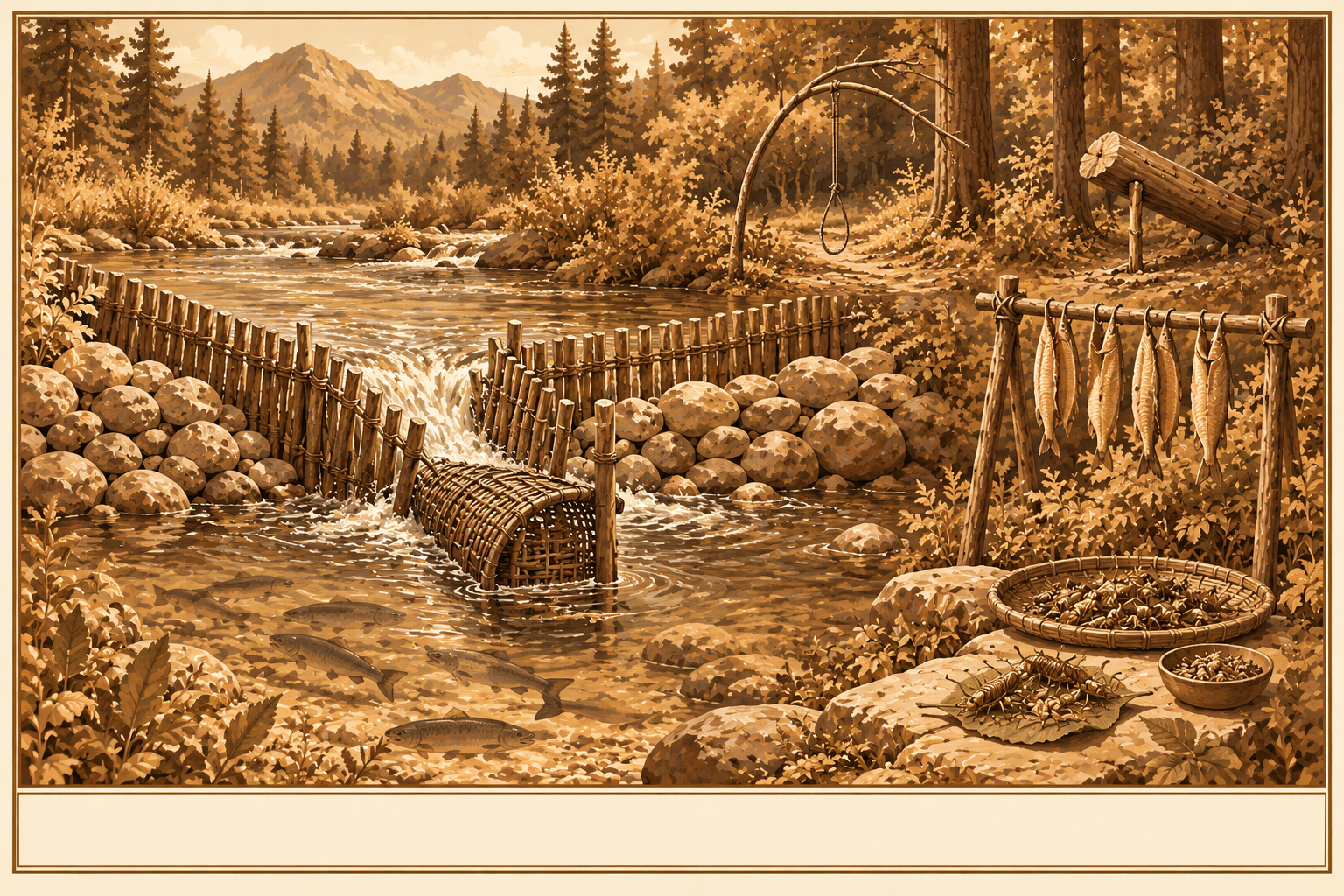
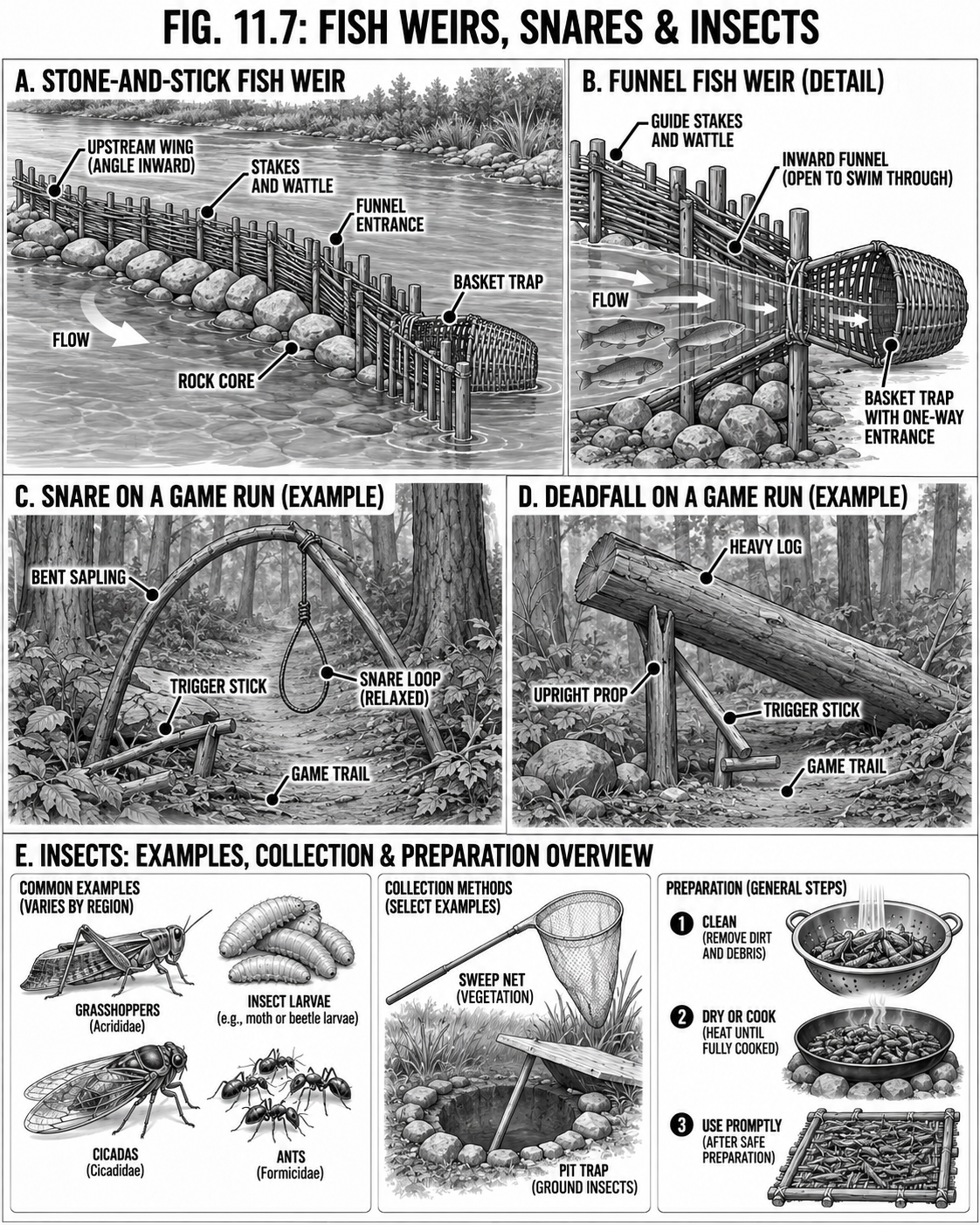
Protein came from traps that work while you do other things. Fish weirs (a stone or stake fence that funnels fish into a basket or a holding pen) fed whole villages. Snares and deadfalls on game runs (see Hunting) take small game. And in hard times, insects (grasshoppers, grubs, crickets) are honest protein that many peoples harvested without shame. The iron law was respect: use the whole animal, meat, hide, sinew, bone, and fat, and waste nothing.
Step by step
Fish weir: set a low funnel of stones or stakes across a stream, narrowing to a basket or a trap pen; check it often.
Small game: set snares and deadfalls on the trails and feeding runs (Chapter 8), and run your line morning and evening.
Insects: roast grasshoppers and grubs dry; they grind into a protein meal.
Dress and use every part: smoke the meat, render the fat, keep the hide and sinew (Tools and Hunting).
Safety & law Weirs, many traps, and some harvests are restricted or illegal except in a true survival emergency: know your fish and game laws, and keep these skills for practice on your own land and for genuine need. Cook wild meat, fish, and insects thoroughly.
Old Ways · KeepingPemmican & Smoke
Pemmican, Smoke & Dried Stores
How the wild harvest was made to last through a northern winter.
DifficultyBeginner-Intermediate
TimeDays
CostLow
SkillsPreserving
Why it is worth it
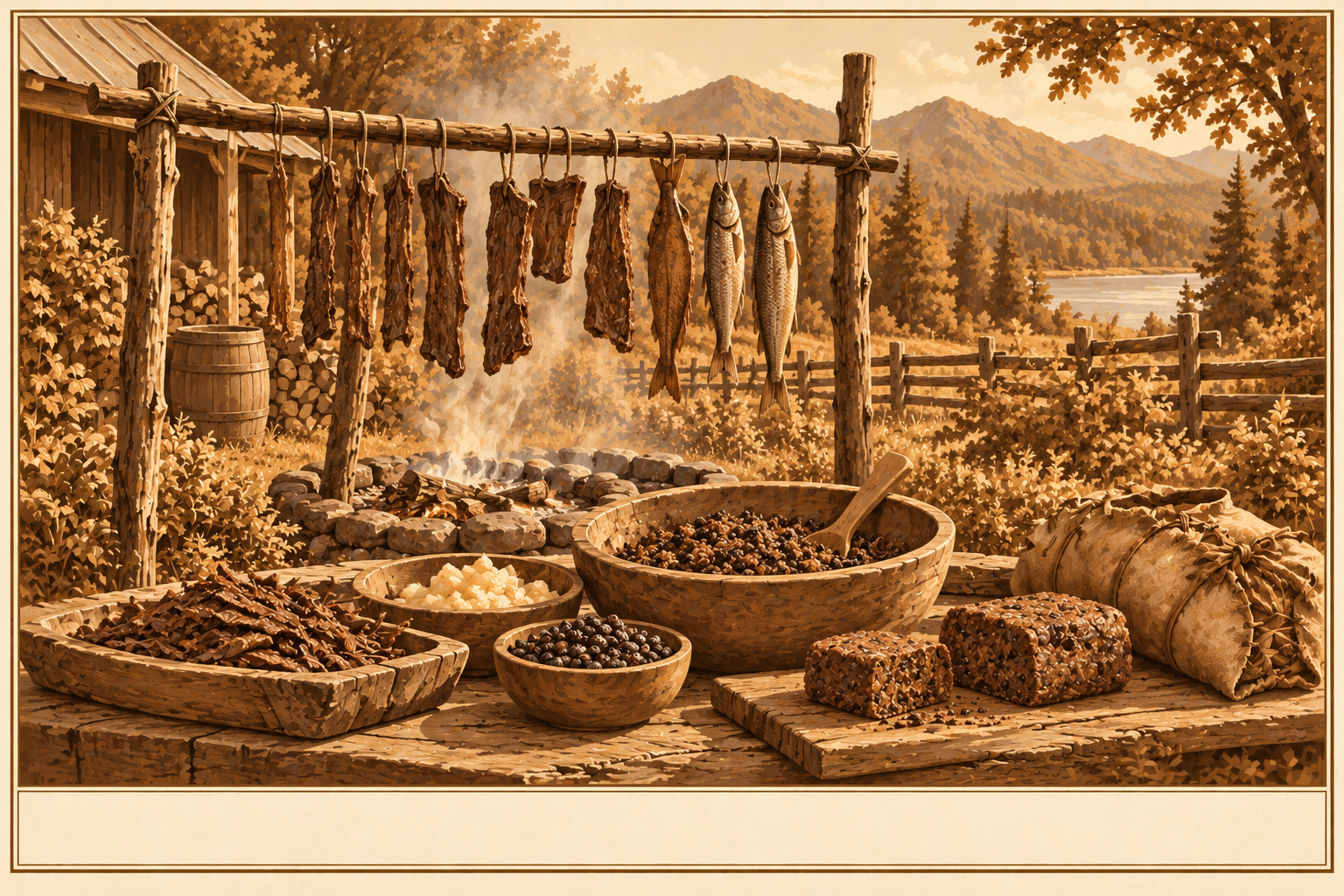
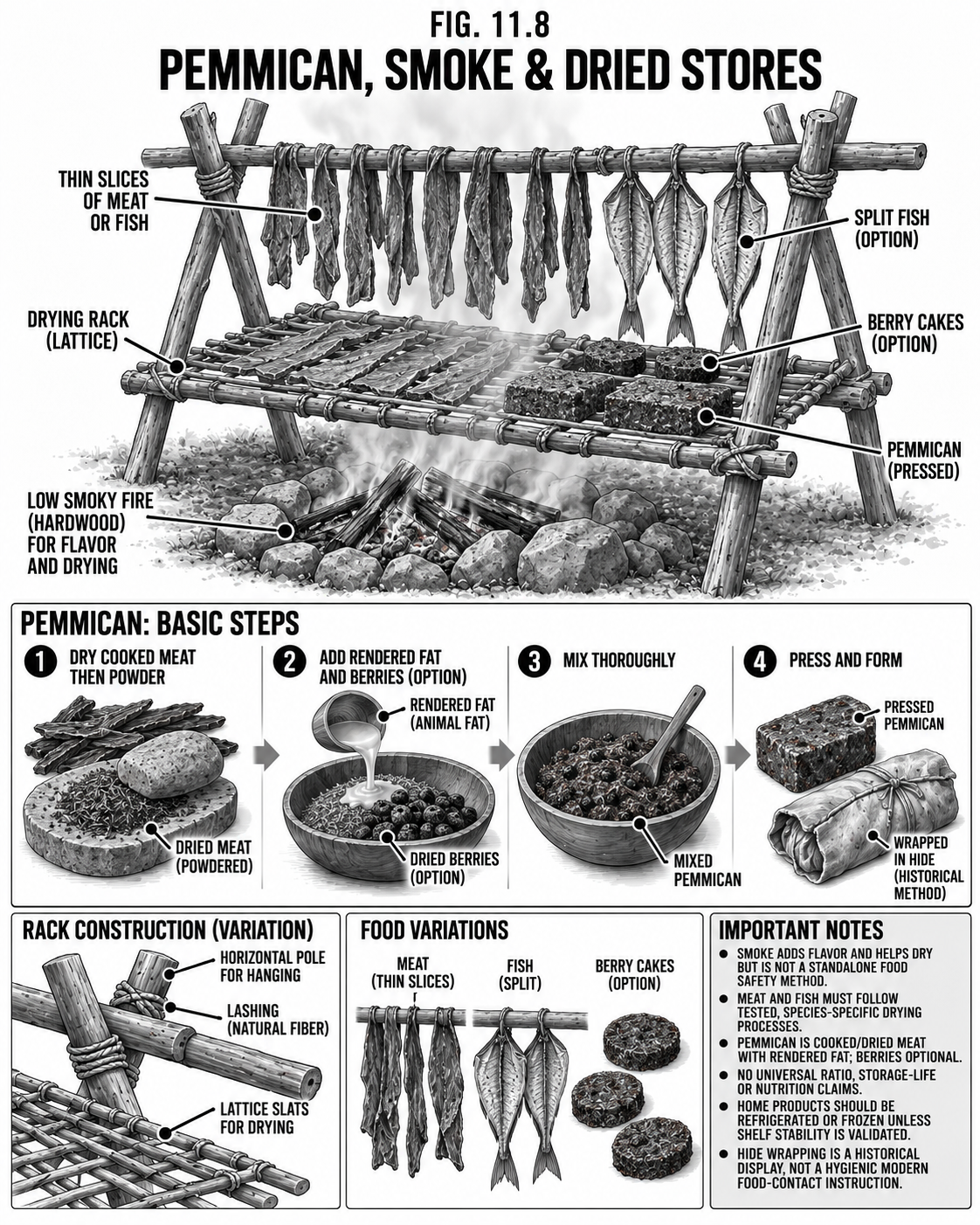
A good hunt or harvest only mattered if it kept. The old answer was dry it, smoke it, or render it. Pemmican (dried meat pounded with fat and berries, Chapter 10) was the great traveling and winter food, a Cree word and a Plains invention that the whole fur trade later ran on. Thin-sliced meat and split fish dried hard over a slow smoky fire. Berries dried into cakes. Fat was rendered and stored.
Step by step
Slice meat and fish thin and dry them on racks over a low, smoky (not hot) fire until hard.
Pound the dried meat to a powder and mix with an equal weight of rendered fat and dried berries; press into pemmican.
Dry surplus berries into flat cakes.
Store it all cool, dry, and wrapped, away from damp and animals.
Safety Dry meat and fish until hard and leathery, and keep them bone dry: any softness or mold means spoilage. Smoke flavors and helps dry, but it is the drying, not the smoke, that keeps the food safe.