The harvest and the herd only matter if you can turn them into food that keeps. This chapter is the recipe book: how to make the cheese, cure and can the meat, bake the staples, and press the old iron rations that carried armies across continents. Clean hands, honest heat, and the botulism rules are not optional here: a full larder is only a good one if it cannot hurt you.
Larder · CheeseMethod & Fresh
Cheese: The Method & Fresh Cheeses
Milk plus acid or rennet, and you are already making cheese.
DifficultyBeginner
TimeAn hour+
CostLow
SkillsKitchen
The method, in one breath
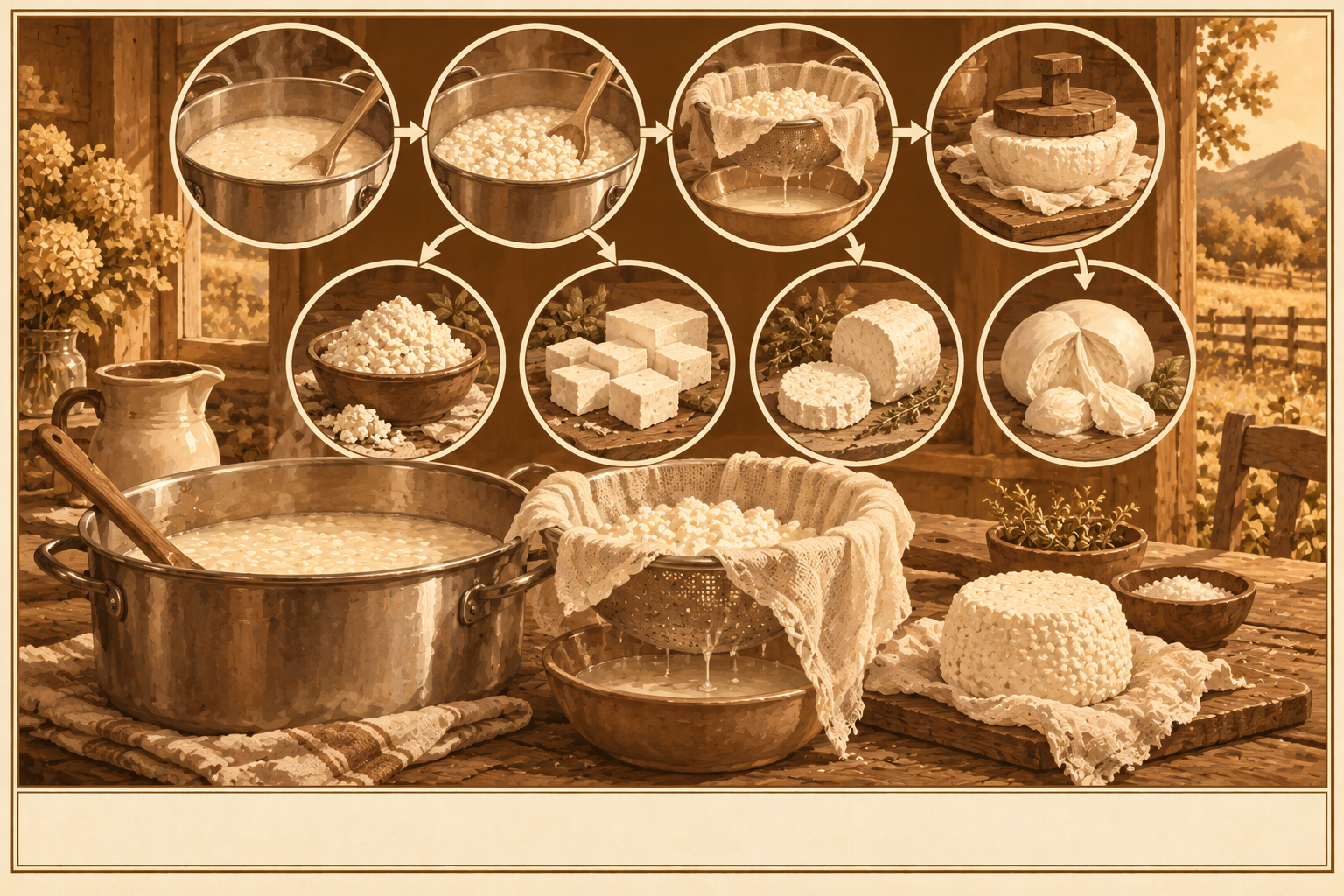
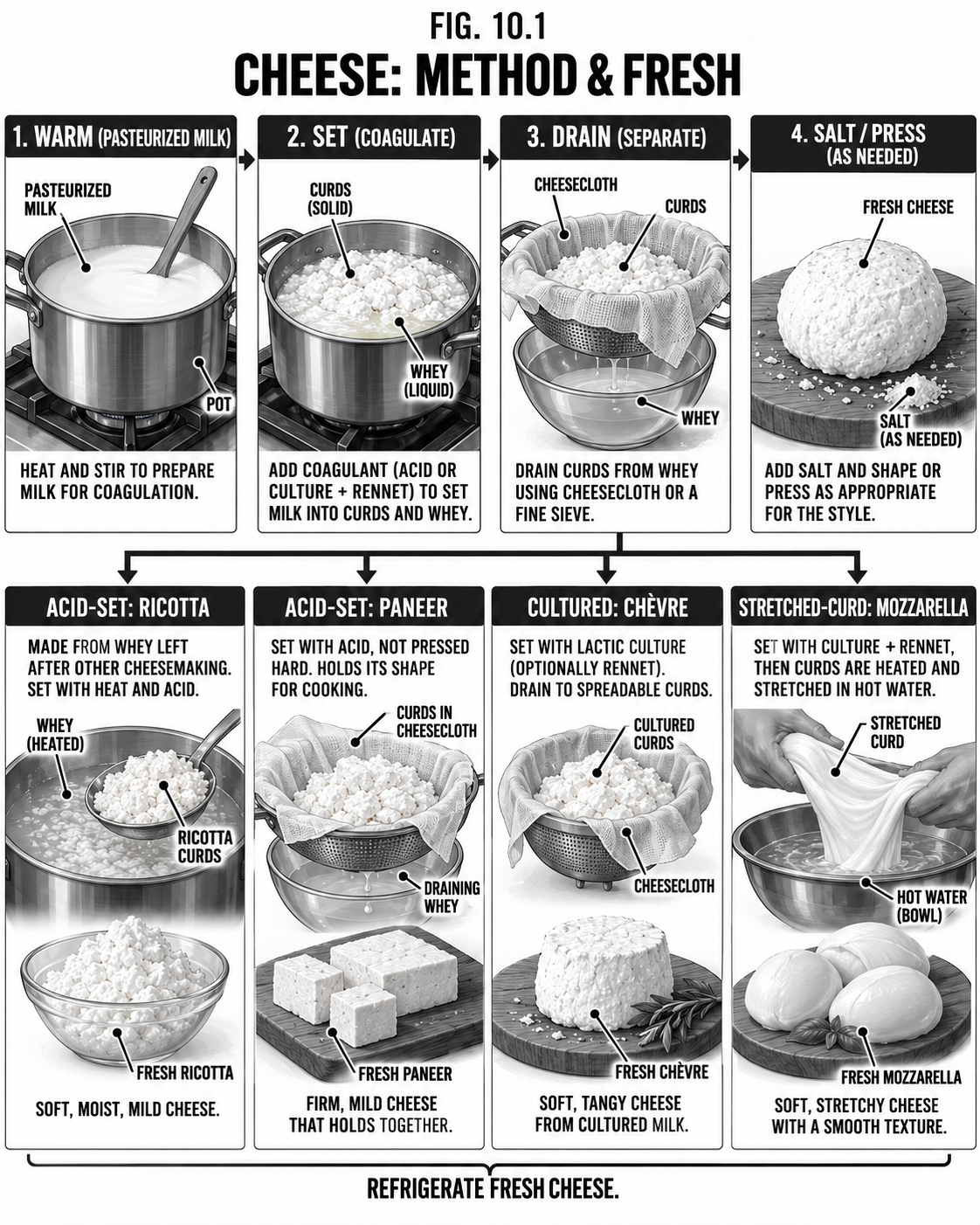
Every cheese is the same four moves: warm the milk, set it into curd (with acid or with rennet), separate the curd from the whey, then salt it and either eat it fresh or press and age it. Fresh cheeses stop after the drain, so they are where you start.
Step by step (a basic fresh cheese)
Heat a gallon of whole milk to about 185 to 195 F, stirring so it does not scorch.
Off the heat, stir in acid (a quarter cup of vinegar or lemon juice) and let it sit; the curds pull away from the clear whey.
Ladle the curds into a cheesecloth-lined colander and let them drain.
Salt to taste. Eat soft as ricotta, or tie and hang it, or press it under a weight into a firm block (paneer, queso blanco, farmer cheese).
Safety Scald every pot, cloth, and spoon. Use clean, fresh milk; if you use raw milk know your source and your local law. Fresh cheese is not a keeper: eat it within days or press and age it (next).
Larder · CheeseHard & the Family Brick
Hard Cheese & the Family Brick
Culture, press, and wait: the cheese that keeps for a year in the cellar.
DifficultyIntermediate
TimeWeeks to months
CostLow-Med
SkillsCheesemaking
Why it is worth it
A hard, aged cheese is milk you can keep for a year. It takes a starter culture and rennet, a press, and patience. The family brick is the farmhouse favorite: a washed-curd cheese pressed into a brick, mild and sliceable young, sharp and pungent aged, the kind every old farm kitchen made its own way.
Step by step
Warm the milk to about 88 F and stir in a mesophilic starter; let it ripen.
Stir in rennet and let it set into a clean, firm curd, then cut it into cubes.
Cook the curd slowly up to about 100 F, stirring, so it firms and the whey runs off.
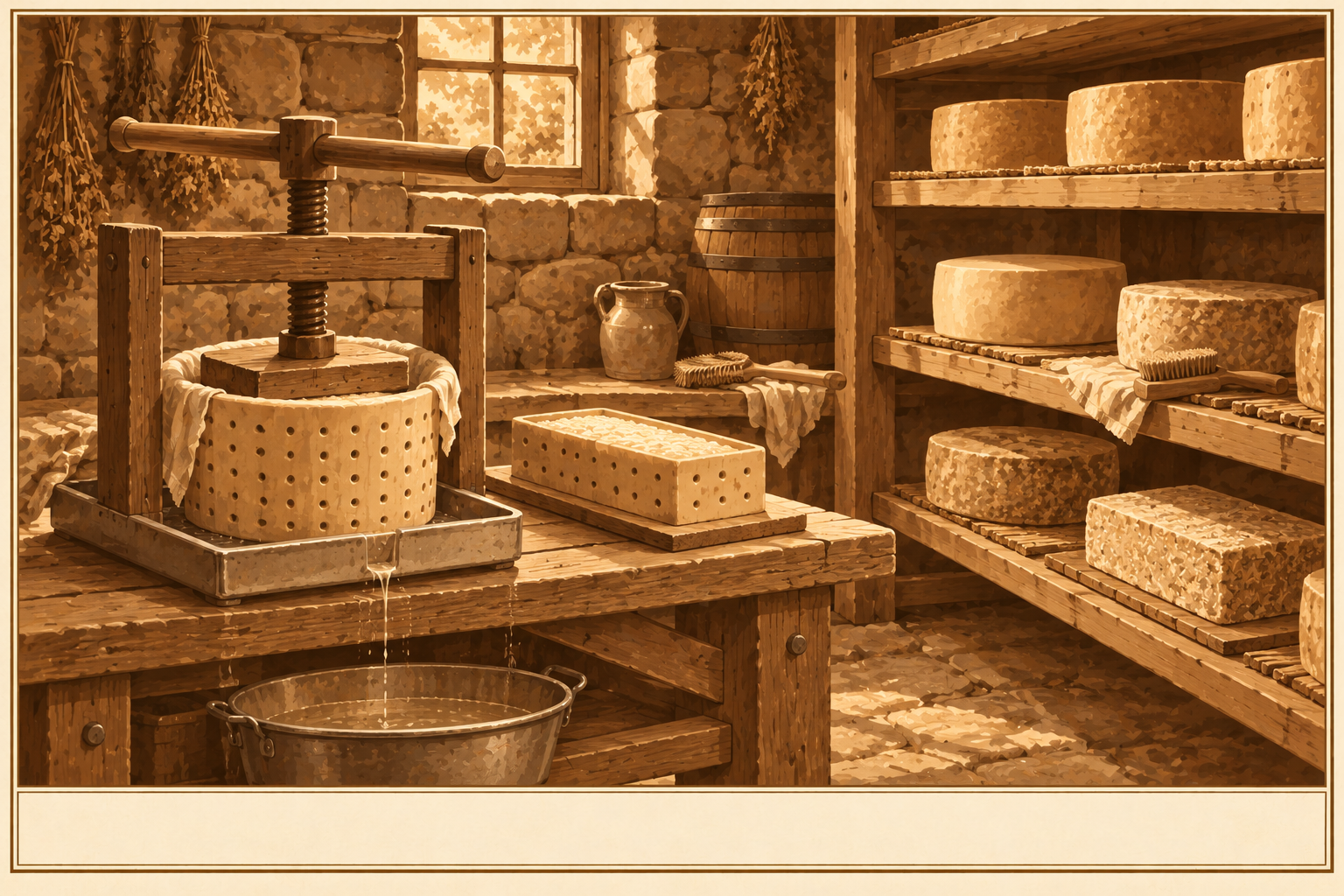
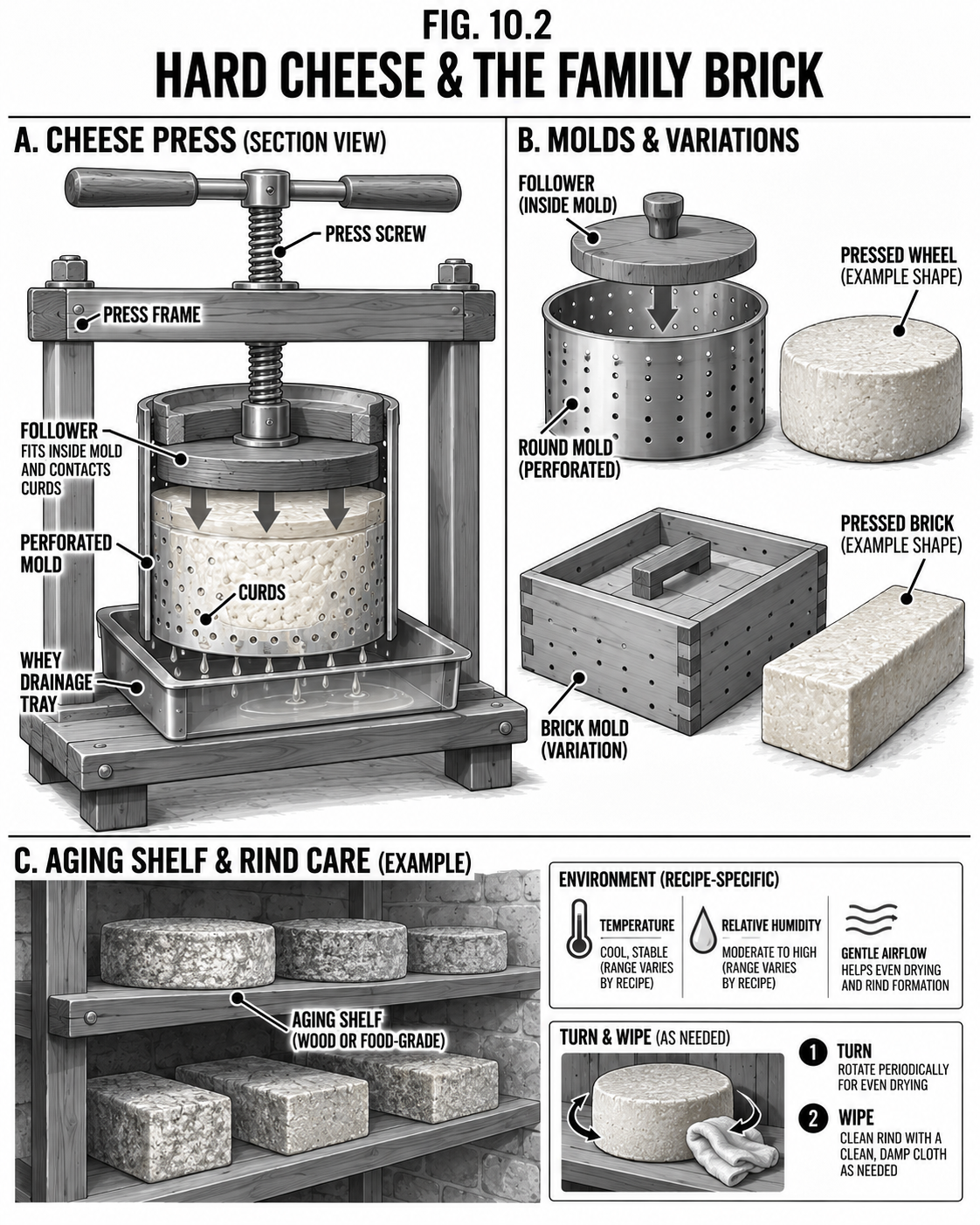
Drain, salt (or brine), and pack the curd into a brick mold or a wheel.
Press under increasing weight for a day, turning it; then air-dry a rind.
Age in a cool, humid cellar (about 50 to 55 F). For the brick, wipe the rind with a light brine wash every few days for the classic tang. Wax or cloth-wrap wheels. Wait weeks to months.
Safety Cleanliness and steady cellar temperature are everything. Toss any cheese with fuzzy colored mold on a cut surface or an off, ammonia-sharp smell. A good rind protects the paste; a cracked, dried-out one lets rot in.
Larder · CheeseThe Army Brick
The Army Cheese Brick (Processed)
The shelf-stable ration brick: smooth, sliceable, and slow to spoil.
DifficultyBeginner
TimeAn hour
CostLow
SkillsKitchen
Why it is worth it
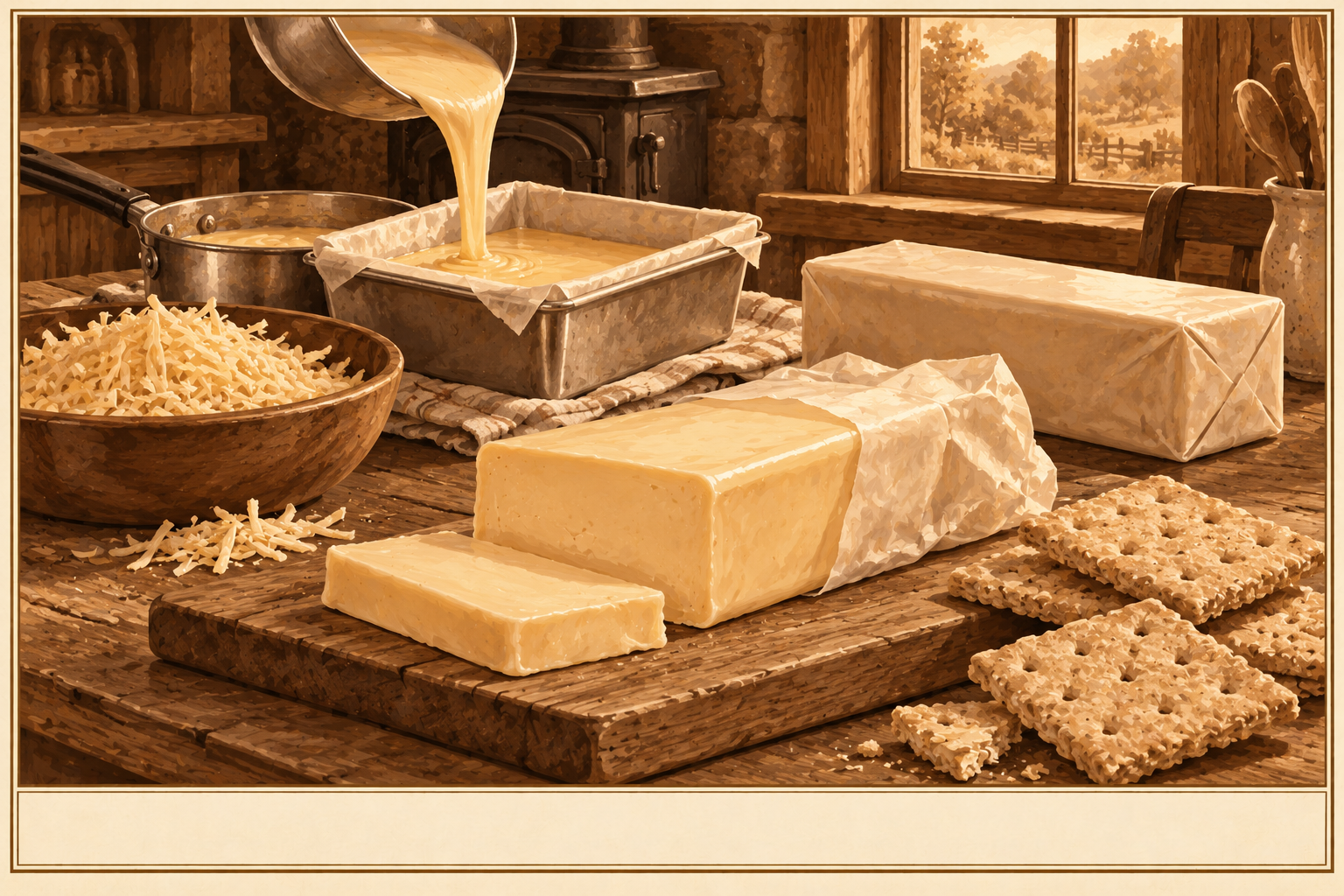
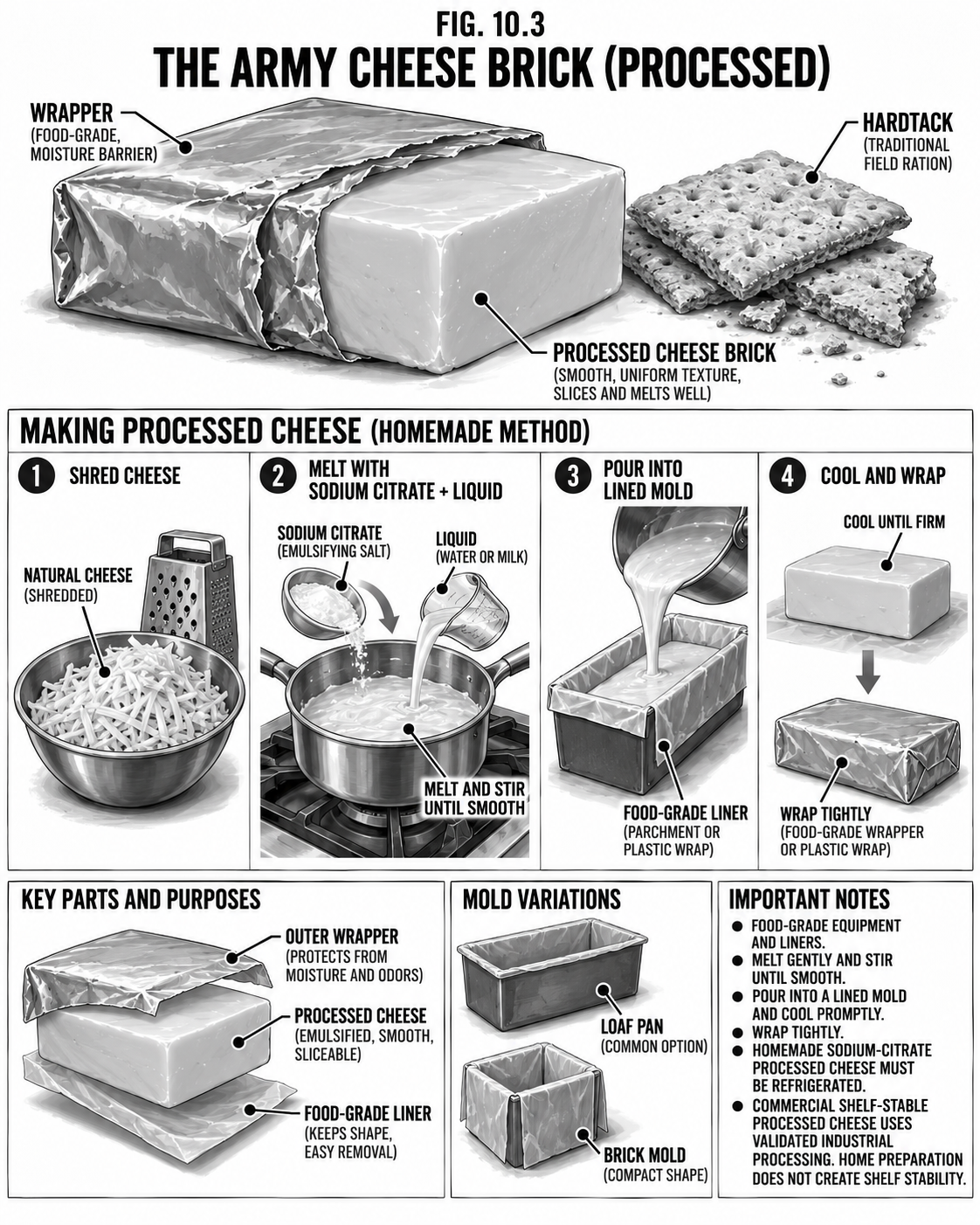
This is the government-ration cheese: natural cheese melted back together with an emulsifying salt so it stays smooth, slices cold, melts without breaking, and keeps far longer than the cheese it was made from. It is how armies and schools moved cheese by the truckload.
Step by step
Shred a pound of aged cheese (cheddar or your brick).
In a pan, warm a splash of milk or water with about one teaspoon of sodium citrate (the emulsifying salt) until dissolved.
Melt the cheese into it a handful at a time, stirring, until it is glossy and smooth.
Pour into a loaf or brick form lined with parchment; cool until firm, then wrap tight.
Safety This keeps weeks cool and longer cold, but it is not a canned good: never pressure-can or water-bath cheese, which is a botulism risk with no safe approved method. Keep the brick cool and wrapped, and watch for off smells.
Larder · MeatJerky & Dried
Jerky, Biltong & Dried Meat
Dry it right and a pound of meat keeps for months in a pocket.
DifficultyBeginner
TimeA day or two
CostLow
SkillsBasic
Why it is worth it
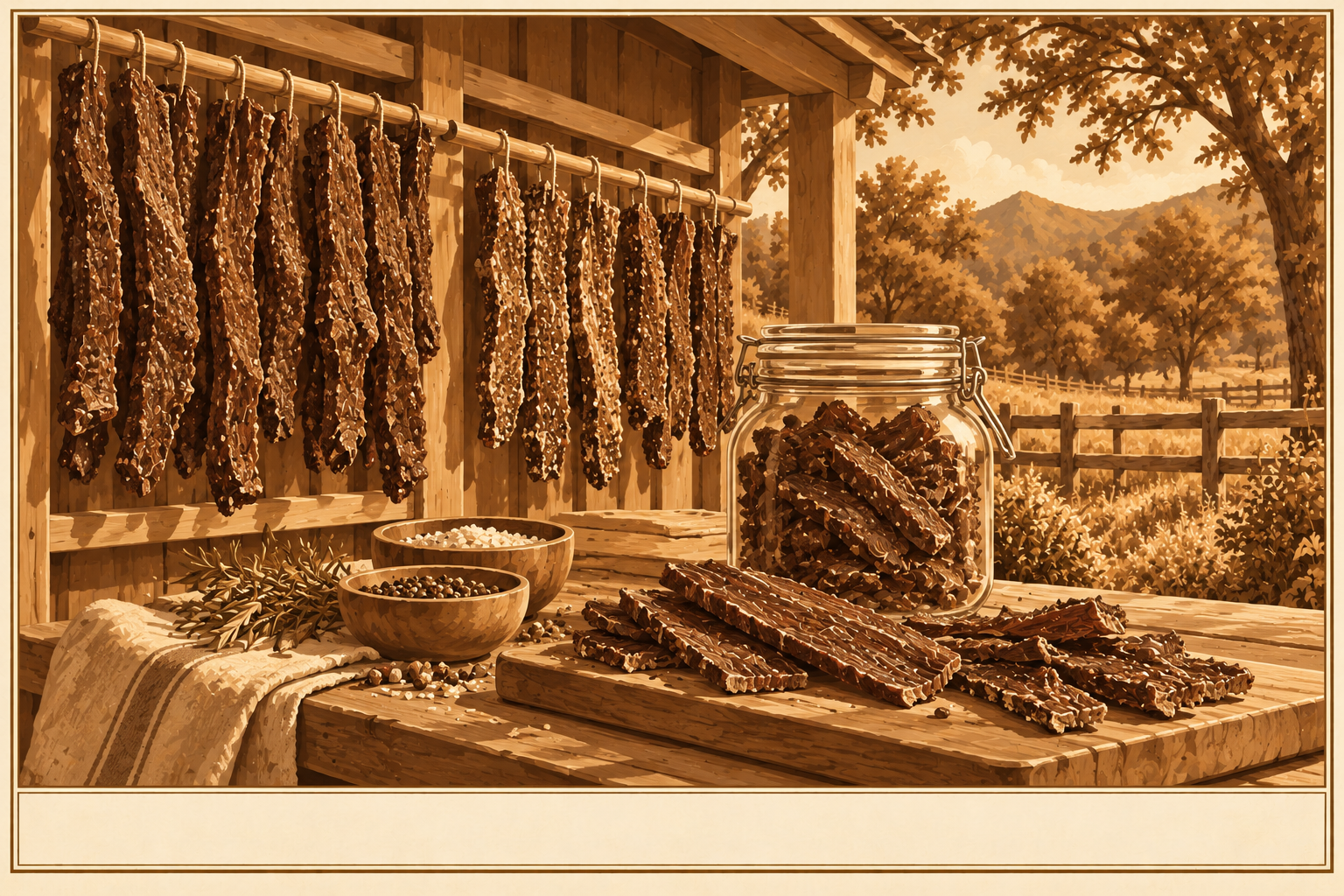
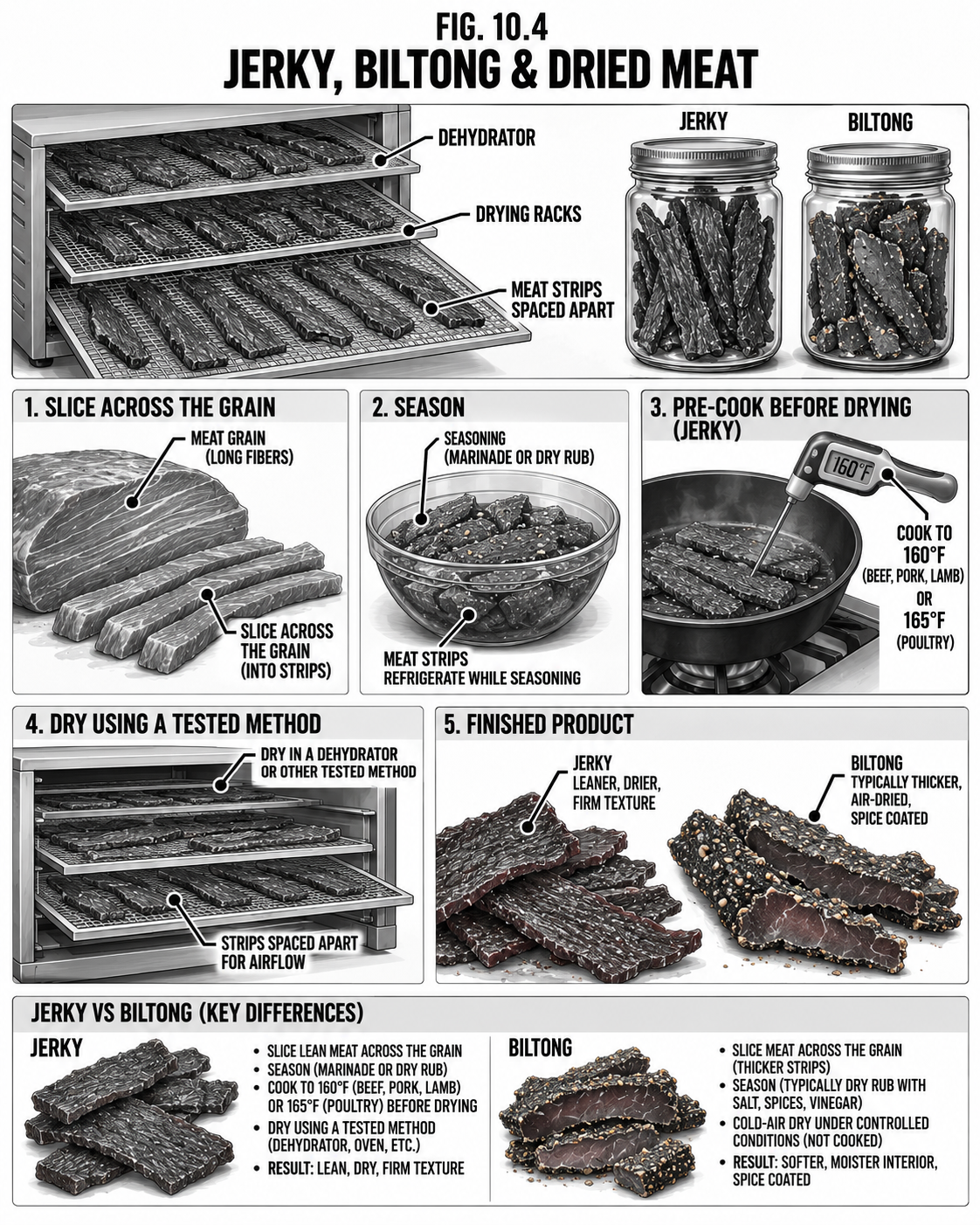
Drying is the oldest way to keep meat. Jerky is lean meat sliced thin, seasoned, and dried hard; biltong is thicker strips cured in vinegar and salt and air-dried whole. Both shed the water that spoilage needs and carry light and long.
Step by step (jerky)
Trim every scrap of fat (fat goes rancid); slice lean meat thin across the grain, part-frozen for an even cut.
Season or marinate with salt and spice (salt is the preservative, not just flavor).
Dry at low heat (a dehydrator, a low oven with the door cracked, or a smoker) until it bends and cracks but does not snap.
For safety, heat the meat to 160 F at some point in the process. Cool and store dry.
Safety Lean only: fat left in jerky turns the whole batch rancid. Bring the meat to 160 F to kill pathogens. Store bone dry in a sealed jar; any moisture or mold means toss it.
Larder · MeatPemmican
Pemmican: The Original Iron Ration
Dried meat and fat pressed into a cake that keeps for years.
DifficultyIntermediate
TimeA day+
CostLow
SkillsBasic
Why it is worth it
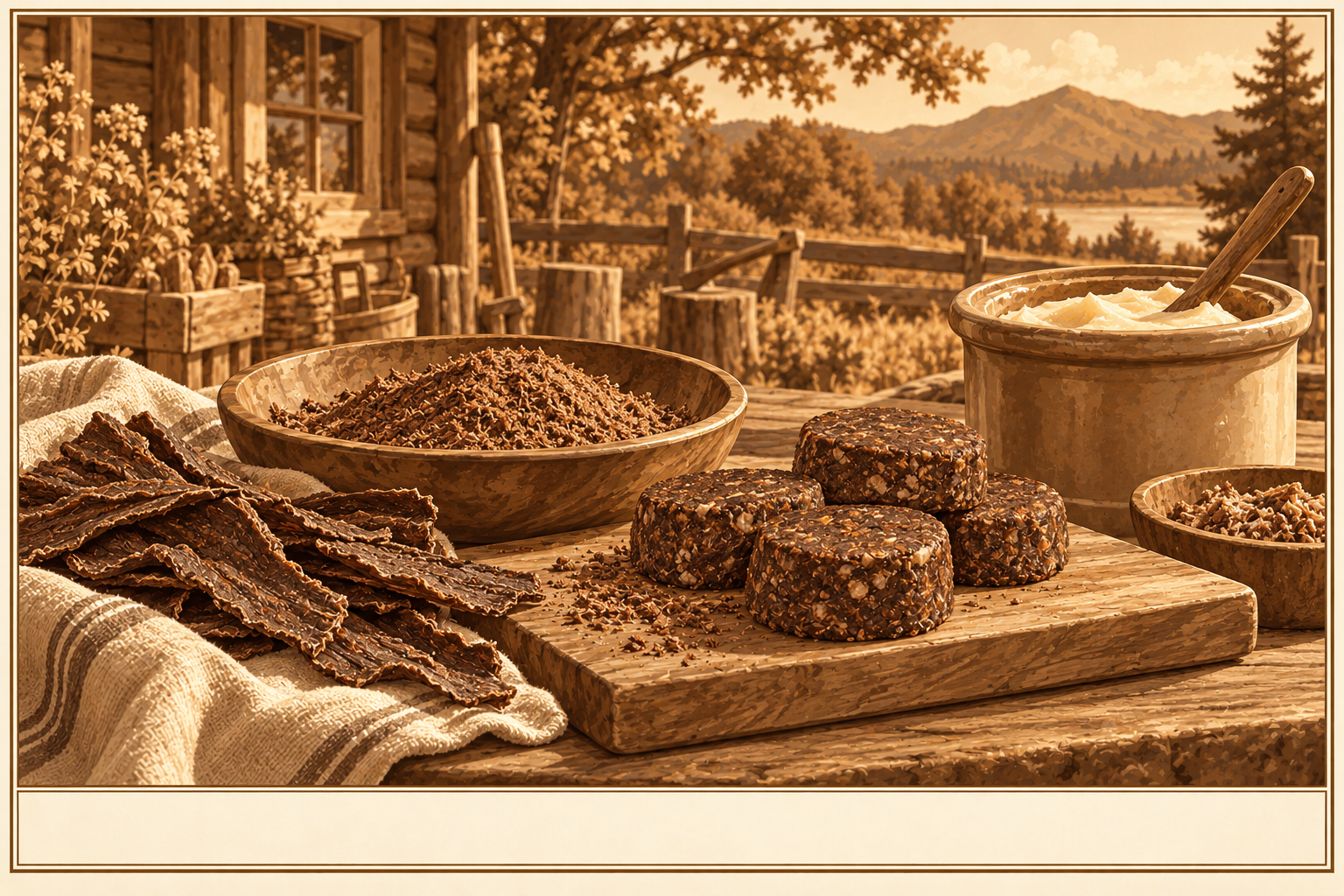
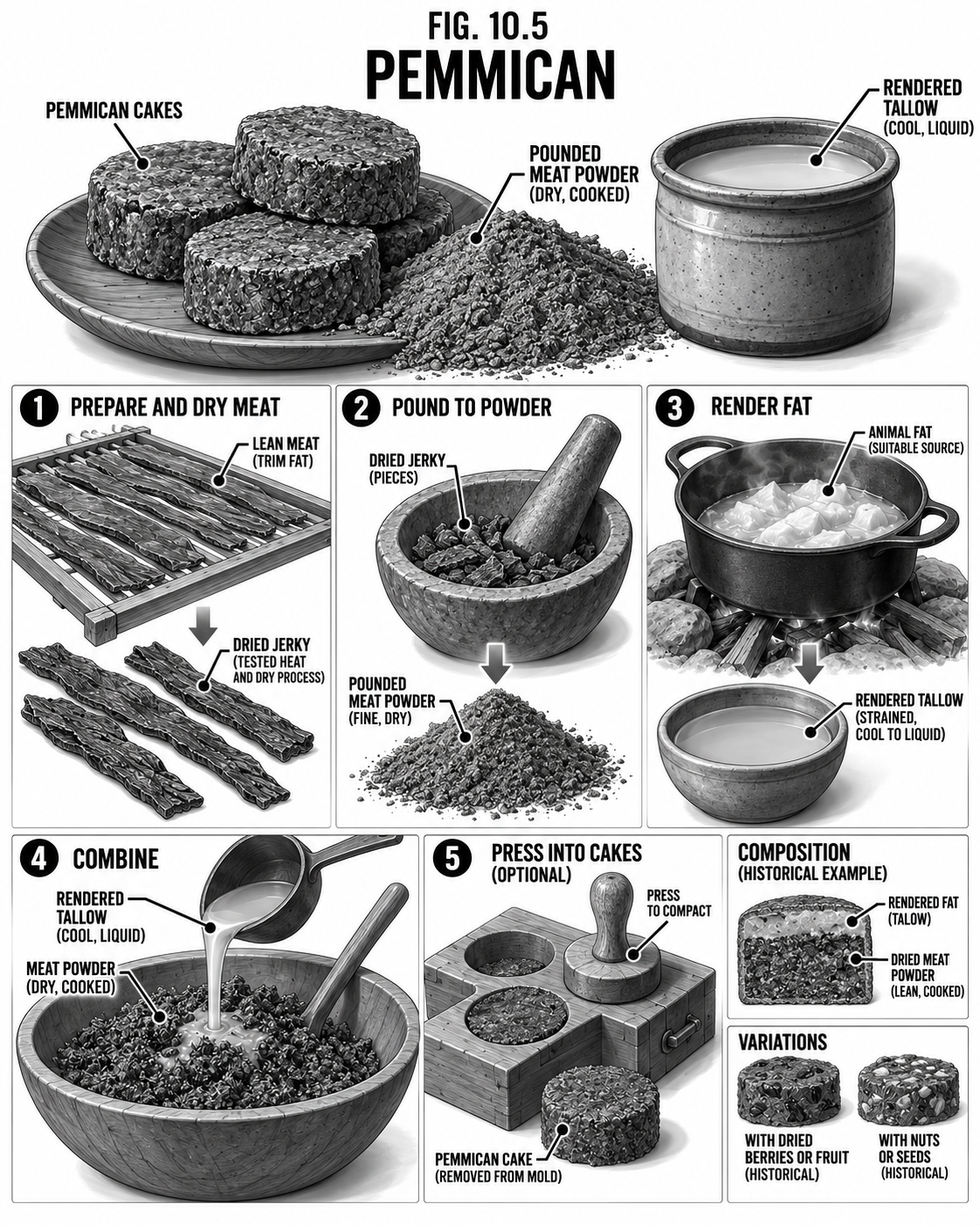
Pemmican is the original survival ration: dried lean meat pounded to powder and bound with an equal weight of rendered fat, sometimes with dried berries. It is nearly all protein and energy, it keeps for years without refrigeration, and it carried trappers, explorers, and armies where nothing else would travel.
Step by step
Make jerky (above) from lean meat, bone dry, then pound or grind it to a powder.
Render clean fat (beef tallow is classic) by melting it low and straining out the solids.
Mix the meat powder with roughly its own weight in warm liquid tallow until it just holds together; fold in dried berries if you like.
Press into cakes or bars and let them set firm. Store cool and dry.
Safety Use rendered fat, never raw: raw fat spoils. Keep the meat fully dry before grinding. Stored cool and dry it lasts for years; kept warm the fat will eventually turn, so smell before you trust an old batch.
Larder · MeatCanning Pork & Beef
Canning Meat: Pork, Beef & Corned Beef
Jars of cooked meat on the shelf, good for years, if you do it the one safe way.
DifficultyIntermediate
TimeHalf a day
CostMed
SkillsPressure canning
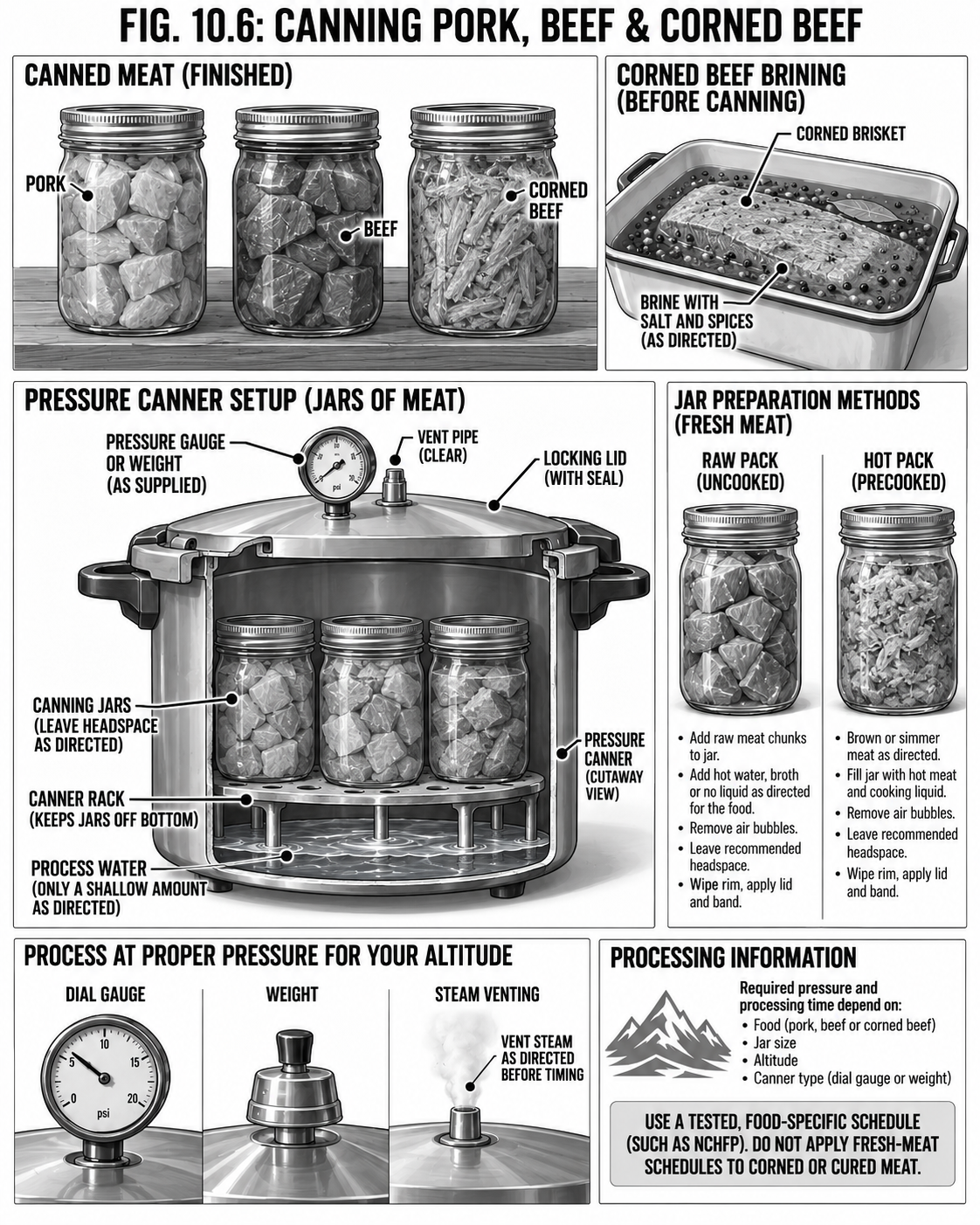
READ THIS FIRST Meat is a low-acid food. It MUST be pressure-canned, never water-bathed. Low-acid food canned wrong grows Clostridium botulinum, which makes a toxin that can kill you and leaves no smell or taste. Use a tested pressure canner, follow a current USDA or extension guide for the pressure and time at your altitude, and if a jar ever unsealed, smells wrong, or spurts when opened, destroy it without tasting. There is no safe shortcut here.
Step by step
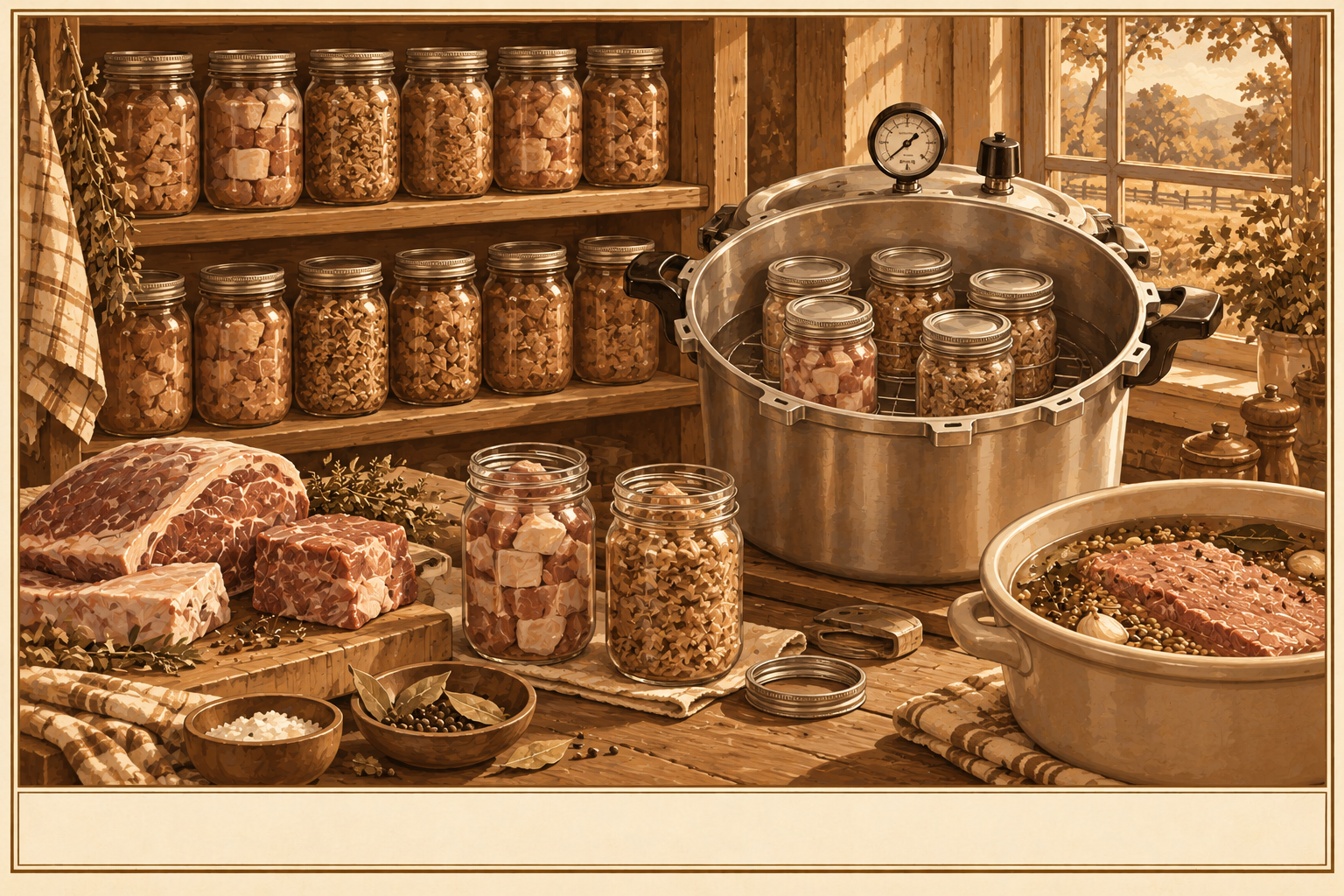
Cut pork or beef into chunks, trimming heavy fat. Raw-pack into clean jars, or brown first and hot-pack, leaving the headspace the guide specifies.
Add about a half teaspoon of canning salt per pint (optional, for flavor). Add no liquid for raw pack; the meat makes its own.
Wipe rims, set lids, and process in the pressure canner at your guide's pressure and time (pints of meat run roughly 75 minutes, quarts 90, at the correct pressure for your altitude).
Let the canner cool on its own, remove jars, and check every seal the next day.
Corned beef
Cure a brisket for a week or two in a brine of water, canning salt, a little sugar, pickling spice, and curing salt (sodium nitrite, "pink salt number 1," which keeps it safe and pink). Rinse, then cook to eat, or can the cooked meat by the rules above.
Larder · StaplesBread & Hardtack
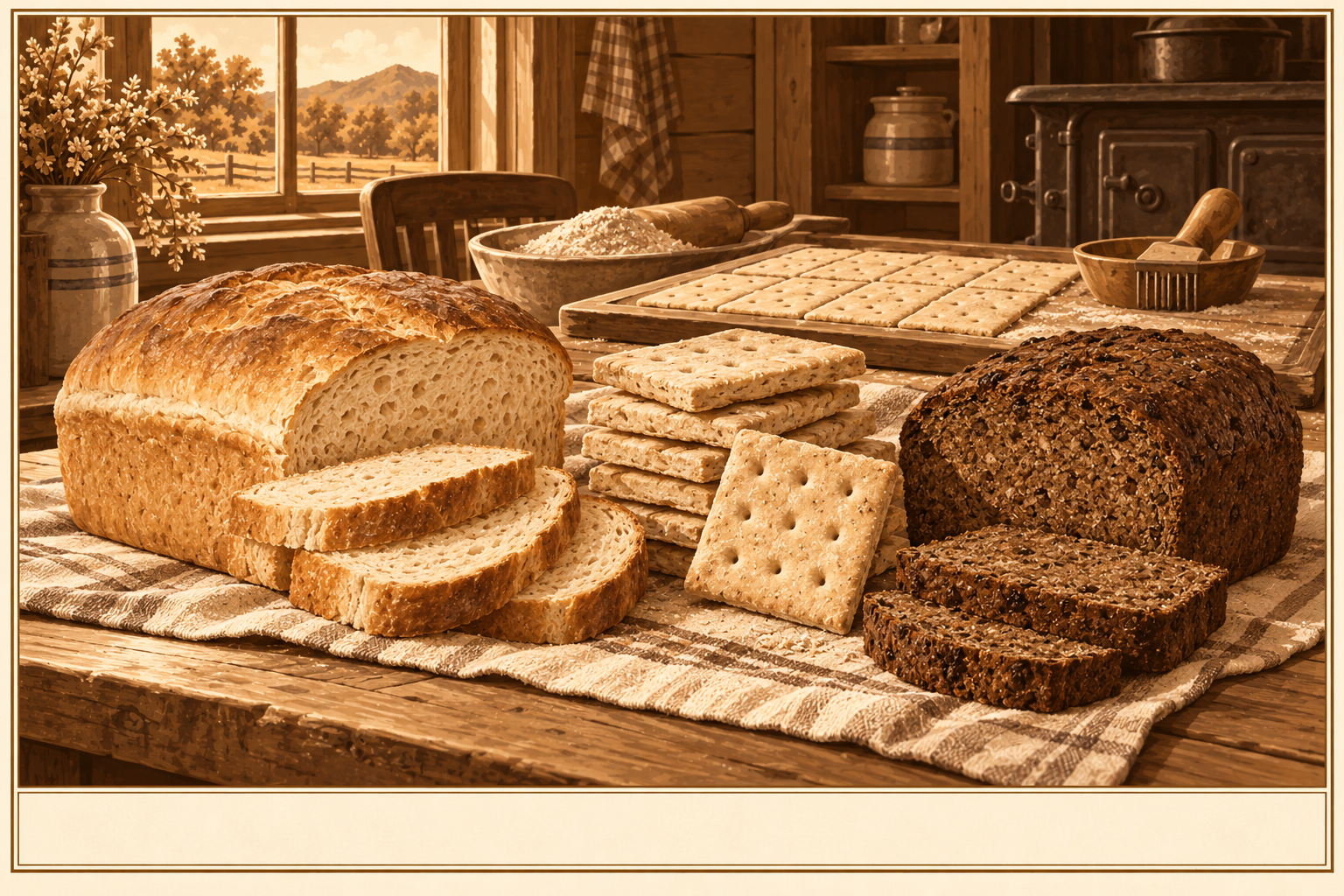
Staples: Bread, Hardtack & Logan Bread
From a daily loaf to a cracker that outlives the baker.
DifficultyBeginner
TimeHours
CostLow
SkillsBaking
Why it is worth it
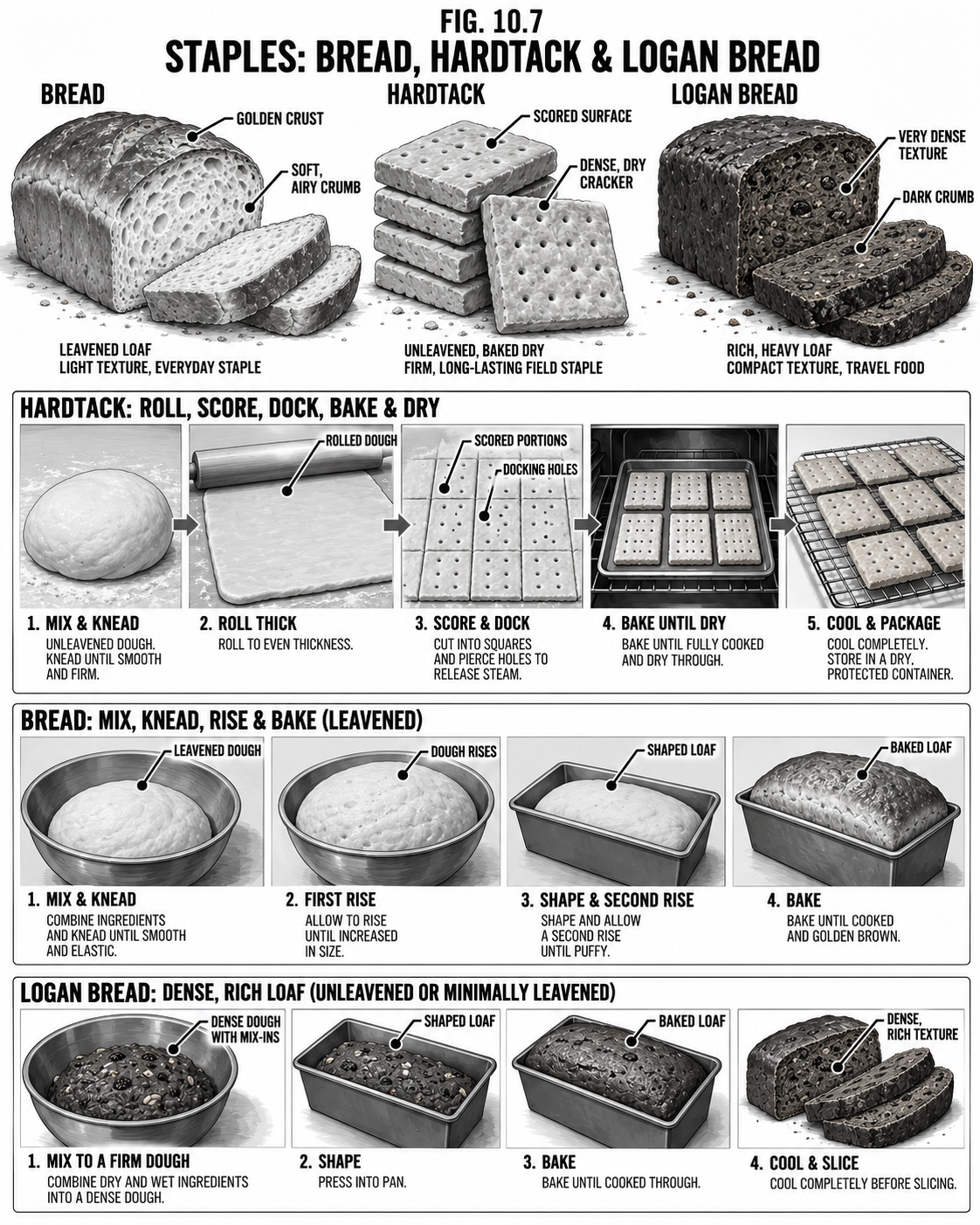
Grain is the base of the larder. A daily bread feeds you now; hardtack feeds you in ten years. Logan bread splits the difference: a dense, fruit-and-honey survival loaf that packs real calories and keeps for weeks.
Hardtack (keeps for years)
Mix three parts flour to one part water with a good pinch of salt into a stiff dough.
Roll it a half-inch thick, cut into squares, and poke rows of holes through each.
Bake low (about 250 F) for a few hours, turning once, until rock hard and bone dry.
Cool fully and store dry. To eat, soak or dunk it soft in soup, coffee, or stew.
Everyday bread
Flour, water, salt, and leaven (yeast or your sourdough starter): mix, knead, rise, shape, rise, bake hot. Keep a sourdough start alive and you never need store yeast.
Tips & variations Hardtack is only as good as it is dry: any softness invites mold, so store it with the grain and beans in sealed, dry containers (see Food, Storage).
Larder · RationsPocket Soup & Energy Ball
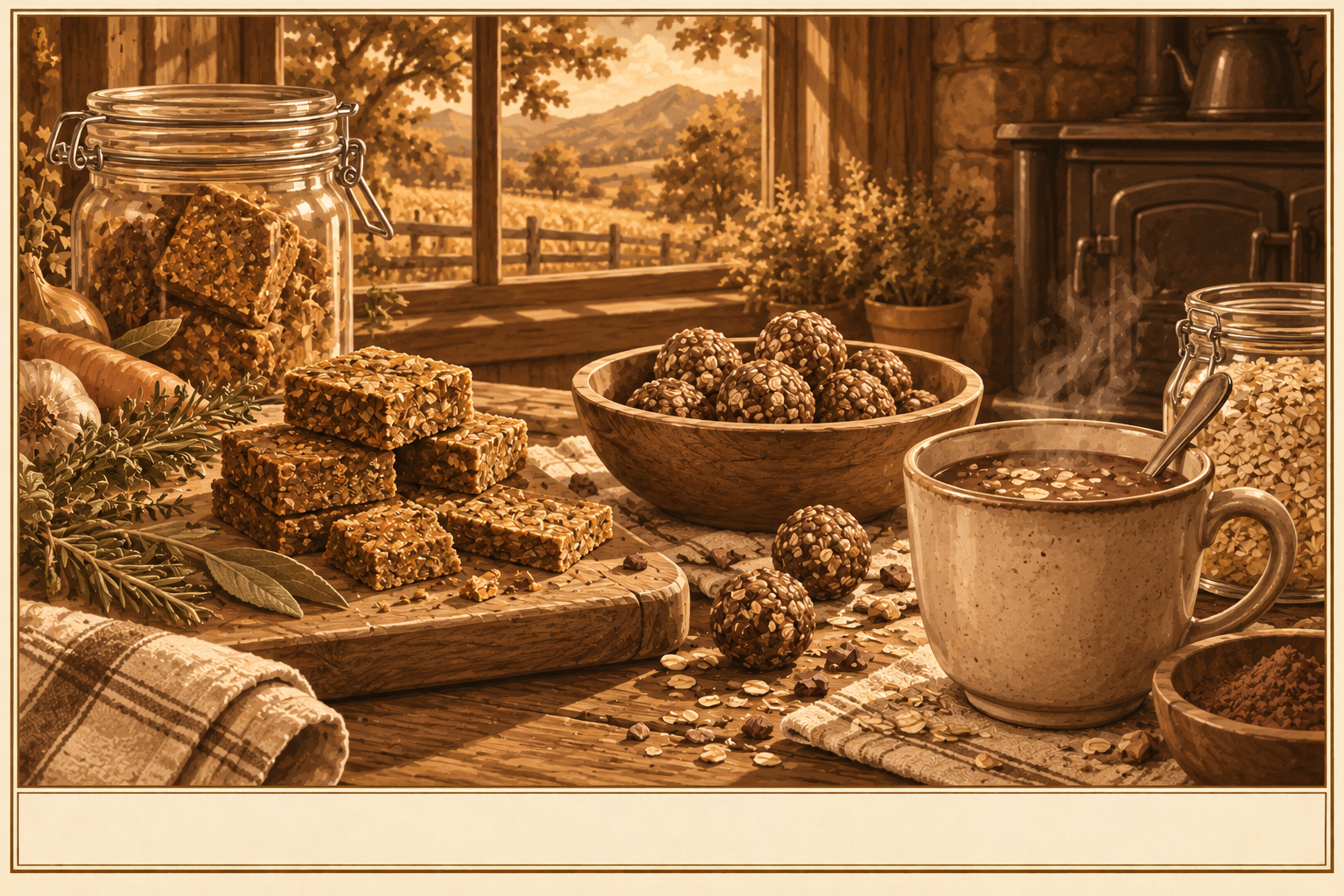
Pocket Soup & the Instant Energy Ball
Drop it in hot water and get a hot meal or a hot drink in a minute.
DifficultyIntermediate
TimeA day (mostly simmering)
CostLow
SkillsKitchen
Pocket soup (the savory one)
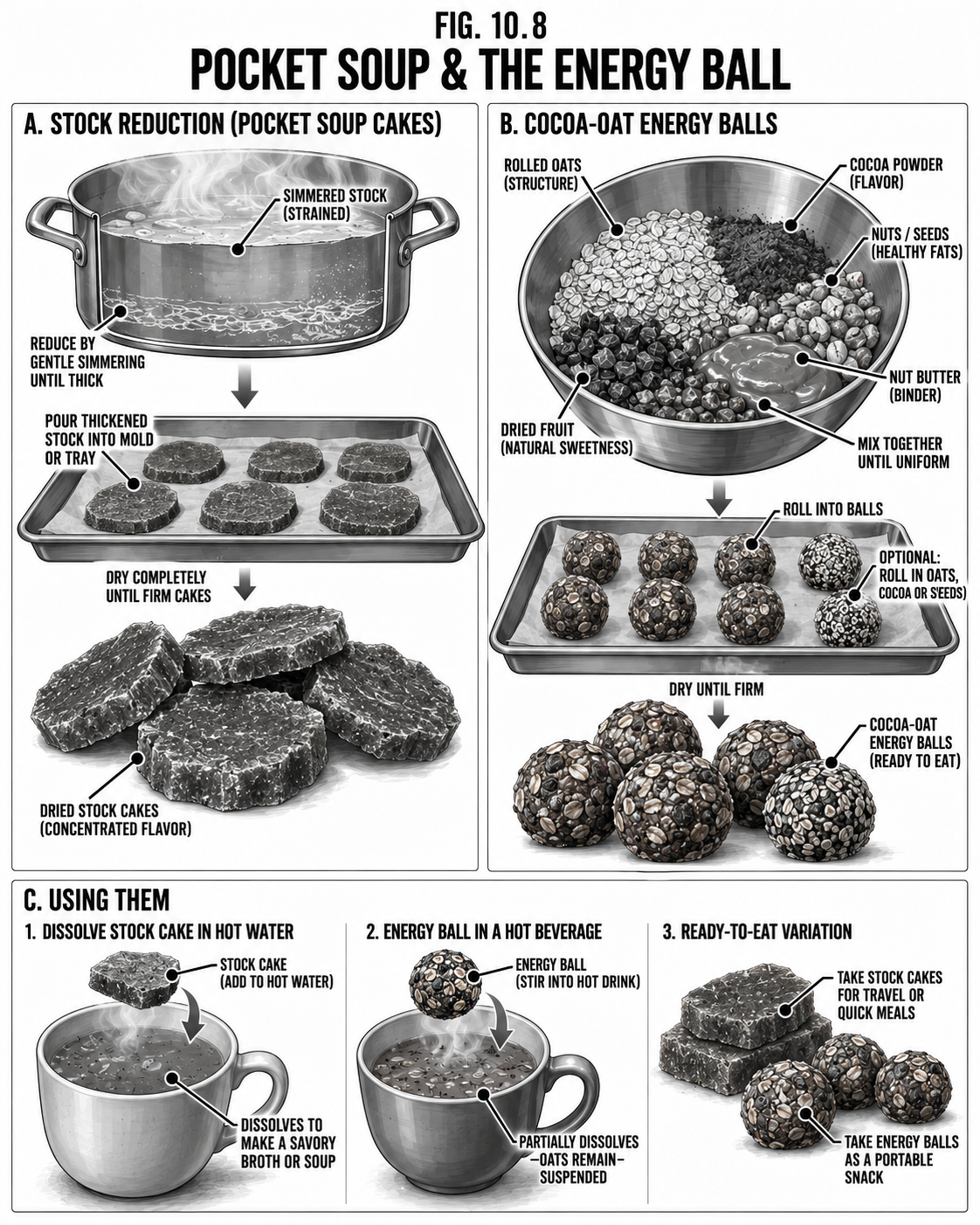
This is the old portable soup that sailors and soldiers carried for a century. Simmer meat and bones down into a rich stock, strain it, then reduce it low and slow until it is a thick, dark glue. Pour it thin to set and dry it hard into chips or cakes. One piece dropped in hot water makes instant broth.
The instant energy ball (the one you asked for)
Grind rolled oats fine. Mix with cocoa powder, instant coffee, powdered milk, and sugar to taste (a strong base is about two parts oat, one each cocoa and milk powder, plus coffee and sugar).
Bind it with just enough honey or a little soft fat to hold a ball.
Roll into balls, then dry them firm (a low oven or a dehydrator).
Drop one in a cup of hot water and stir: a hot cocoa-oatmeal energy drink with a caffeine kick, calories, and comfort in one.
Tips & variations Powdered milk and honey keep the energy balls shelf-stable; leave out the coffee for a bedtime cocoa version. Pocket soup keeps best bone dry in a tin.
Larder · RationsOld Army Rations
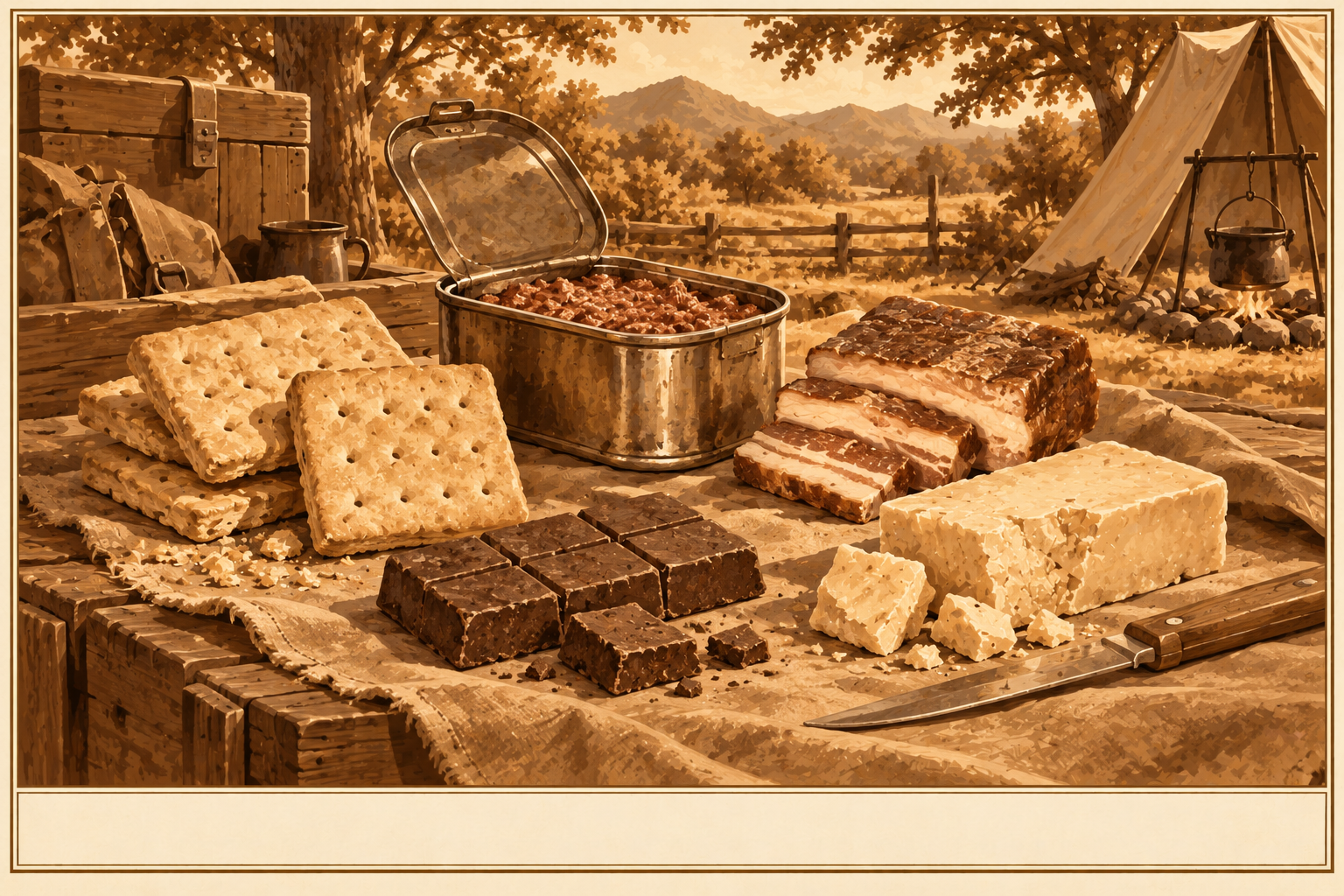
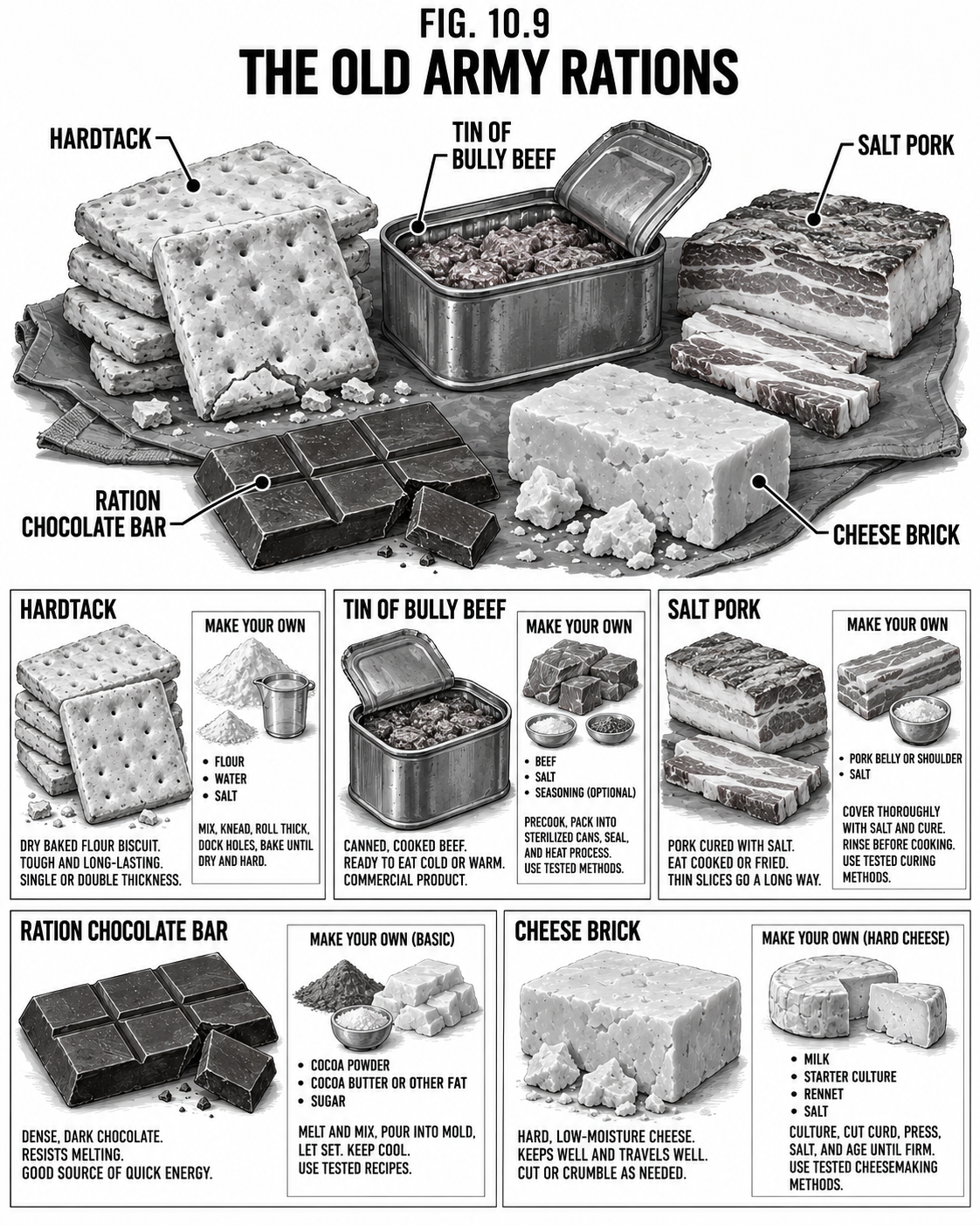
The Old Army Rations
The hard bread, salt meat, bully beef, and chocolate bars that carried armies.
DifficultyBeginner-Intermediate
TimeVaries
CostLow
SkillsLarder
Why it is worth it
Before pouches and freeze-drying, armies ran on a short list of things that would not spoil in a pack. Every one of them is something a homestead can make, and together they are a ready-made emergency pantry.
The lineup, and how to make it
Hardtack: the flour-and-water cracker above, the bread of every old army.
Salt pork: fatty pork packed in salt or heavy brine; it keeps unrefrigerated and flavors beans and greens. Rinse and simmer before eating.
Bully beef: canned corned beef (above). The tinned meat of two world wars.
The iron ration: the emergency can soldiers could not open without orders. Make your own as cakes of dried beef-bouillon-and-wheat plus cakes of hard ration chocolate, sealed in a tin.
The D-ration bar: a dense survival chocolate: melt chocolate with oat flour, sugar, powdered milk, and a little fat, press into a bar, and keep it cool. Made heavy and barely sweet on purpose so a soldier would ration it, not snack it.
The cheese brick: the processed ration cheese above, for fat and protein that slices cold.
Safety Salt pork and brined meats lean hard on salt and cure (nitrite) to stay safe: follow a real cure recipe, do not guess the salt. Keep every ration bone dry and cool, and rotate the pantry so nothing sits past its keeping.
Larder · WorldBritish & Commonwealth
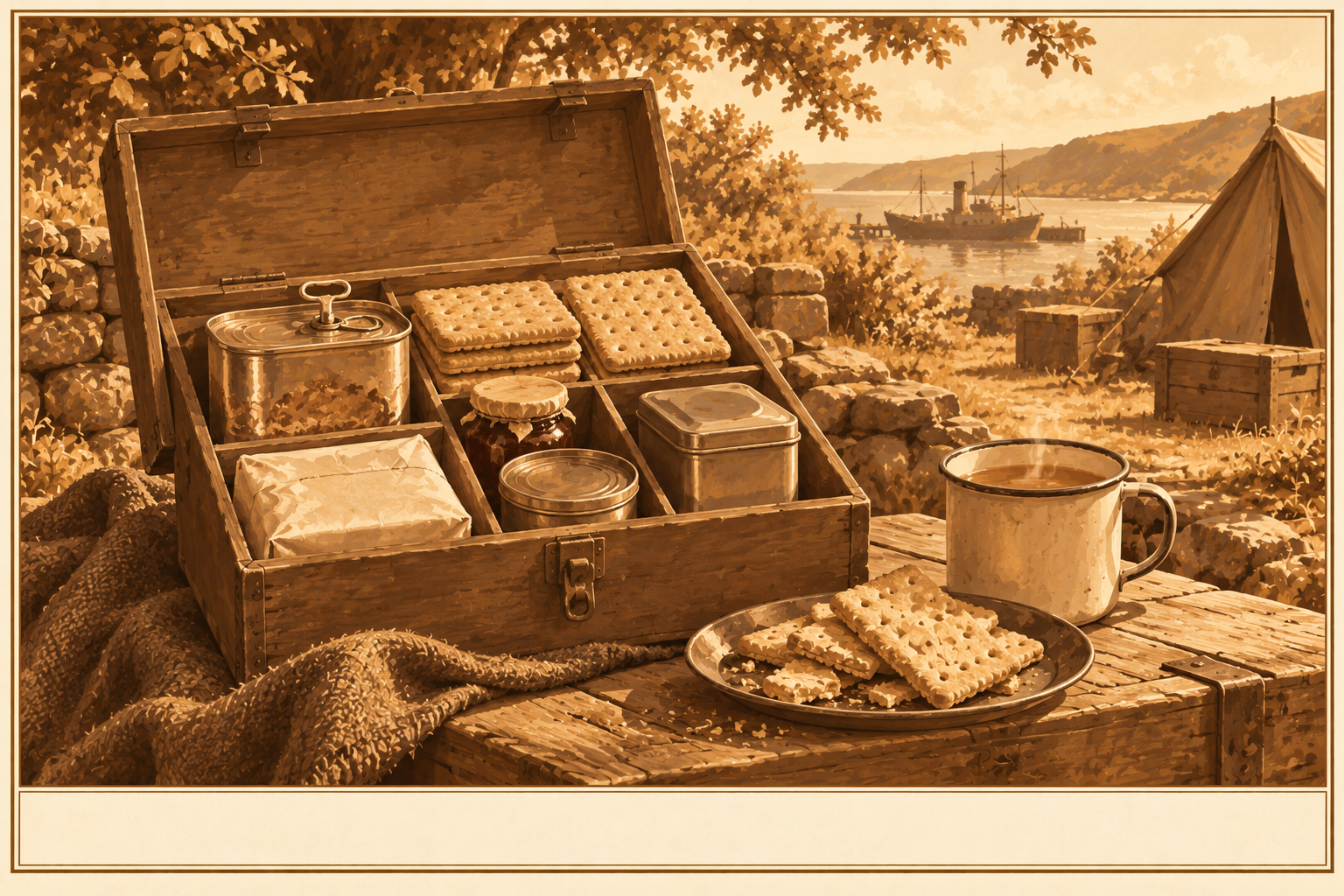
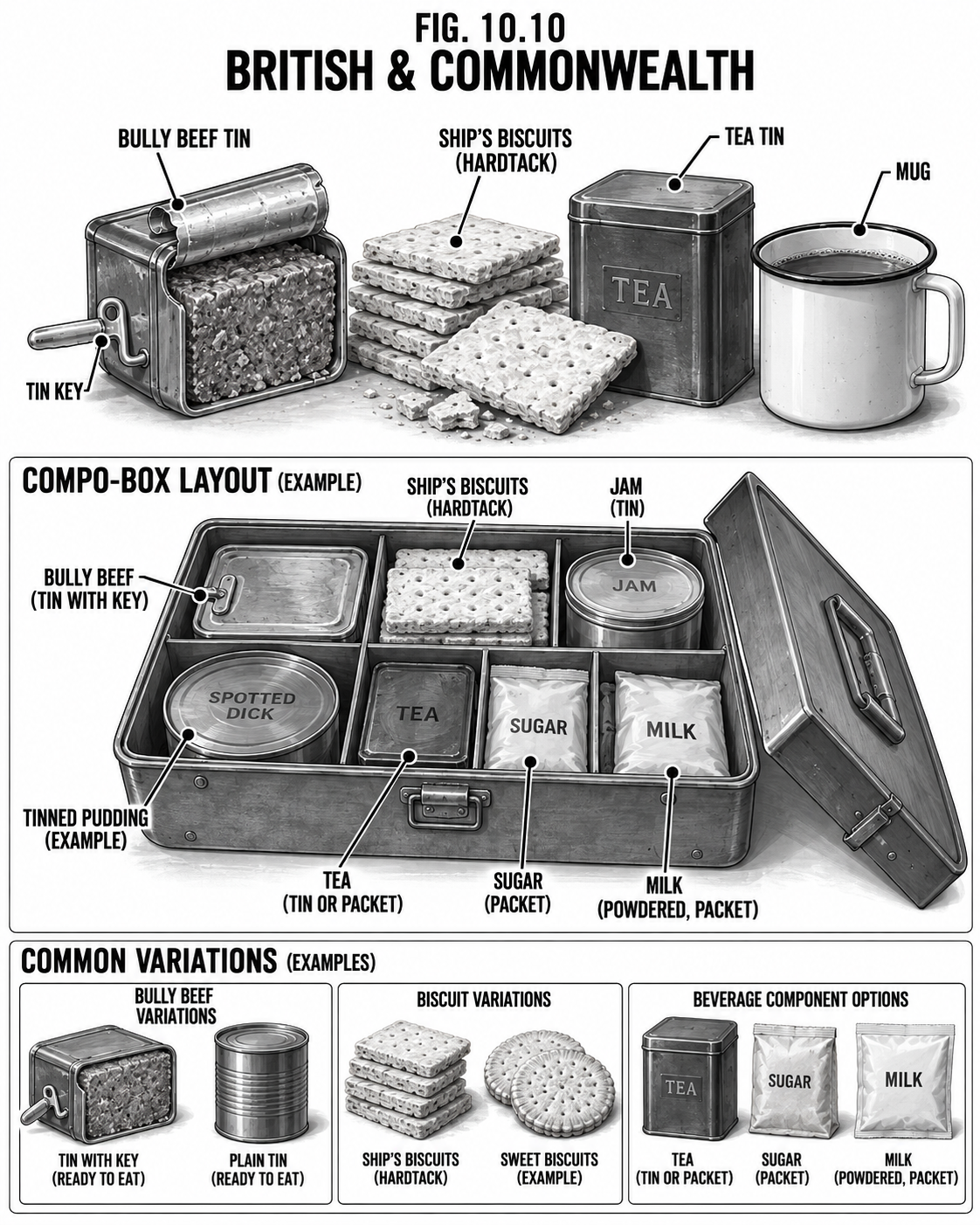
British & Commonwealth Rations
Bully beef, hard biscuit, and a strong brew: the ration of an empire.
DifficultyBeginner
TimeVaries
CostLow
SkillsLarder
Why it is worth it
The British soldier ran on three things for two centuries: bully beef (canned corned beef, your Chapter 10 corned beef in a tin), ship's biscuit (a harder, rounder cousin of hardtack that fed the Royal Navy), and tea. The "compo" ration boxed these with jam, tinned pudding, and biscuits brown. Dull, heavy, and it kept forever.
Make it
Bully beef: can corned beef by your meat-canning method.
Ship's biscuit: hardtack made rounder and baked even harder; store bone dry and dunk it soft.
The brew: strong black tea, the morale ration. Carry loose tea, sugar, and powdered milk together.
Tips & variations Fried with onion and crumbled biscuit, bully beef becomes a hot hash; that is how it was actually eaten in the field.
Larder · WorldFrench, German & Roman
French, German & Roman Rations
The nations that invented canning, the soup-sausage, and the marching biscuit.
DifficultyBeginner-Intermediate
TimeVaries
CostLow
SkillsLarder
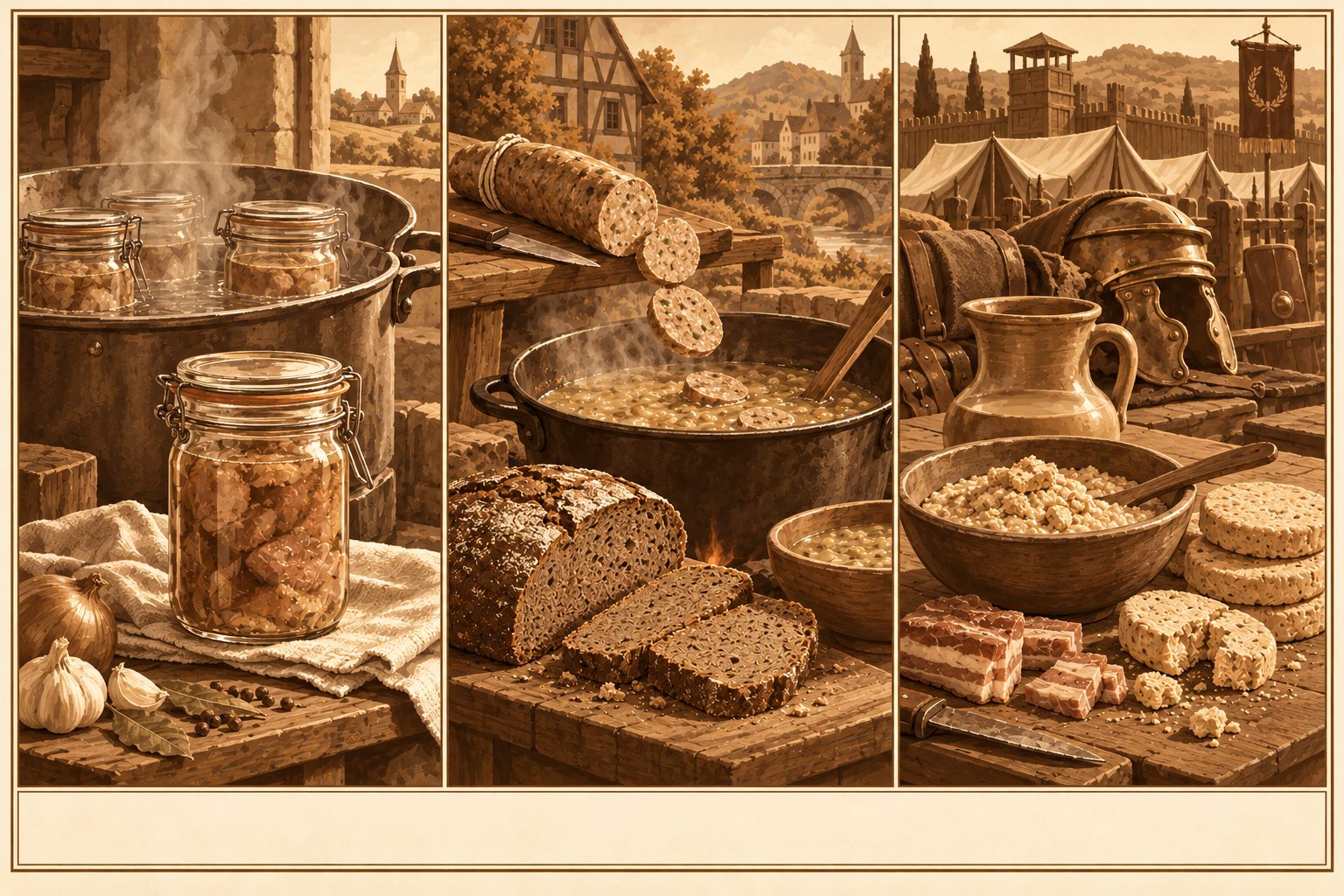
France: the birthplace of canning
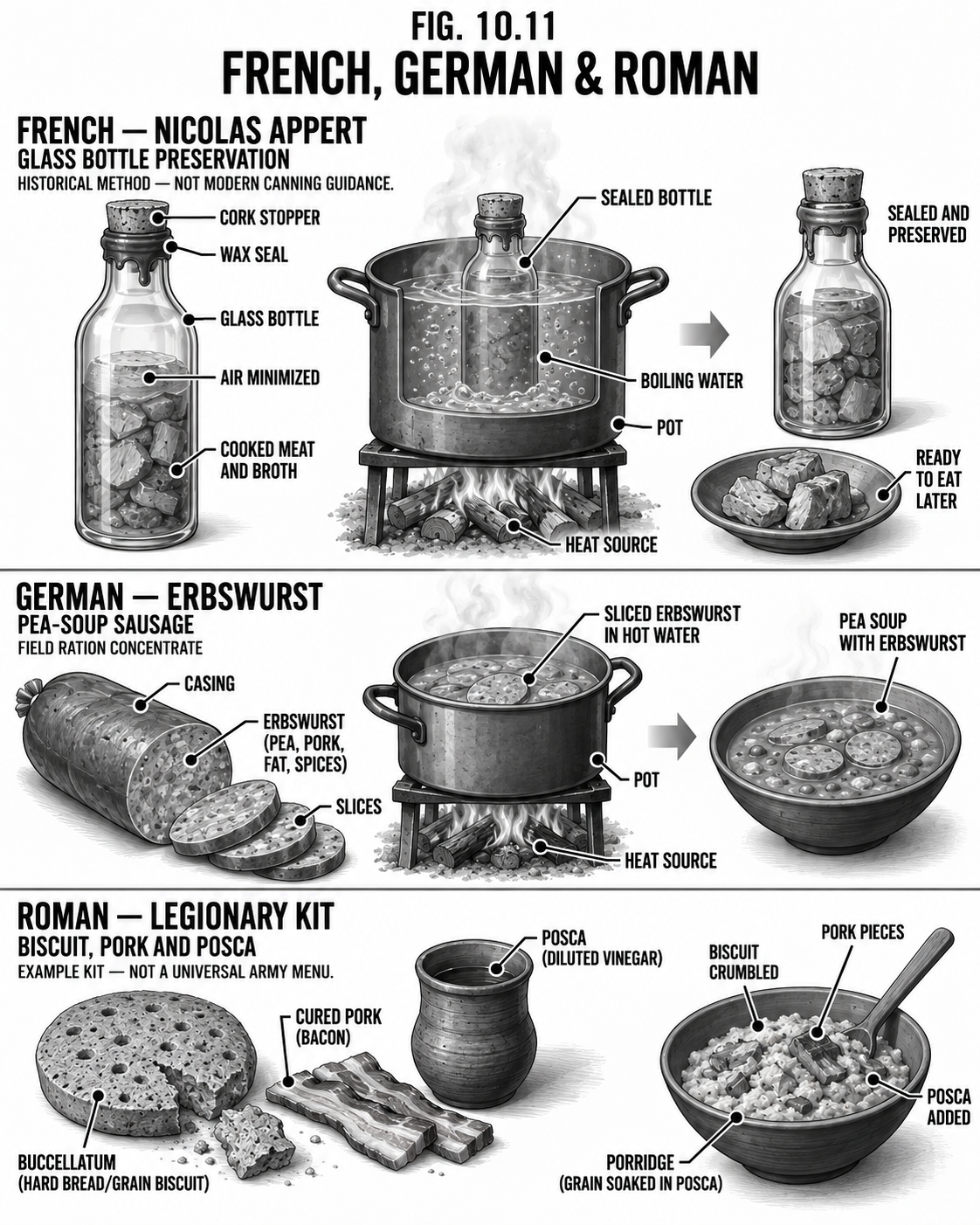
Napoleon's government offered a prize for a way to keep food for the army, and in about 1809 Nicolas Appert won it by sealing cooked food in glass and boiling it: canning itself was invented as a military ration. French troops later called their tinned corned beef "singe" (monkey). Your whole canning section is Appert's idea.
Germany: Kommissbrot & Erbswurst
Kommissbrot is the dense, sour rye army loaf that stays good for weeks. Erbswurst is the clever one: a sausage of pea flour, fat, and bacon or onion, dried hard; slice off a coin, stir it into hot water, and you have instant pea soup. The Prussian army carried it from the 1870s. It is the ancestor of every instant soup since.
Rome: buccellatum & puls
The legions marched on buccellatum (a hard twice-baked biscuit, the original hardtack), puls (an emmer-wheat porridge), bacon, and posca (water cut with sour wine or vinegar, which kept it safe and the men going).
Tips & variations Make your own Erbswurst: cook and dry split peas to a flour, work in rendered fat and salt and a little fried onion, press into a tube, and dry it hard.
Larder · WorldRussian & Nordic
Russian & Nordic Rations
Stewed meat in a tin, dried bread, cured fat, and crispbread that never dies.
DifficultyBeginner
TimeVaries
CostLow
SkillsLarder
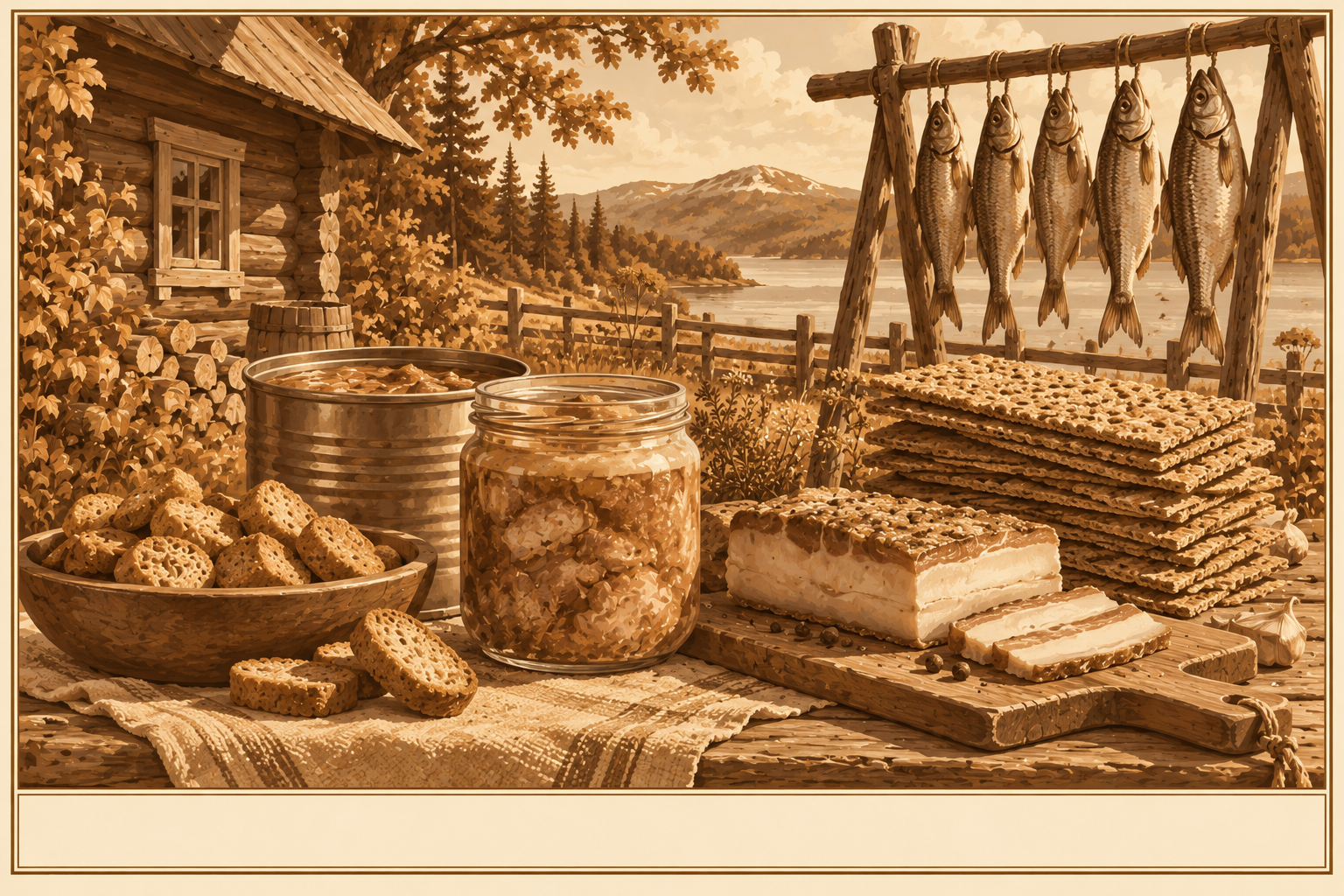
Russia: tushonka, sukhari & salo
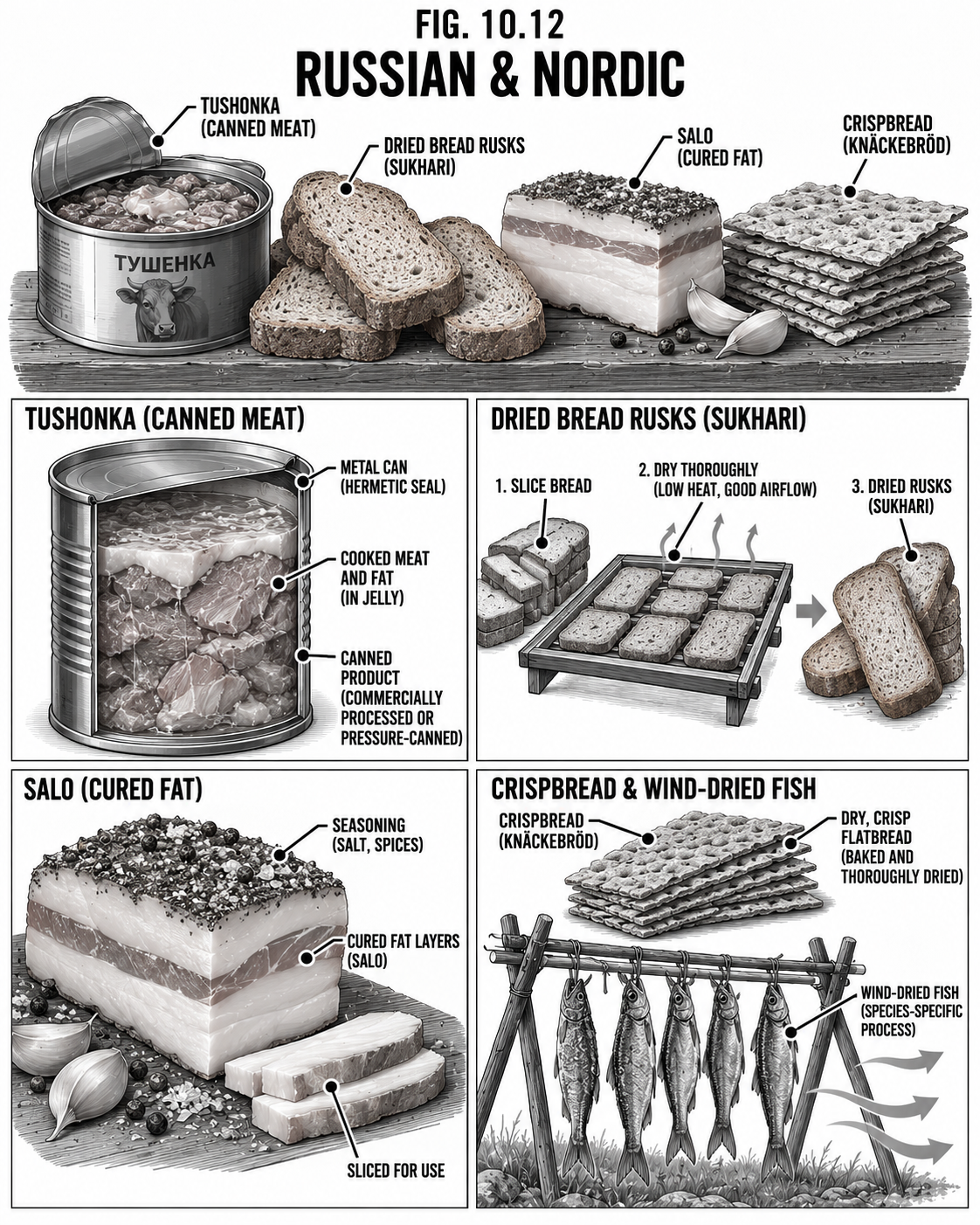
Tushonka is canned stewed meat, slow-cooked in its own fat and jelly: the meat tin that fed the Red Army and still fills Russian packs. Sukhari are dried bread rusks (stale bread baked dry, kept for months, softened in soup or tea). Salo is salt-cured slab pork fat, pure cold-weather fuel, eaten in slices with black bread. Kasha (buckwheat porridge) rounds it out.
The Nordic countries: crispbread & dried fish
Knäckebröd and näkkileipä (rye crispbreads, baked dry with a hole to hang them) keep almost forever and travel flat. Dried and salted fish (stockfish and klippfisk, wind- and salt-dried cod) carried the north through winter. The Finnish army's hernekeitto, a thick pea-and-pork soup, is still served every Thursday.
Safety Tushonka is canned low-acid meat: pressure-can it by the rules in Canning Meat, never water-bath. Salo and dried fish lean on heavy salt to stay safe: follow a real cure, do not guess.
Larder · WorldEast Asian & Mongol
East Asian & Mongol Rations
Dried rice, dried fish, soup balls, and the meat powder that conquered a continent.
DifficultyBeginner-Intermediate
TimeVaries
CostLow
SkillsLarder
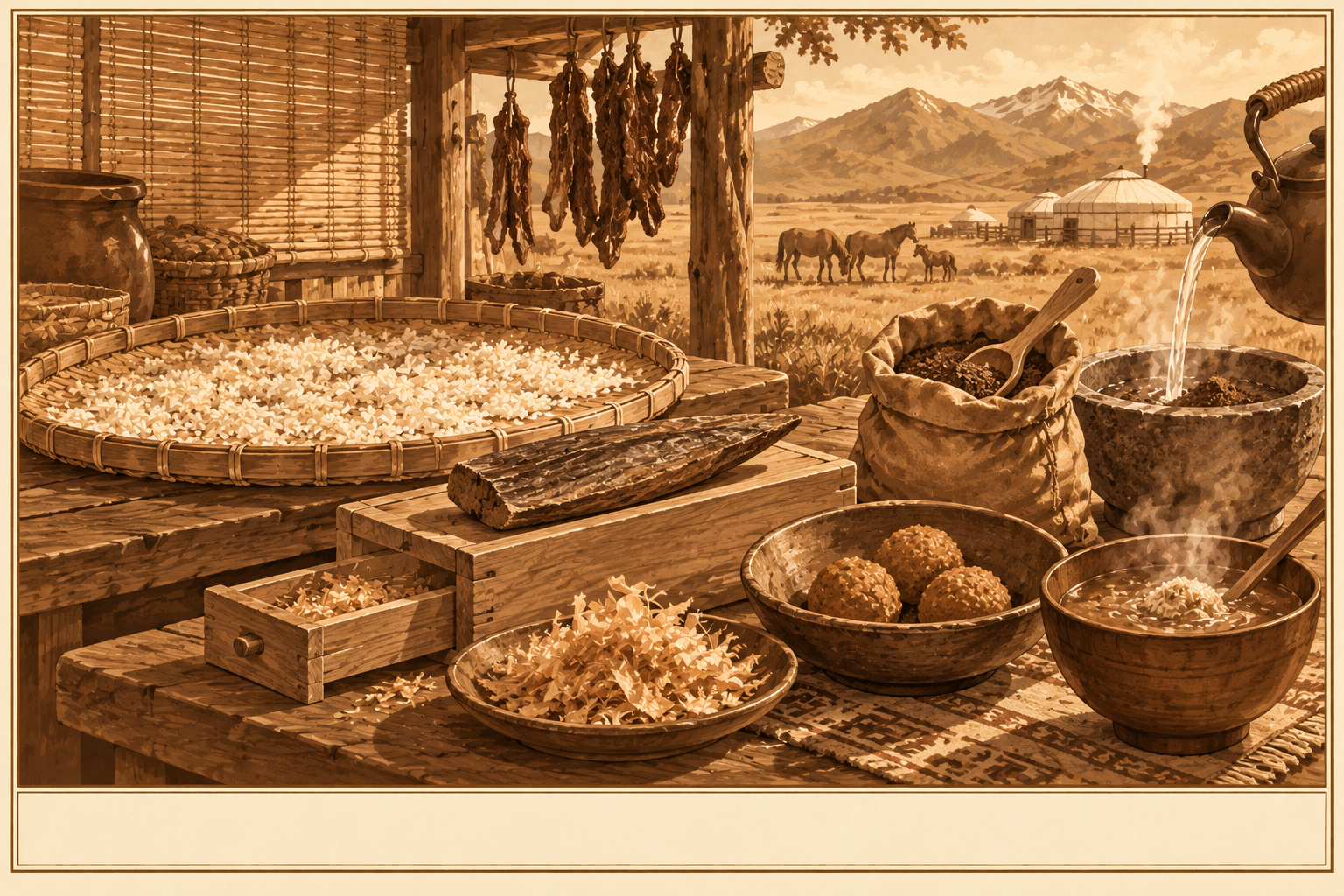
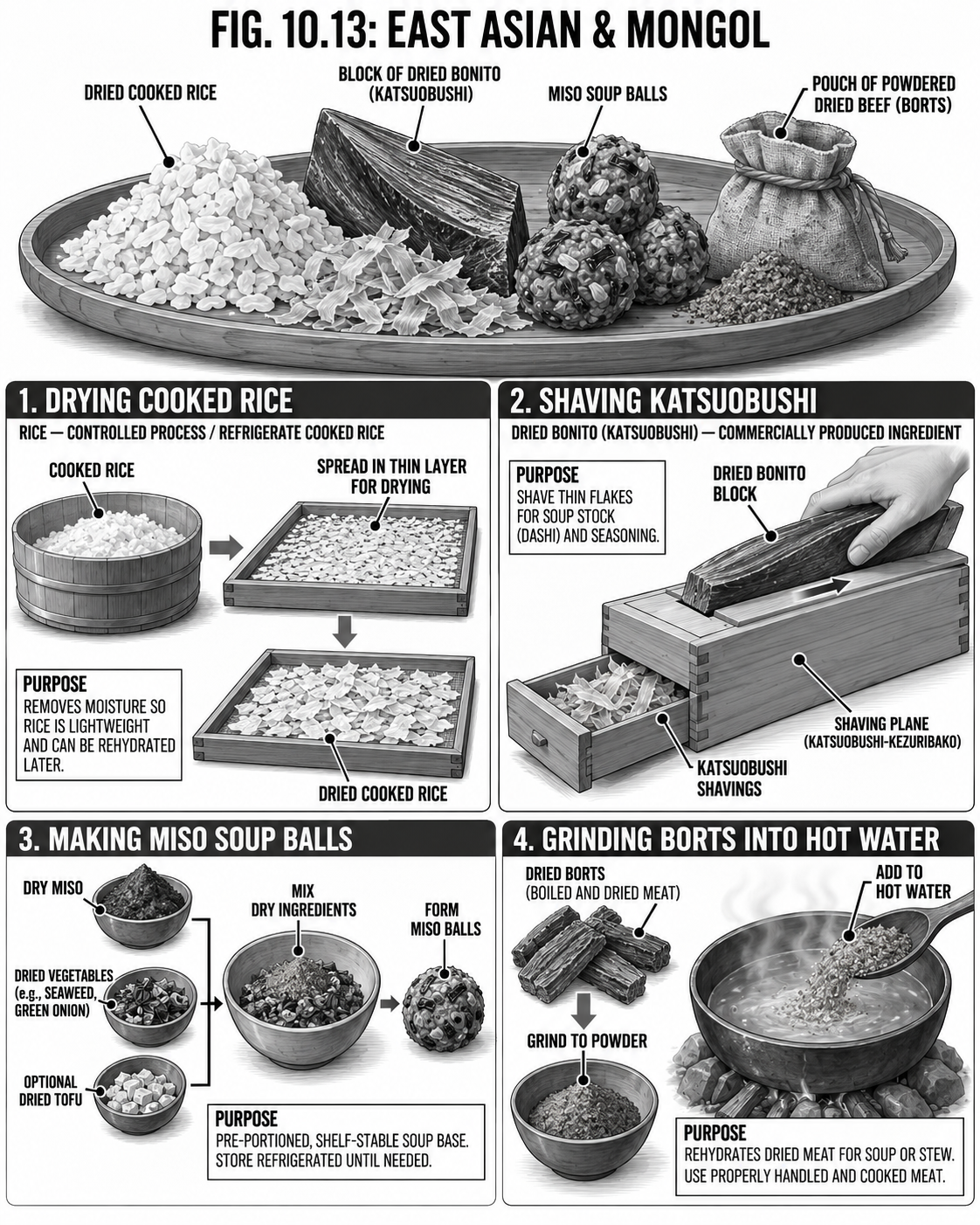
Japan: hoshi-ii, katsuobushi & miso balls
The samurai carried hoshi-ii: cooked rice dried hard, that you soak or boil back to a meal (or chew on the march). Katsuobushi is bonito dried to a wooden block and shaved for instant broth. Miso balls are the trick worth stealing: a lump of miso with dried wakame, green onion, and bonito rolled together; drop one in hot water for instant soup.
The Mongols: borts & qurut
The Mongol horde moved faster than any supply train because it carried its food dried to powder. Borts is lean beef air-dried hard and ground fine; a handful stirred into hot water makes an instant meat broth, and a whole animal reduces to a few pouchfuls. Qurut (aaruul) is dried curd, a hard sour cheese that keeps for years and softens in water or tea.
Tips & variations Borts is pemmican's eastern cousin without the fat: make it from your leanest jerky, ground to powder, and it stores tiny and light.
Larder · WorldSouth Asian & Ottoman
South Asian & Ottoman Rations
Roasted flour you drink, spiced air-dried beef, and meat kept under its own fat.
DifficultyBeginner-Intermediate
TimeVaries
CostLow
SkillsLarder
South Asia: sattu
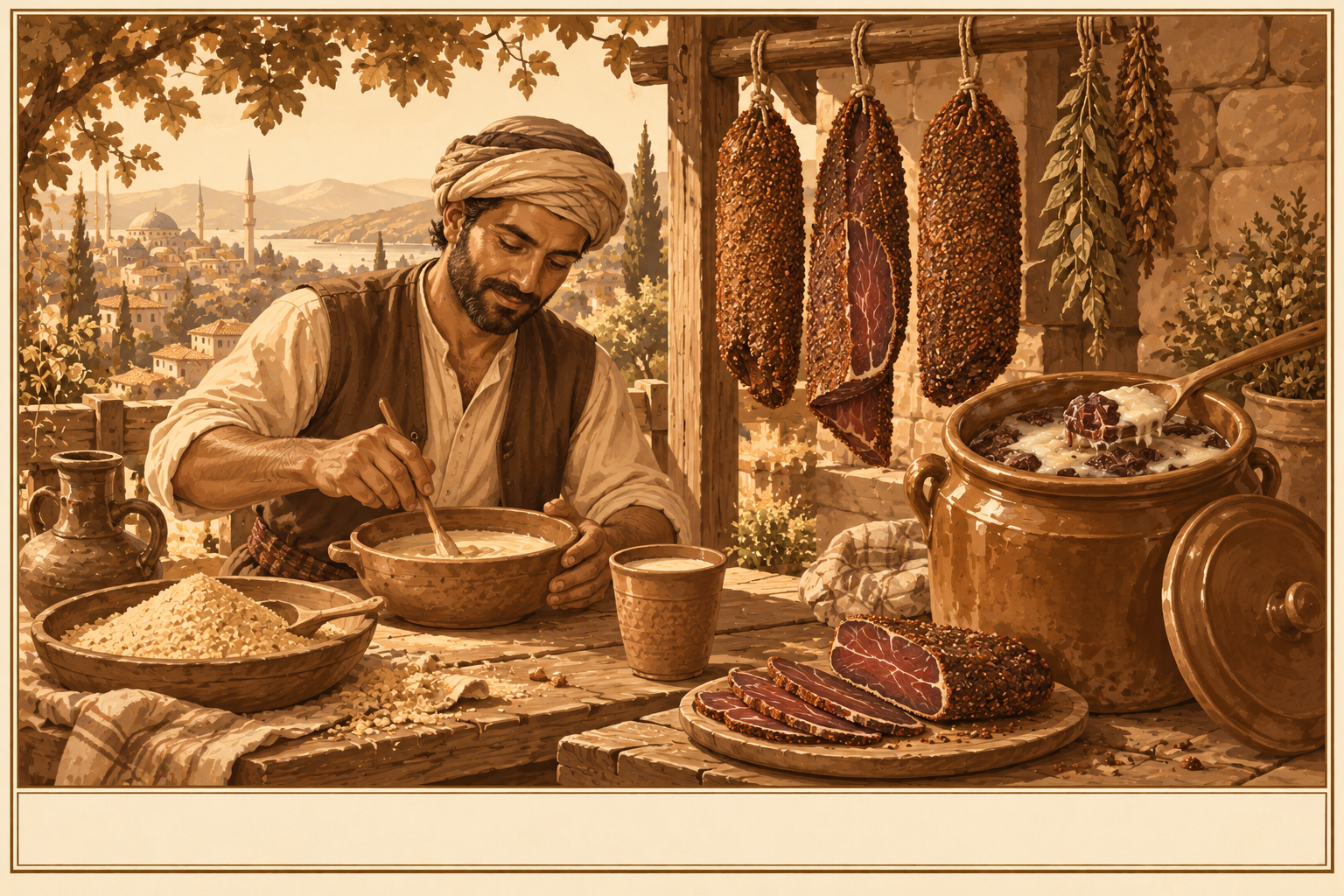
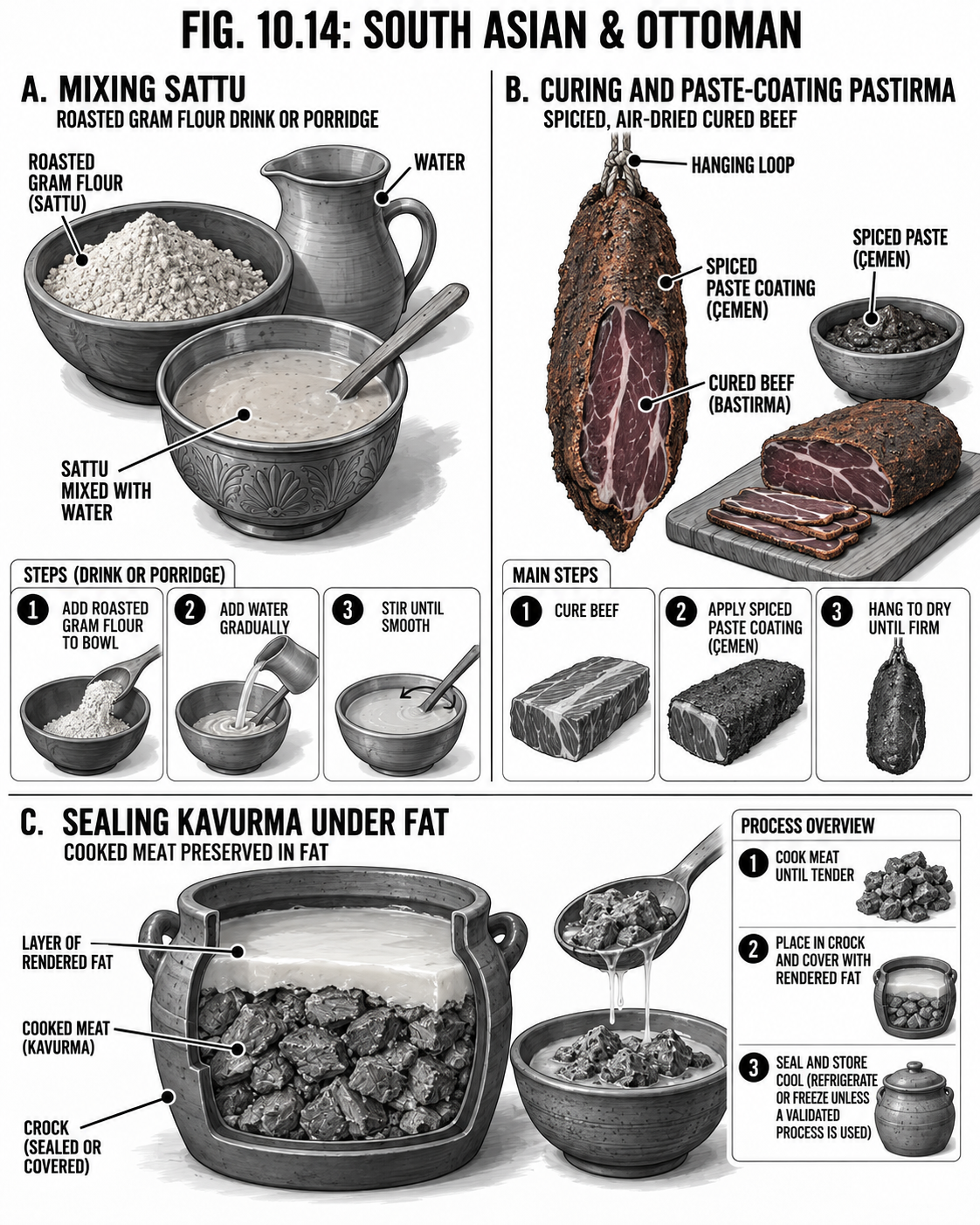
Sattu is roasted gram or barley ground to flour. Stir it into water with a little salt or sugar and you have an instant, cooling, filling energy drink that needs no fire: the marching and field food of soldiers and laborers across the subcontinent for centuries. It keeps dry for months and weighs almost nothing.
The Ottoman world: pastirma & kavurma
Pastirma is beef cured with salt, then pressed and air-dried under a thick paste of garlic, fenugreek, and paprika: a dense, spiced cured meat that slices thin and keeps without cold, a cavalry ration of the Turkic and Ottoman armies. Kavurma is meat cooked down and packed under its own rendered fat (like French confit or English potted meat); sealed by the fat, it keeps for months in a cool larder.
Safety Pastirma and kavurma are cured and fat-sealed meats: use a proper salt cure (and nitrite where a recipe calls for it), keep kavurma fully submerged under fat and cool, and toss any with mold in the paste or an off smell.
Larder · WorldThe Americas
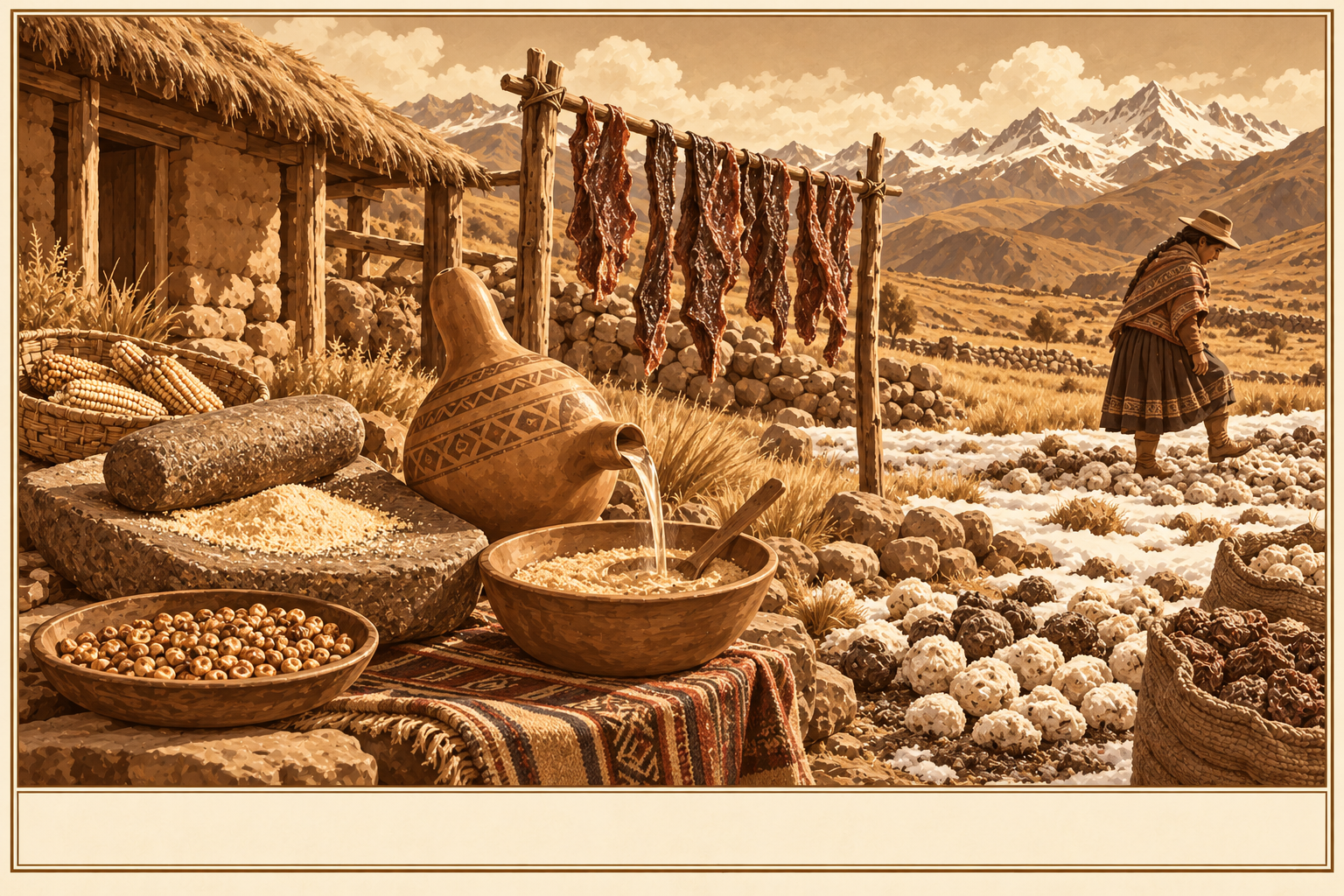
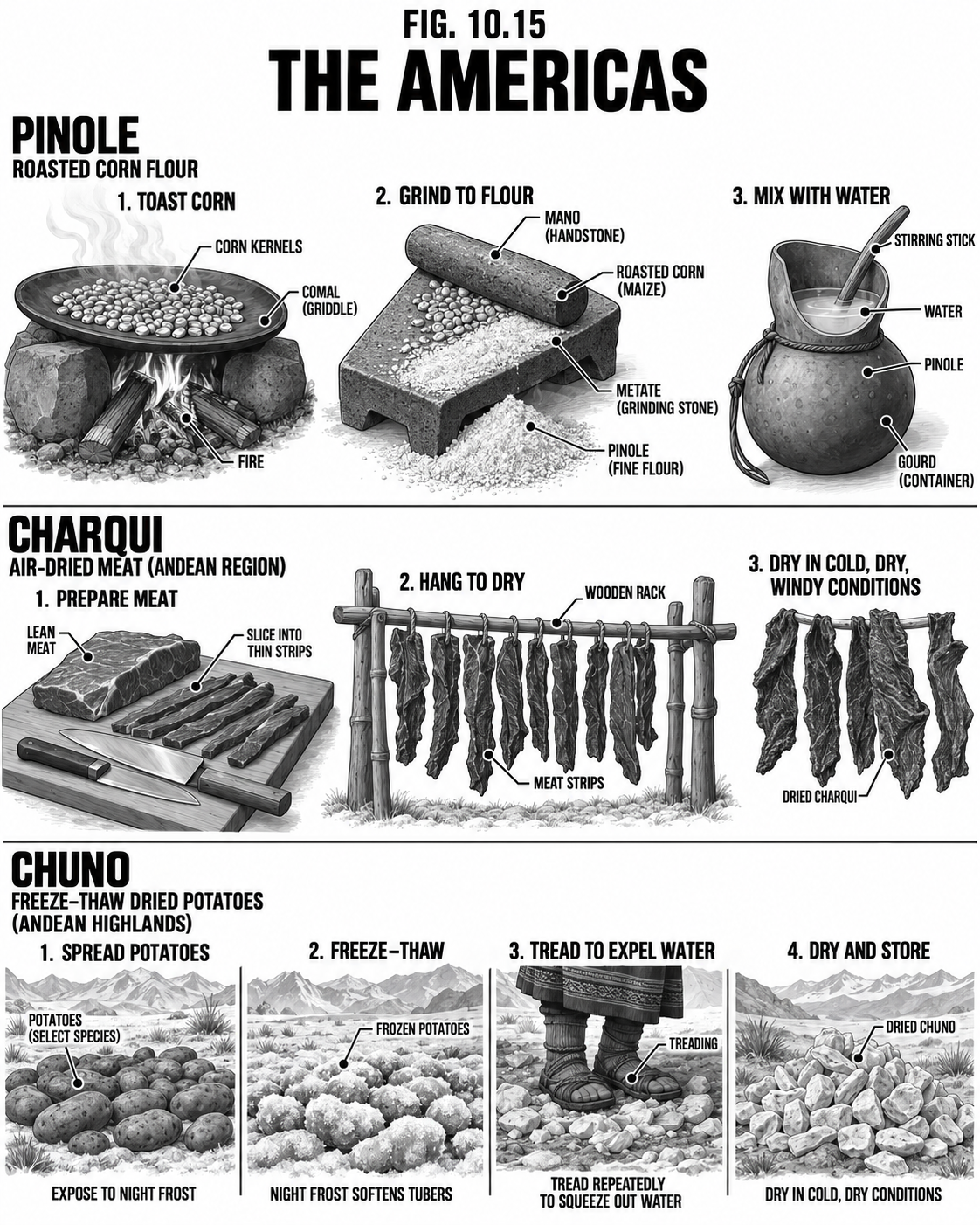
Rations of the Americas
Roasted corn you drink, the jerky that named jerky, and frost-dried potato.
DifficultyBeginner
TimeVaries
CostLow
SkillsLarder
Mexico: pinole
Pinole is maize toasted and ground to a sweet flour, often with cinnamon. Stir it into water, hot or cold, for an energy drink that has carried runners and soldiers across deserts: the Tarahumara run a hundred miles on it. Dry and light, it keeps for months.
The Andes: charqui & chuno
Charqui is sun- and wind-dried meat, the Quechua word that became "jerky," the ration that fed the Inca armies and their road runners. Chuno is potato freeze-dried the old way: left out to freeze at night and thaw and be trodden by day over a few cycles, until it is a light, rock-hard nugget that stores for years and softens back in a stew. It was the strategic grain-store of the Andes.
Tips & variations Chuno is a free trick in a hard-frost climate like yours: let cut potatoes freeze overnight, press the water out by day, repeat, and you have potato that keeps for years with no canning.
Larder · WorldThe Ration Ball
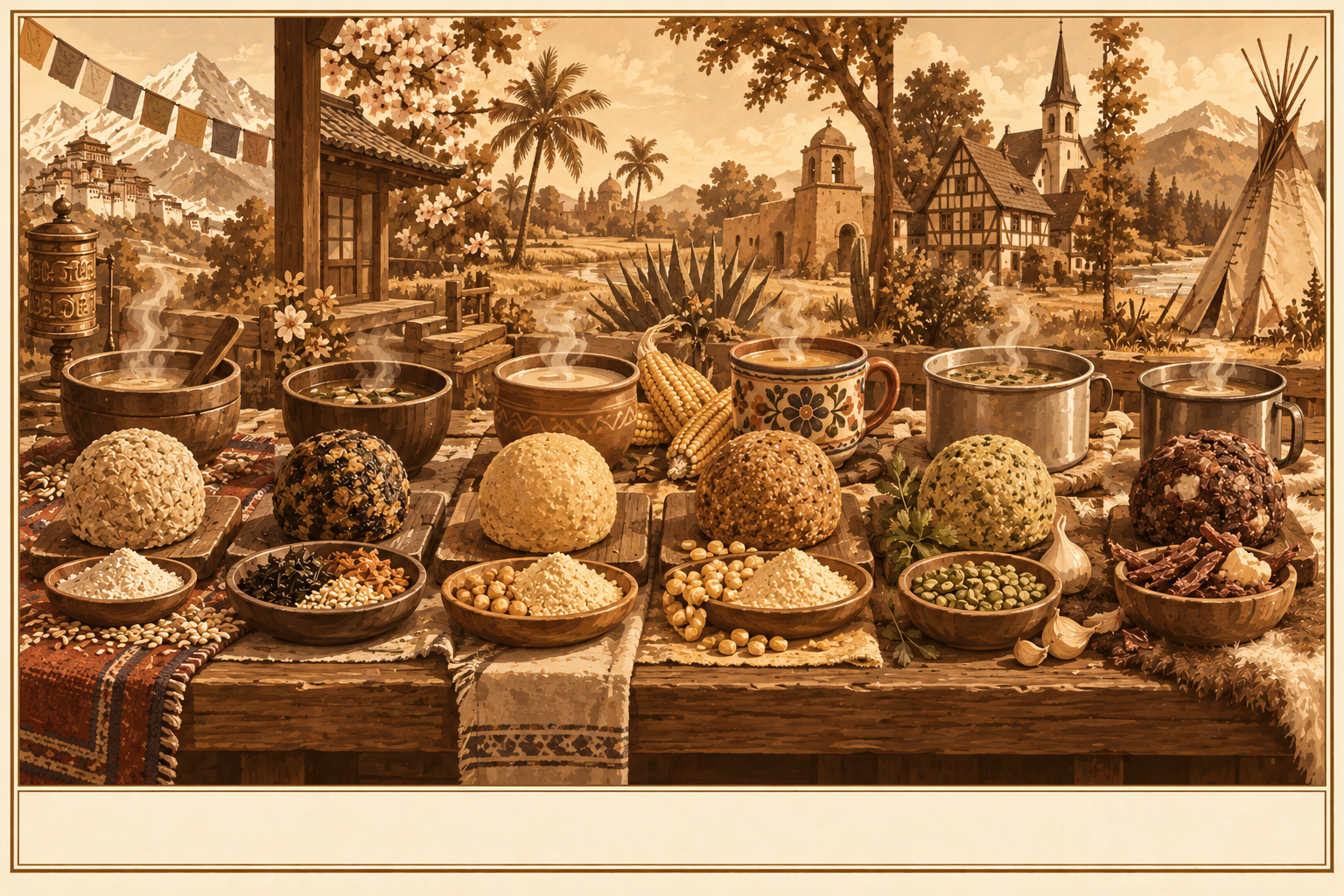
The Instant Ration Ball, the World Over
Nearly every people invented the same trick: dry it, press it, drop it in hot water.
DifficultyBeginner
TimeVaries
CostLow
SkillsLarder
Why it is worth it
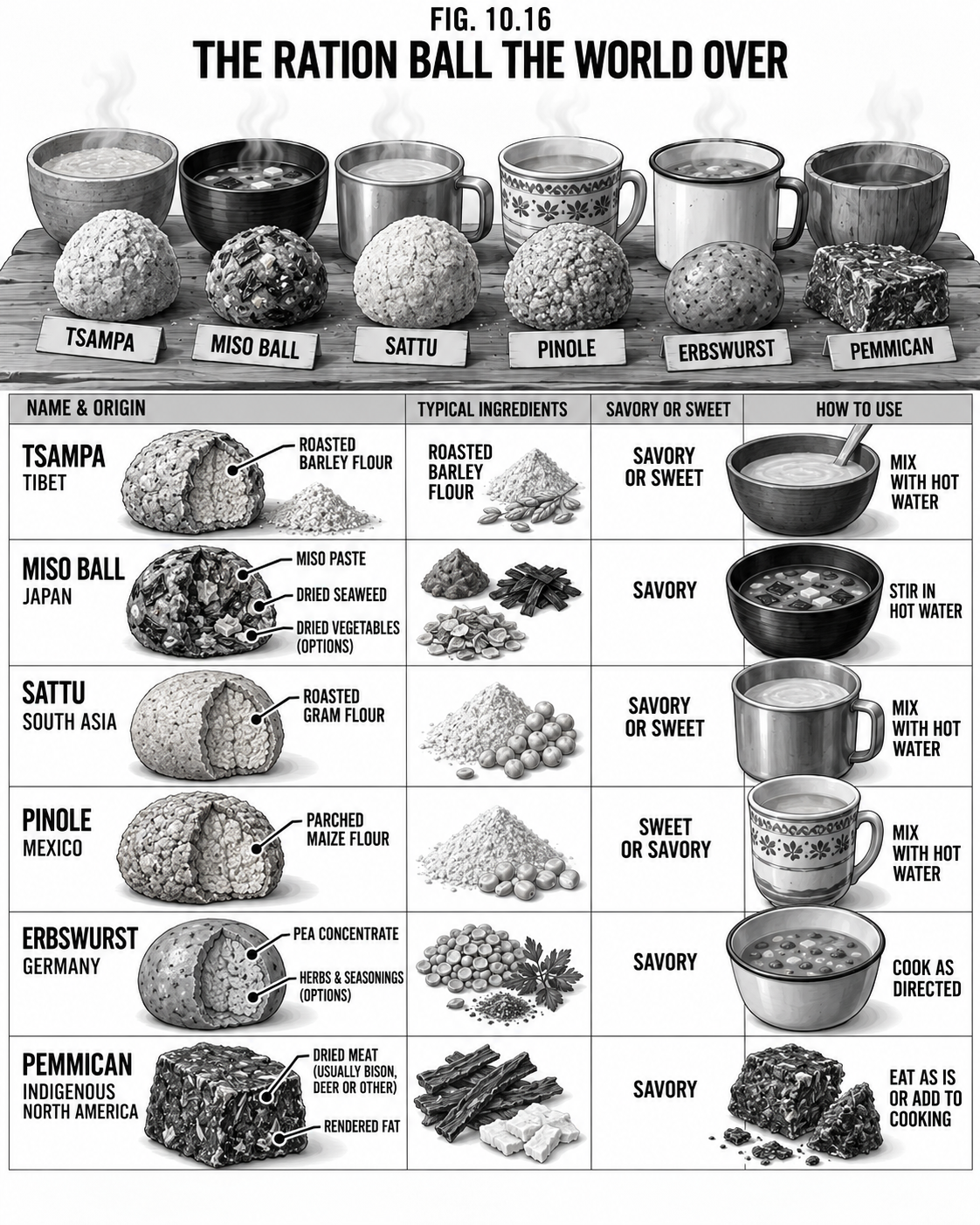
The ball or cake you dissolve in hot water is not one invention, it is the same good idea reached again and again by people who had to carry food light and far. Line them up and you have a whole menu from one principle.
The family of them
German Erbswurst: dried pea, fat, and bacon, into instant pea soup.
Japanese miso ball: miso with dried seaweed and bonito, into instant savory broth.
Mongol borts: powdered dried beef, into instant meat stock.
Indian sattu: roasted gram flour, into a cool energy drink, no fire needed.
Mexican pinole: roasted corn flour with cinnamon, into a sweet energy drink.
Tibetan tsampa: roasted barley flour kneaded with butter tea into a ball, eaten or dissolved.
Old pocket soup: stock dried to a cake, into instant broth.
Your energy ball: oats, cocoa, coffee, milk powder, and honey, into a hot energy drink.
Tips & variations The rule behind all of them: dry something to kill the water, add fat or sugar for energy and a little salt for keeping and taste, press it small, and keep it bone dry. Invent your own with whatever your land gives you.