PROPOSED CHAPTER
Bible Recipes
The oldest recipe book there is. These are the foods named in scripture, written up the way the rest of this book is: what it is, the verse it comes from, and how to actually make it on a homestead from what you grow and keep. Thousands of years old, and every one of them still feeds a family. Where a food was miraculous (manna) or forbidden, the note says so plainly.
Bible · BreadEzekiel Bread
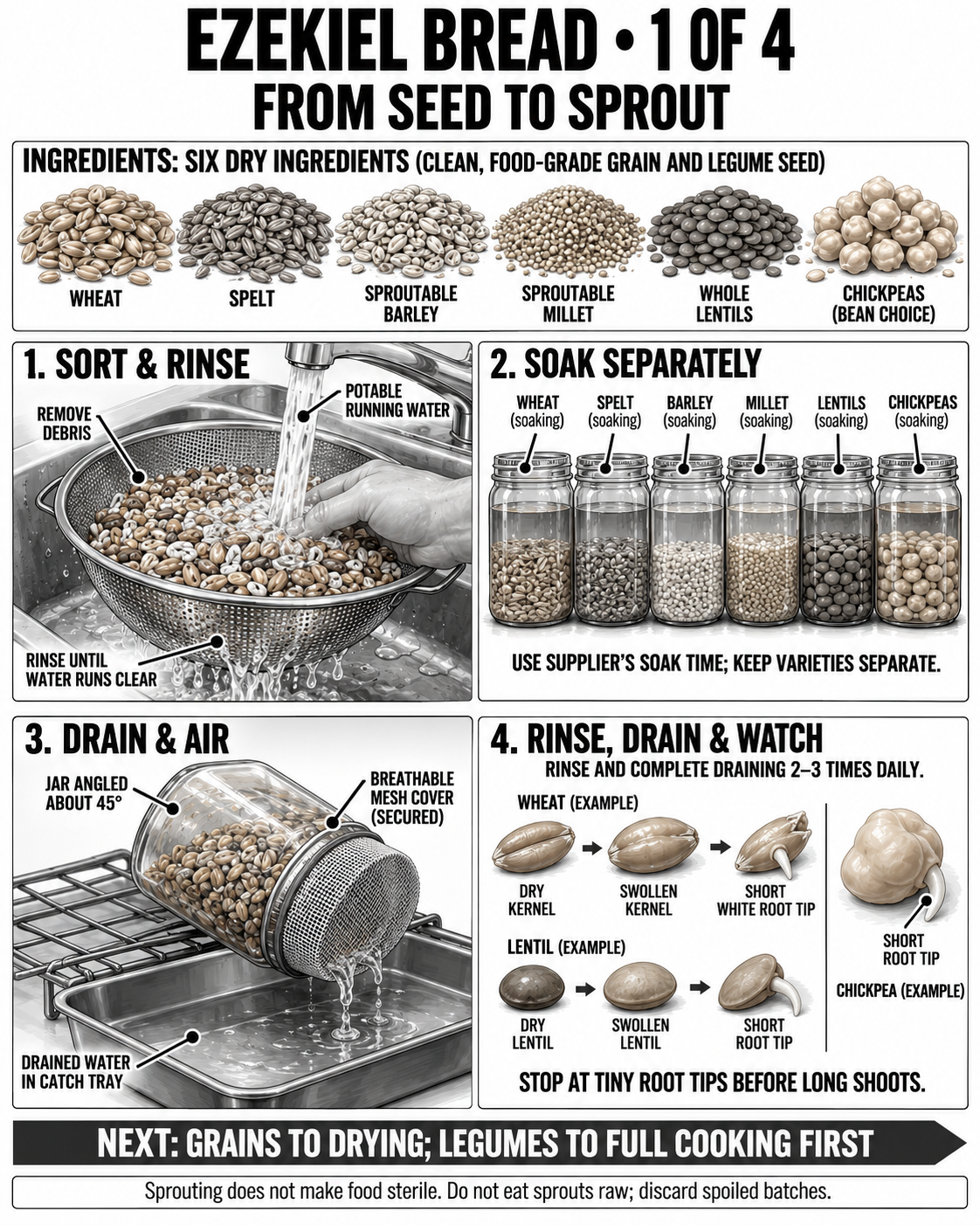
Ezekiel Bread (Sprouted Grain & Bean)
The six-ingredient bread, built from the grains and legumes a homestead stores by the sackful.
"Take thou also unto thee wheat, and barley, and beans, and lentils, and millet, and spelt, and put them in one vessel, and make bread of it." (Ezekiel 4:9)
DifficultyAdvanced
Time3 to 4 days
CostLow
SkillsSprouting, milling, baking
Why it is worth it
The verse names six things grown and stored on any homestead: wheat, barley, beans, lentils, millet, and spelt. Pairing grain with legume makes a complete protein, a full meal in a slice. The verse is an ingredient list, not a measured recipe, so what follows is a modern honest method for turning those six into real bread. (This version uses chickpeas as the bean; use whatever bean you grow.)
The method, in two streams
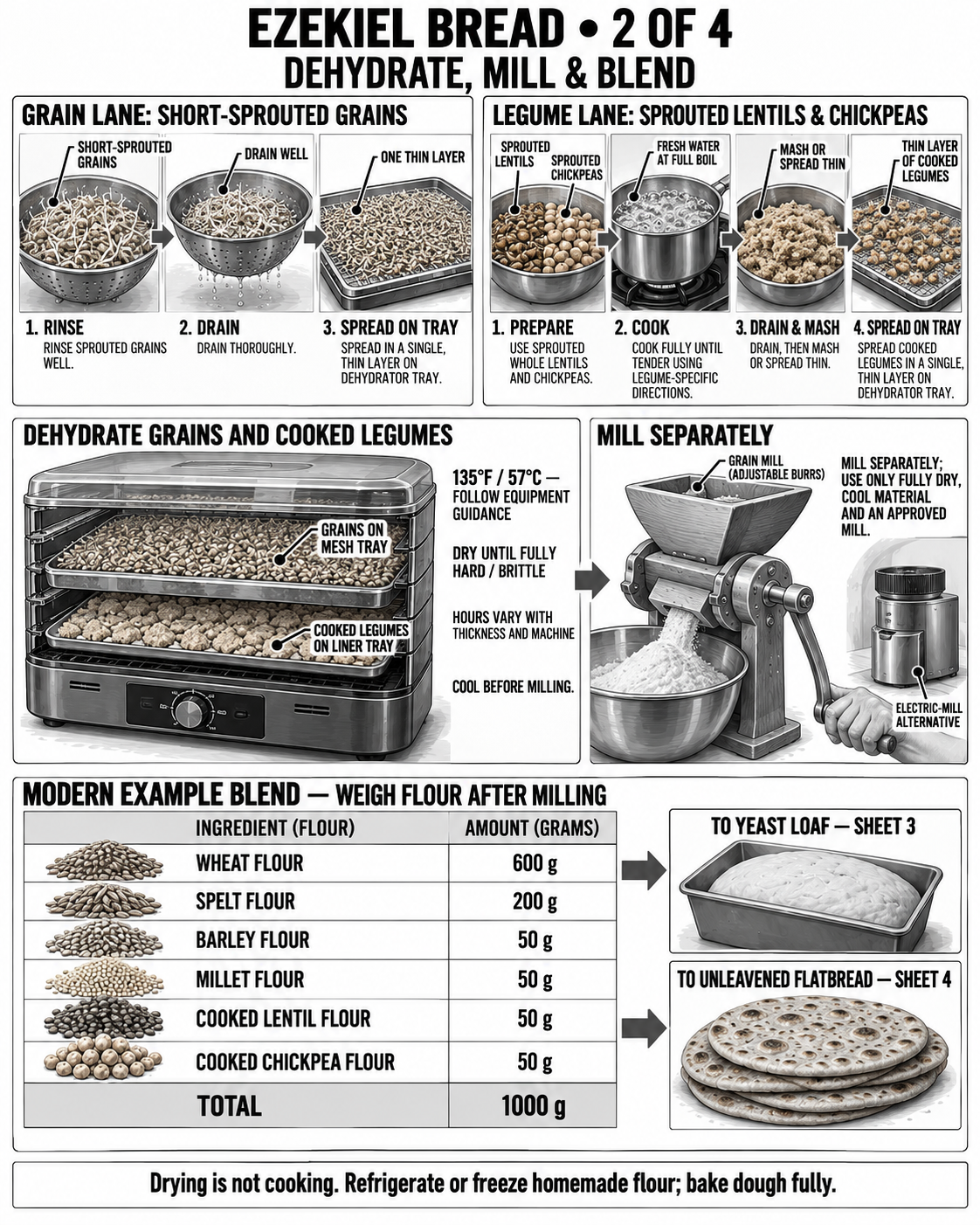
Grains and legumes are handled separately. The grains (wheat, spelt, barley, millet) are soaked and sprouted, then dried and milled to flour. The legumes (lentils, chickpeas) are soaked, then cooked all the way through in fresh water, then dried and milled. Cooking the legumes is not optional: raw and merely-sprouted beans carry lectins that can make you sick, and cooking destroys them. Blend the flours, then either raise a yeast loaf or bake a quick flatbread.
1 · Soak & sprout (separately)
2 · Cook the legumes, dry, and mill to flour
A worked example blend, weighed after drying and milling: 600 g wheat, 200 g spelt, 50 g barley, 50 g millet, 50 g cooked lentil flour, 50 g cooked chickpea flour (1000 g total). The yeast loaf below uses 500 g of this blend; the flatbread uses 250 g.
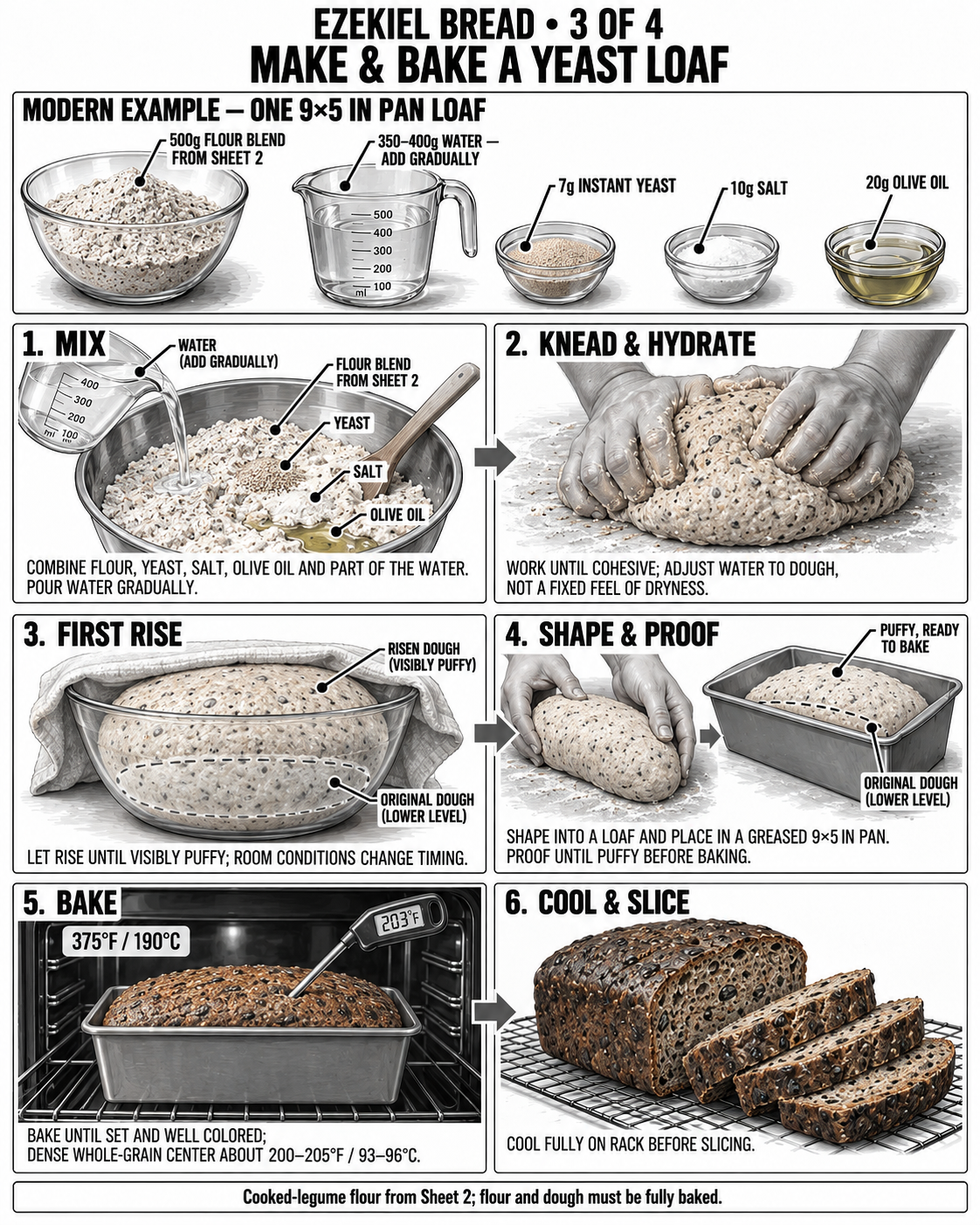
3 · Make & bake a yeast loaf
500 g flour blend, 350 to 400 g water added gradually, 7 g instant yeast, 10 g salt, 20 g olive oil. Mix, knead until cohesive, rise until puffy, shape into a greased 9x5 pan, proof, then bake at about 375 F (190 C) until the dense center reads roughly 200 to 205 F. Cool fully on a rack before slicing.
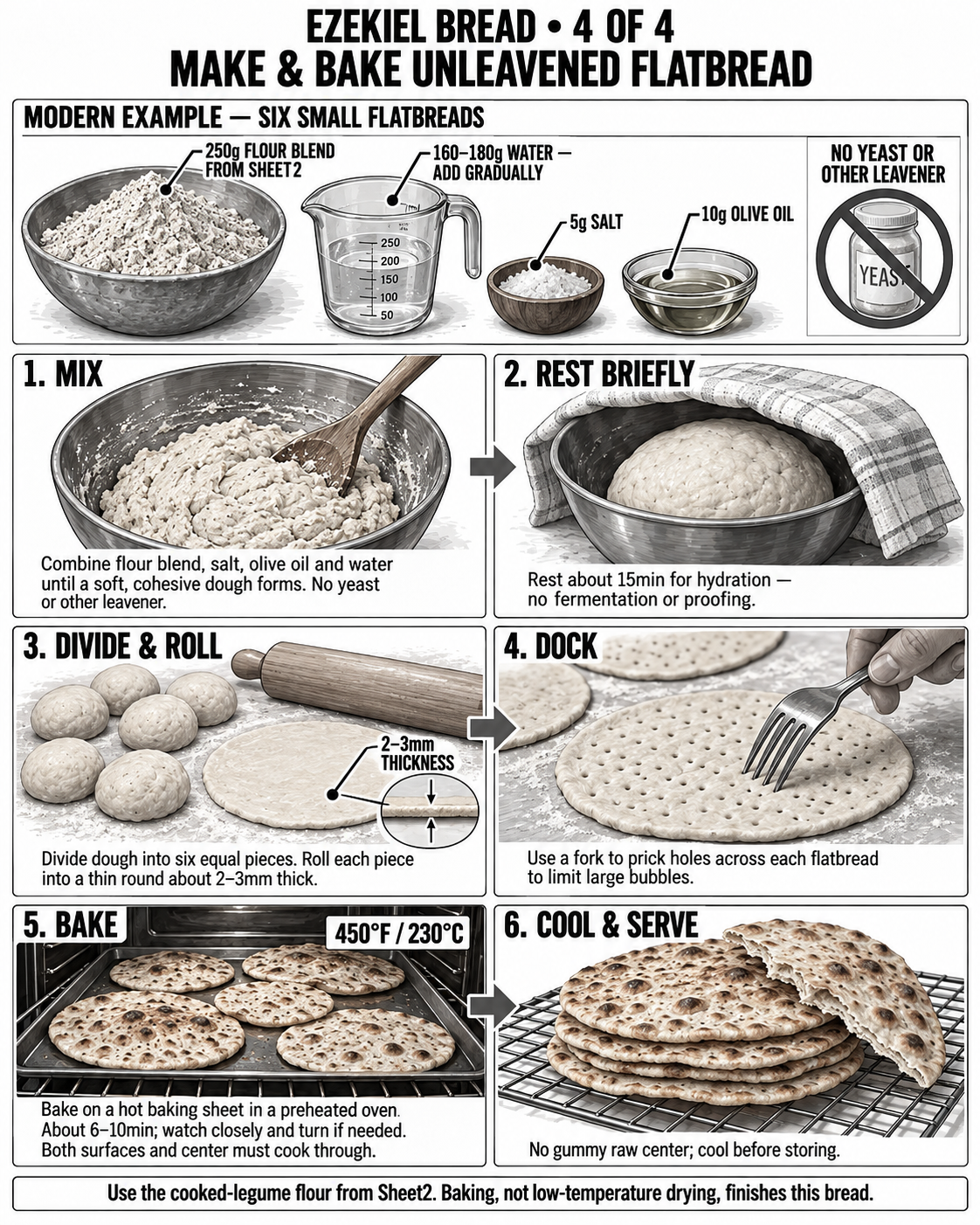
4 · Or a no-leaven flatbread
With no yeast or other leavener, mix 250 g of the blend with water (and a little oil and salt) into a stiff dough, roll thin, and bake on a hot stone or griddle. This is the plain, unleavened form.
Safety Cook the legumes fully before drying and milling (lectins). Sprouting and drying do not replace cooking, and the milled flour and both doughs still need full baking. Keep grain and legume preparation separate, keep sprouting jars clean and rinsed (sprouts sour and grow bad bacteria fast in warm, still water), and do not taste raw dough or raw flour. These dough weights are development examples, not a kitchen-tested formula, so trial-bake and adjust water to the dough before you trust exact numbers.
Bible · BreadUnleavened Bread
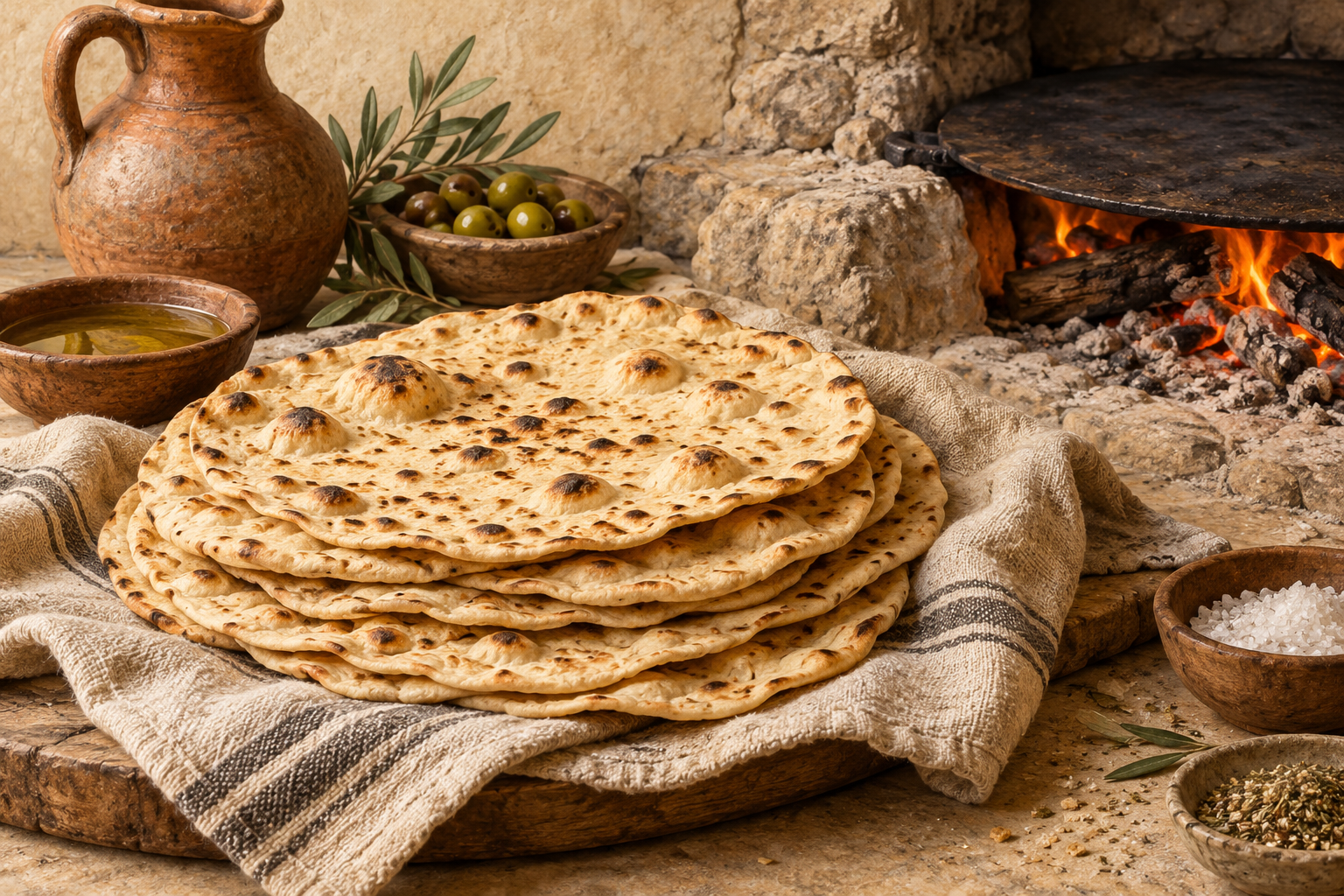
Unleavened Bread (Matzo)
Flour and water, no leaven and no waiting: the bread of the Exodus.
"They baked unleavened cakes of the dough... because they were thrust out of Egypt, and could not tarry." (Exodus 12:39)
DifficultyBeginner
TimeUnder an hour
CostLow
SkillsBaking
Why it is worth it
The simplest bread there is: no yeast, no rise, nothing to keep alive. When you have no leaven, or no time, flour and water on a hot stone still feeds you. It is the Passover bread and the plainest trail bread at once.
Step by step
- Mix flour with a little water and a pinch of salt into a stiff dough; work it fast.
- Roll thin and prick all over so it does not puff.
- Bake on a hot stone, griddle, or in a hot oven just a few minutes a side until dry and blistered.
- Eat fresh, or dry it hard to keep like hardtack.
[ Fig: mix, roll thin, prick, bake on a hot stone ]
Tips True Passover matzo is made start to finish in under eighteen minutes so no wild yeast can start it rising.
Bible · BreadBarley Loaves
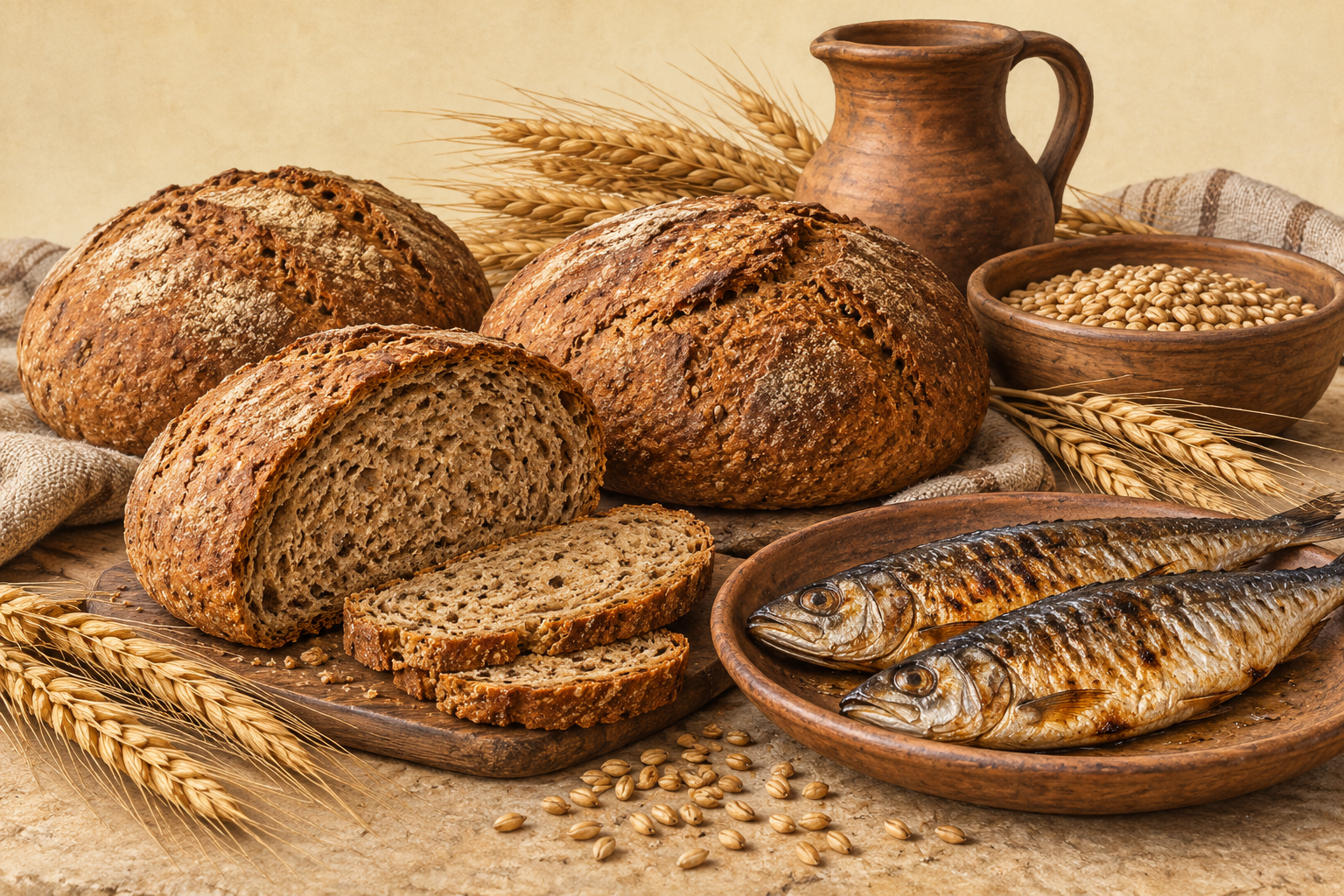
Barley Bread
The poor man's loaf that fed the five thousand.
"There is a lad here, which hath five barley loaves, and two small fishes." (John 6:9)
DifficultyBeginner
TimeHours
CostLow
SkillsBaking
Why it is worth it
Barley grows where wheat will not and was the everyday bread of the poor. It bakes into a denser, darker, nuttier loaf. For a homestead it is a hardy backup grain that keeps you in bread through a bad wheat year.
Step by step
- Mix barley flour (alone, or part wheat for a lighter loaf) with water, salt, and leaven.
- Knead, let rise (barley rises little on its own, so sourdough or a wheat blend helps), shape round.
- Bake hot until the crust is firm and hollow-sounding.
[ Fig: barley flour, mix, rise, shape, bake; a wheat-blend note for a lighter loaf ]
Tips All-barley bread is flat and dense by nature; blend in wheat or spelt if you want more rise.
Bible · PottageRed Lentil Stew
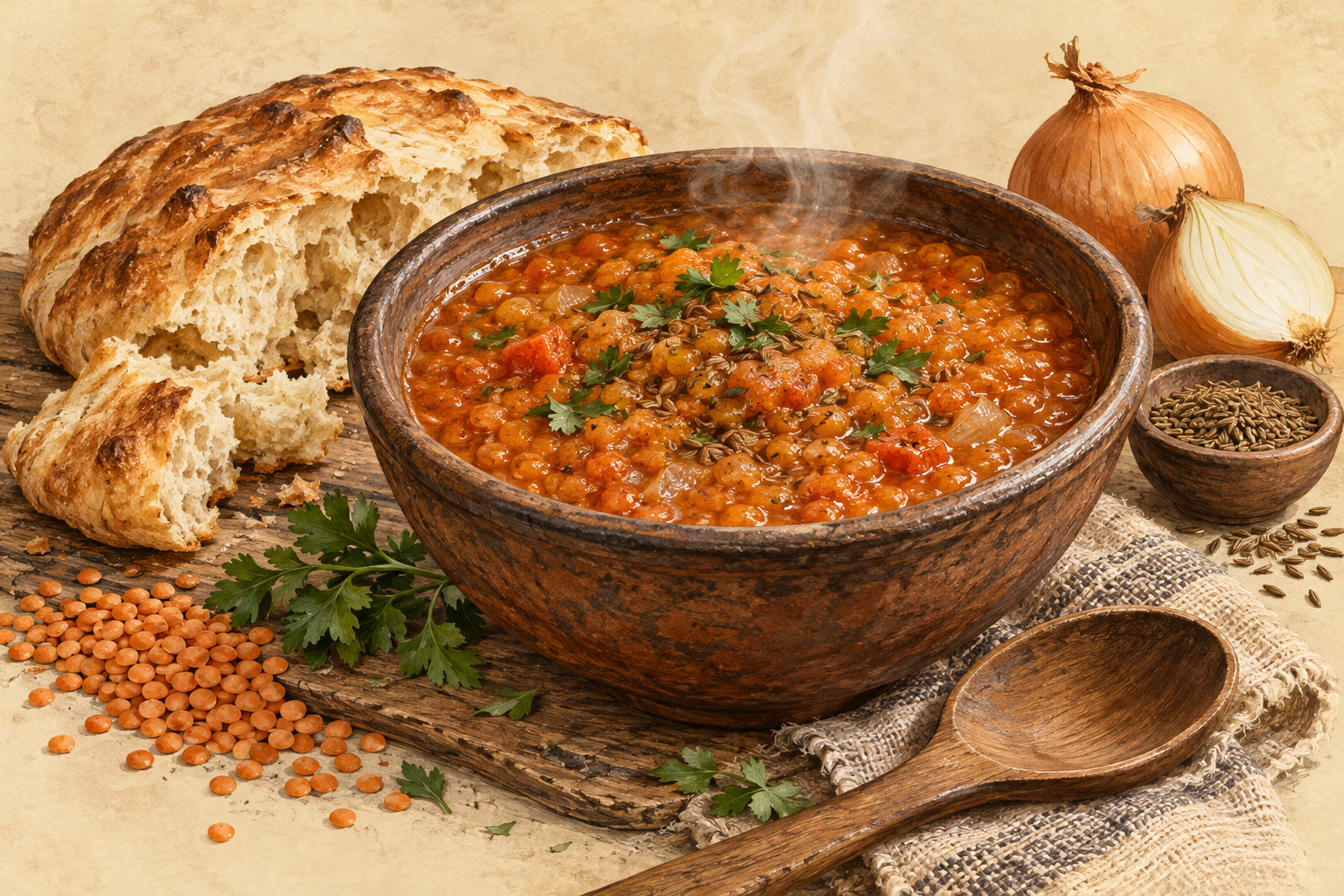
Esau's Red Lentil Stew (Pottage)
The bowl of stew a man once sold his birthright for.
"Jacob gave Esau bread and pottage of lentils... and he did eat and drink." (Genesis 25:34)
DifficultyBeginner
TimeAn hour
CostLow
SkillsCooking
Why it is worth it
Red lentils cook down fast into a thick, filling, protein-rich stew with nothing but water, salt, and whatever onion, garlic, cumin, and oil you have. It is the cheapest hot meal on the place and it kept the ancient world fed.
Step by step
- Rinse red lentils; simmer in plenty of water until they fall apart (20 to 30 minutes).
- Fry an onion (and garlic, cumin) in oil and stir it in; salt to taste.
- Cook down to a thick pottage; serve with bread to scoop it.
[ Fig: rinse, simmer lentils, fry aromatics, combine, serve with bread ]
Tips A splash of vinegar or a squeeze of lemon at the end lifts the whole bowl.
Bible · GrainParched Grain
Parched Grain
Roasted grain by the handful: the field lunch of the harvest.
"Eat of the bread, and dip thy morsel in the vinegar. And she ... did eat ... and he reached her parched corn." (Ruth 2:14)
[ Plate: a pan of toasted golden grain, some in a cloth for the field ]
DifficultyBeginner
TimeMinutes
CostLow
SkillsBasic
Why it is worth it
Fresh grain dry-roasted in a pan puffs, browns, and turns nutty, ready to eat by the handful with no grinding and no baking. It kept for the road and fed the reapers in the field. The simplest way there is to eat your wheat or barley.
Step by step
- Dry-roast threshed grain in a hot pan, shaking, until it puffs and browns.
- Salt it; eat warm by the handful, or carry it in a pouch.
- Soften old parched grain in water, broth, or (as Ruth did) with a little vinegar.
[ Fig: thresh, dry-roast in a pan, salt, pouch for the field ]
Tips This is the same trick as the Old Ways parched corn; it works for wheat, barley, and corn alike.
Bible · FruitFig Cakes
Pressed Fig Cakes (Debelah)
Dried figs pressed into a cake that travels and keeps for months.
"[Abigail] took ... two hundred cakes of figs, and laid them on asses." (1 Samuel 25:18)
[ Plate: round pressed cakes of dried figs, one cut to show the dense fruit ]
DifficultyBeginner
TimeDrying days
CostLow
SkillsPreserving
Why it is worth it
Ripe figs dried hard and pressed into a dense cake carry sweet energy by the saddlebag, and were money, gift, and ration all at once. (The same fig cake, mashed, was the poultice that healed King Hezekiah's boil.)
Step by step
- Dry ripe figs in the sun or a low oven until leathery.
- Chop or mash and press hard into a mold or a round, binding with their own stickiness.
- Dry the cake further, then wrap. Slice off pieces as needed.
[ Fig: dry figs, mash, press into a cake, wrap and store cool ]
Safety Dry the figs by a tested method first. A moist homemade pressed cake is best kept refrigerated or frozen rather than trusted for a year at room temperature.
Bible · FruitRaisin Cakes
Pressed Raisin Cakes
Dried grapes pressed into sweet cakes of pure energy.
"He dealt ... to every one a loaf of bread, and a good piece of flesh, and a flagon of wine [a cake of raisins]." (2 Samuel 6:19)
[ Plate: dark pressed raisin cakes beside a cluster of drying grapes ]
DifficultyBeginner
TimeDrying days
CostLow
SkillsPreserving
Why it is worth it
Grapes dried to raisins and pressed into cakes were handed out at feasts and carried as marching food (David fed a whole crowd with them). Pure, keeping sweetness from your own vines.
Step by step
- Dry grapes to raisins in the sun.
- Press them hard into cakes; they bind with their own sugar.
- Dry a little more and wrap for storage.
[ Fig: dry grapes to raisins, press into cakes, store ]
Tips Seedless grapes make a smoother cake; otherwise press and the seeds stay put.
Bible · DairyCurds & Honey
Curds & Honey (and Leben)
Soured milk set to soft curd, eaten with wild honey.
"Butter and honey shall he eat." (Isaiah 7:15) "[Abraham] took butter, and milk ... and set it before them." (Genesis 18:8)
[ Plate: a bowl of soft white curds drizzled with honey, a skin bag of soured milk behind ]
DifficultyBeginner
TimeA day
CostLow
SkillsDairy
Why it is worth it
Before refrigeration, milk was kept by souring it. Leben (soured, cultured milk) and the soft curds strained from it were a daily food, and sweetened with honey they were a treat set before honored guests. It is the simplest dairy a homestead makes (see the Larder cheese pages).
Step by step
- Warm pasteurized milk and stir in a defined culture (a spoon of live cultured milk or a packaged starter), holding the temperature the culture calls for until it sets.
- Strain the curds in clean cloth, chilled, to the thickness you like.
- Salt for savory, or spoon with honey for sweet.
[ Fig: warm pasteurized milk, add culture, set, strain cold, serve savory or with honey ]
Safety Use pasteurized milk and a known culture, follow its time and temperature, and strain and store the curds cold. Do not let raw milk just sit and sour warm. Do not give honey to a child under one year (infant botulism).
Bible · MeatPassover Lamb
Roast Lamb with Bitter Herbs
Whole lamb roasted over fire, with unleavened bread and bitter greens.
"They shall eat the flesh ... roast with fire, and unleavened bread; and with bitter herbs they shall eat it." (Exodus 12:8)
[ Plate: a lamb roasting on a spit over coals, flatbread and bitter greens beside ]
DifficultyIntermediate
TimeHours
CostMed
SkillsButchery, fire
Why it is worth it
The Passover meal, and the oldest way to cook meat: a whole young animal roasted over an open fire, not boiled, eaten with flatbread and sharp bitter greens that cut the fat. For a homestead it is how you feast a crowd from one animal (see Hunting and Food for the butchery).
Step by step
- Dress a young lamb or kid; season simply with salt (and herbs if you have them).
- Spit it whole, or joint it, and roast slowly over coals, turning, until done.
- Serve with unleavened bread and bitter herbs (see below).
[ Fig: spit and roast over coals, turn, thermometer to 145 F plus rest; plate with bread and greens ]
Safety Cook whole cuts to at least 145 F (63 C) and let them rest three minutes, checking several thick spots; ground meat to 160 F. Scripture also forbids boiling a kid in its mother's milk (Exodus 23:19), the root of keeping meat and dairy apart; whatever your reason, do not stew meat in milk from the same animal.
Bible · MeatRoast Quail
Roast Quail
The small birds that fell on the camp in the wilderness.
"At even the quails came up, and covered the camp." (Exodus 16:13)
[ Plate: small quail roasting on sticks over a low fire ]
DifficultyBeginner
TimeUnder an hour
CostLow
SkillsGame
Why it is worth it
Quail and other small game birds dress out fast and roast in minutes over coals, a quick meal of real meat (see Hunting for snaring and dressing birds).
Step by step
- Pluck or skin and gut the birds (do not rinse raw poultry, which just spreads germs).
- Salt, skewer, and roast over coals, turning, until done.
- Eat hot off the stick.
[ Fig: dress the bird, skewer, roast over coals, thermometer to 165 F ]
Safety Cook poultry to an internal 165 F (74 C) checked with a thermometer, not by the look of the juices. Know your bird-hunting seasons and licenses (see Hunting).
Bible · FishBroiled Fish
Broiled Fish & Honeycomb
Fish grilled on the coals by the shore, the breakfast on the beach.
"They gave him a piece of a broiled fish, and of an honeycomb." (Luke 24:42) "A fire of coals ... and fish laid thereon, and bread." (John 21:9)
[ Plate: whole fish on a bed of coals, bread and a piece of honeycomb beside ]
DifficultyBeginner
TimeMinutes
CostLow
SkillsFire, fish
Why it is worth it
A fresh-caught fish laid on the coals is the oldest cooked meal by the water, and the one the risen Christ ate and served. Nothing but fire and fish, with bread and a little honey (see the Old Ways and Hunting for catching and dressing fish).
Step by step
- Gut and scale the fish; leave it whole or split it open.
- Lay it on hot coals or a grate, or skewer it by the fire; turn once.
- Cook until it flakes and reads 145 F; eat with bread, and honeycomb for sweet.
[ Fig: gut, split, grill on coals, thermometer to 145 F; serve with bread and honey ]
Safety Cook fish to an internal 145 F (63 C), and know your waters are clean (see Water).
Bible · WildLocusts & Honey
Locusts & Wild Honey
The wilderness ration of John the Baptist: roasted insects and comb honey.
"His meat was locusts and wild honey." (Matthew 3:4) "The locust ... ye may eat." (Leviticus 11:22)
[ Plate: roasted locusts in a bowl beside a dripping piece of wild honeycomb ]
DifficultyBeginner
TimeMinutes
CostFree
SkillsForaging
Why it is worth it
Locusts and grasshoppers are honest protein that scripture lists as clean food, and wild honey is pure energy. Together they kept a man alive in the desert. For a homestead, insects are a free protein in a lean year (see the Old Ways on eating insects).
Step by step
- Catch grasshoppers or locusts in the cool of morning; remove wings and legs.
- Roast them dry in a hot pan or over the fire until crisp; salt them.
- Eat as is, or grind to a protein meal; pair with honey cut from a wild comb.
[ Fig: catch, de-wing, dry-roast, salt; cutting comb honey ]
Safety Be sure what you are eating: positively identify the insect, since unknown wild insects are not automatically safe, and people with a shellfish allergy can react to them. Harvest only from land free of pesticides and roast them thoroughly. Take wild honey carefully (bees and height); do not give honey to a child under one.
Bible · OilOlive Oil
Pressed Olive Oil
Crush and press the olive for oil to cook, light, and anoint.
"Pure oil olive beaten for the light, to cause the lamp to burn always." (Exodus 27:20)
[ Plate: olives crushed in a stone basin, golden oil running into a jar, a burning oil lamp ]
DifficultyIntermediate
TimeA day
CostLow
SkillsPressing
Why it is worth it
Olive oil was cooking fat, lamp fuel, soap, medicine, and holy anointing all in one. If you can grow olives, pressing your own oil gives you the most useful liquid on the place. The first cold-pressed ("beaten") oil is the finest.
Step by step
- Crush ripe olives, pits and all, to a paste (a stone basin and roller, or a sturdy mortar).
- Spread the paste in mats or a cloth and press hard; the oil and watery juice run out together.
- Let it settle, then skim or decant the oil off the top of the water.
- Store in a cool, dark jar.
[ Fig: crush to paste, press, settle, decant oil off the water ]
Tips The very first light press is the "virgin" oil; later pressings give coarser oil good for soap and lamps.
Bible · VineWine & Vinegar
New Wine, Wine & Vinegar (Posca)
From the grape: sweet must, wine, and the sour wine soldiers drank.
"Dip thy morsel in the vinegar." (Ruth 2:14) "They filled a sponge with vinegar ... and gave him to drink." (John 19:29)
[ Plate: a treading vat of grapes, a jar of wine, and a cup of watered sour wine ]
DifficultyIntermediate
TimeWeeks+
CostLow
SkillsFermenting
Why it is worth it
Grapes give you three keeping drinks from one harvest: the fresh sweet juice (must or "new wine"), fermented wine, and when wine sours, vinegar. Vinegar watered down (posca) was the cheap, safe, thirst-quenching drink of workers and soldiers, and a preservative for the larder.
Step by step
- Tread or crush ripe grapes; strain the juice (new wine) for drinking fresh.
- To make wine, ferment the juice under an airlock until a hydrometer shows it is finished (stopped bubbles alone are not proof); rack it clear and age it.
- To make vinegar, let finished wine stand with a vinegar "mother," covered with a cloth that lets air in but keeps insects out, until it turns sour.
- Posca: cut vinegar with water, a little honey and herbs, for a field drink.
[ Fig: tread grapes, ferment to wine (hydrometer), sour to vinegar under a cloth, mix posca ]
Safety Ferment in clean vessels. Homemade vinegar is not a reliable strength for canning, and watered vinegar does NOT make unsafe water safe to drink. Alcohol is for adults; know your local laws on making it.
Bible · HerbsBitter Herbs & Spices
Bitter Herbs, Mint, Dill & Cumin
The sharp greens of the Passover and the kitchen herbs of scripture.
"Ye pay tithe of mint and anise [dill] and cummin." (Matthew 23:23) "With bitter herbs they shall eat it." (Exodus 12:8)
[ Plate: bundles of bitter greens, mint, dill, and a dish of cumin seed ]
DifficultyBeginner
TimeGarden
CostLow
SkillsGrowing
Why it is worth it
The bitter herbs of Passover (lettuces, endive, dandelion, horseradish and the like) cut rich meat and clean the palate, and the kitchen herbs (mint, dill, cumin, coriander, anise) flavor and preserve. All grow easily in a homestead garden (see Food) and dry for the year.
Step by step
- Grow and cut bitter greens fresh to eat alongside roast meat.
- Grow mint, dill, coriander, cumin, and anise; cut herbs fresh or dry them.
- Let dill, coriander, cumin, and anise flower and set seed; dry and store the seed as spice.
[ Fig: the herb garden labeled, fresh use vs drying leaf vs saving seed ]
Tips Horseradish root, grated, is the sharpest of the bitter herbs and keeps all winter in the ground.
Bible · The LandSeven Species
The Seven Species of the Land
The seven foods the land was blessed with, and how to keep each.
"A land of wheat, and barley, and vines, and fig trees, and pomegranates; a land of oil olive, and honey." (Deuteronomy 8:8)
[ Plate: an arranged still life of wheat, barley, grapes, figs, pomegranates, olives, and dates with a jar of date syrup ]
DifficultyBeginner
TimeSeasons
CostLow
SkillsGrowing, preserving
Why it is worth it
These seven together are nearly a whole diet, and each one keeps: grain stores dry, grapes become raisins and wine, figs press into cakes, pomegranates hold for months, olives give oil, and dates dry or boil down to date honey. (The "honey" of the verse is traditionally understood as date honey, not bee honey, so the seventh species is the date.) Grow and put up the seven and your larder is covered.
Keeping the seven
- Wheat & barley: thresh, dry, and store sealed (see Food, Storage).
- Grapes: raisins and wine (above).
- Figs: pressed cakes (above).
- Pomegranates: keep cool and dry whole for months; dry the seeds (arils).
- Olives: cure in brine to eat, or press for oil (above).
- Dates: dry them whole, or boil them down to date honey (silan); both keep well.
[ Fig: the seven species, each with its keeping method labeled ]
Tips Raw olives off the tree are bitter and all but inedible; they must be cured in brine or lye first, like leaching acorns.
Bible · NoteManna
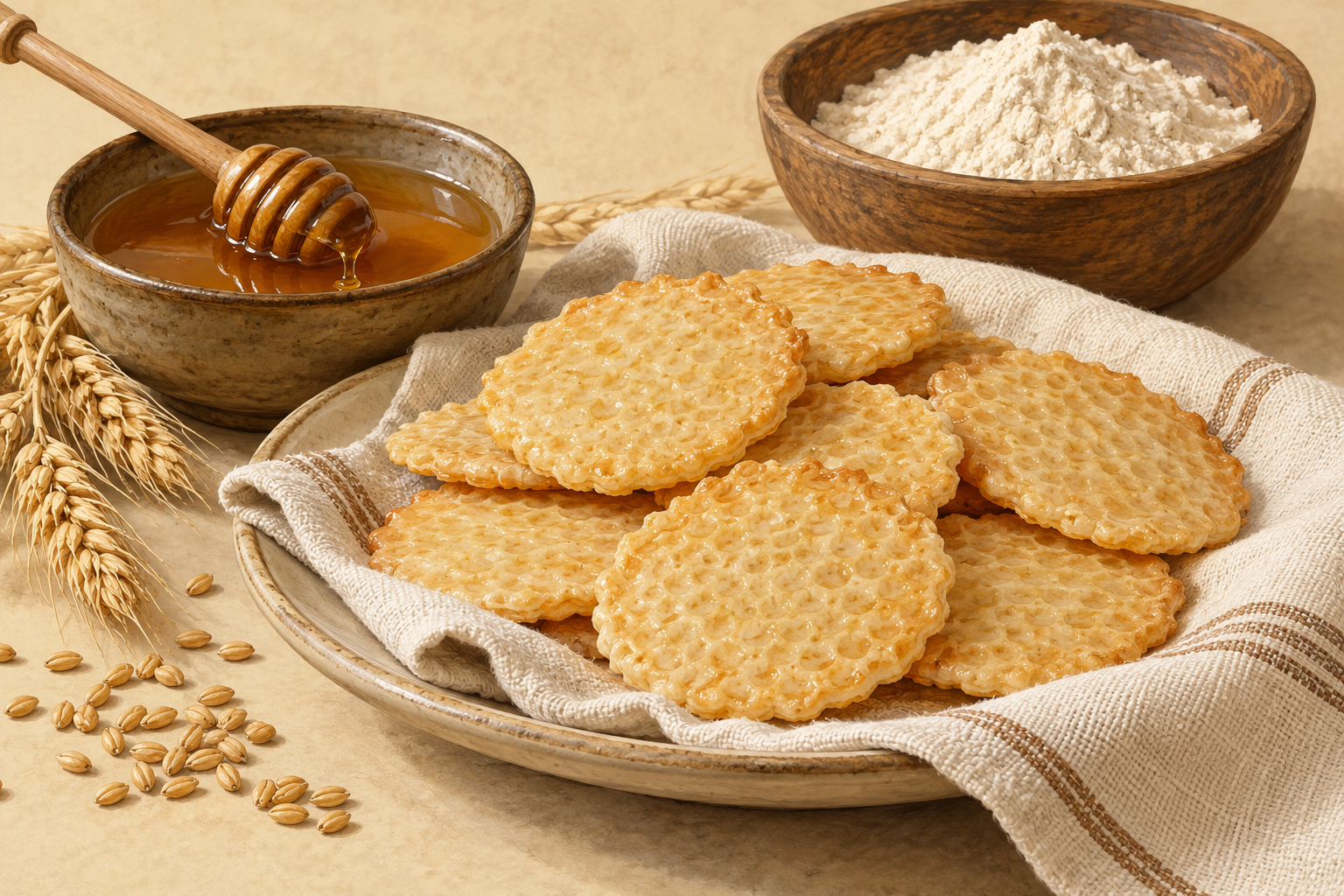
Manna (the closest you can make)
The bread from heaven: miraculous, but here is its taste.
"It was like coriander seed, white; and the taste of it was like wafers made with honey." (Exodus 16:31)
DifficultyBeginner
TimeUnder an hour
CostLow
SkillsBaking
Why it is worth it
Manna itself was a daily miracle, not a recipe, and it could not be stored (it bred worms overnight). But scripture tells us its taste, so you can make a honey wafer that eats like it is said to have: pale, light, and honey-sweet.
Step by step
- Make a thin batter of fine flour, a little honey, and water (a touch of oil keeps it tender).
- Drop small rounds on a hot greased stone or pan; cook through, thin and pale, not browned.
- Eat the day you make them. Do not dust with raw flour to whiten them (raw flour is not safe to eat).
[ Fig: thin honey batter, small rounds on a hot stone, cooked pale ]
Tips This is a taste-of-scripture novelty, not a keeper. Honey is not for children under one.
End of draft. Add, cut, or reorder anything. On your word I will finish the art list, convert it to PHP, and publish it as its own chapter (or fold it into the Larder).