The Machines
Bitcoin mining uses one special kind of machine. Buying the wrong thing is the most common beginner money-waster, so this page is short and clear.
Think of it like this: A regular computer is a Swiss Army knife, decent at everything. A Bitcoin miner is a single giant can-opener, useless at everything except opening cans, but it opens them a million times faster. That one job is making Bitcoin guesses.
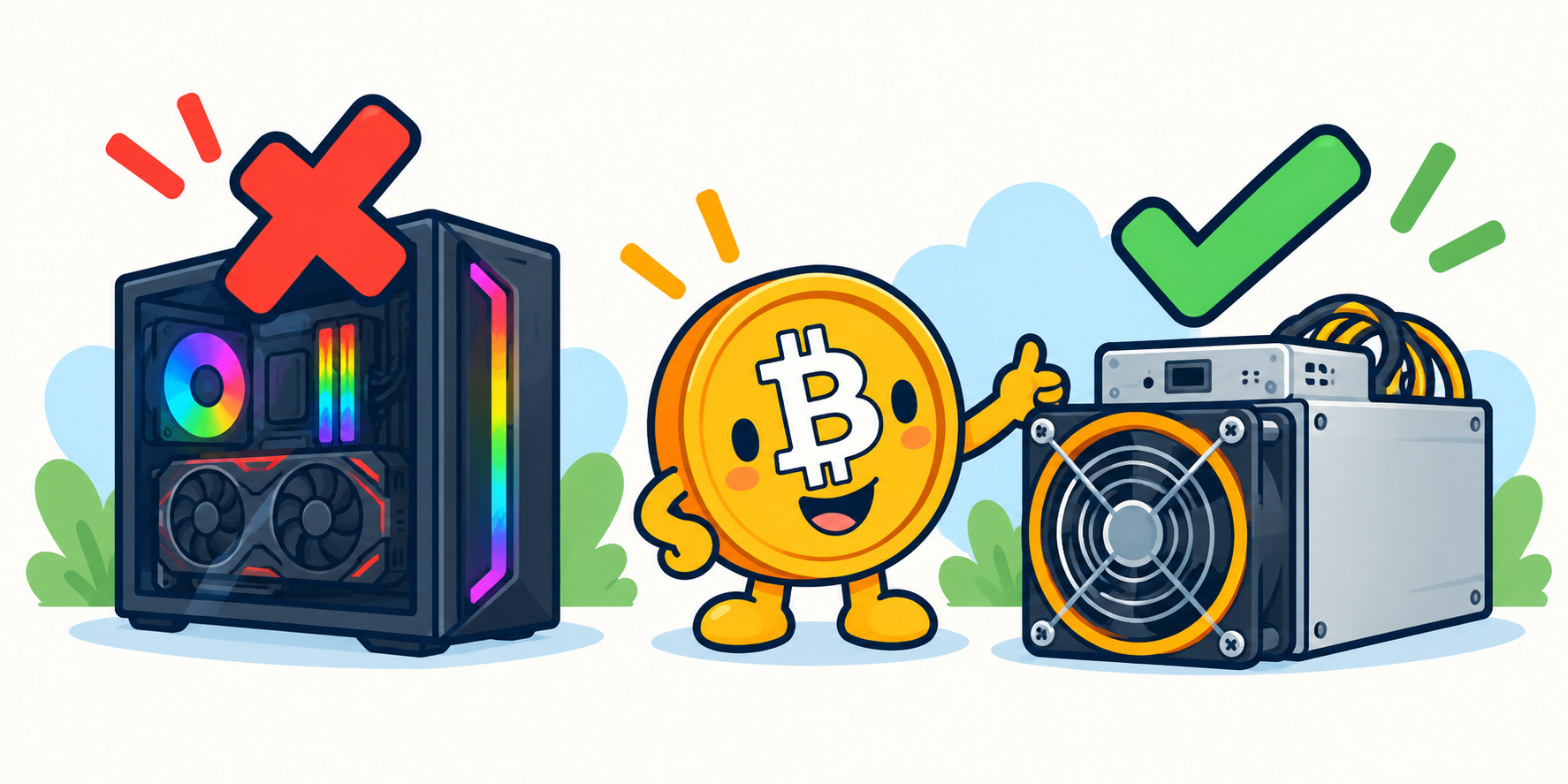
The right tool is an ASIC miner. A gaming PC cannot compete and will only waste power.
What to buy: an ASIC miner
The machine is called an ASIC (say "AY-sick"). It is a sealed box with loud fans, built only to mine Bitcoin. Popular makers are Bitmain (Antminer) and MicroBT (Whatsminer). A gaming PC or graphics card cannot mine Bitcoin for profit anymore. Do not let anyone sell you one for that.
The two numbers that matter
- Hashrate (TH/s). How many trillions of guesses per second. Bigger means more raffle tickets. A modern unit is roughly 100 to 300 TH/s.
- Efficiency (J/TH). How many watts it burns per unit of guessing. Lower is better. This single number decides your power bill, and the power bill decides your profit. A good modern unit is around 15 to 20 J/TH.
Between two miners, the one with better efficiency (lower J/TH) usually wins on profit, even if it guesses a little slower. Chase efficiency, not just raw hashrate.
What comes in the box
- The miner itself (control board, chips, big fans).
- A power supply (PSU), sometimes built in, sometimes sold separately.
- You provide: the right wall power (Step 3), an internet cable, and somewhere it can be loud and hot.
Watch out: brand-new top miners cost thousands and sell out. Used miners are cheaper but may be worn or near the end of their useful life. And beware "cloud mining" or "mining apps" that promise easy returns: most are scams or lose money. If it sounds effortless, it is bait.
Remember: buy an ASIC, not a PC. Judge it by efficiency (J/TH, lower is better) first and hashrate (TH/s) second.
Step 2 of 8